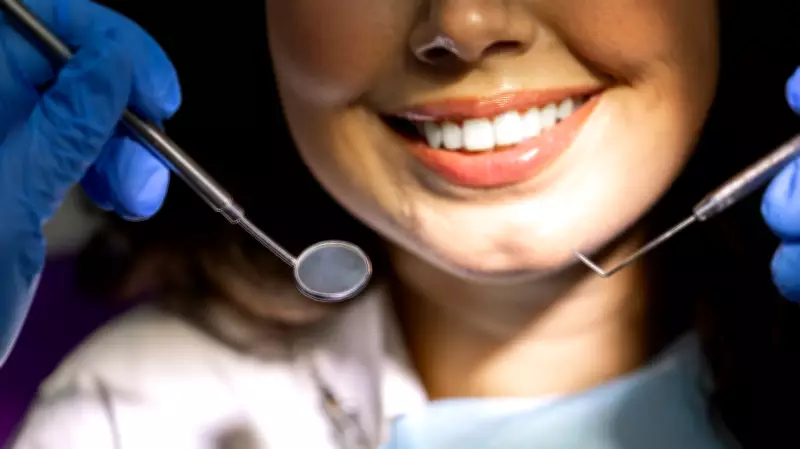
Posting every moment on social media brings both joy and consequences, with one significant outcome being the constant opportunity for self-criticism. Our smiles, surprisingly, often become the focus of this scrutiny. As we scroll through platforms like TikTok, many of us wonder if we should have worn retainers more diligently in our youth. However, a growing number of young women are not just pondering but actively pursuing veneer consultations, even when their teeth are healthy, straight, and fully functional.
The Normalization of Cosmetic Dentistry
Veneers, which are thin, custom-made porcelain shells for teeth once reserved for Hollywood elites or midlife transformations, have quietly entered the modern beauty conversation. They are now discussed alongside Botox, fillers, and laser treatments. What feels new is not the desire for attractive teeth but how commonplace the idea of altering them—often in costly and dramatic ways—has become. In many cases, there is nothing clinically wrong with the teeth at all; a smile might have a slightly warmer tone or a tooth that is a fraction shorter than its neighbor. Yet, details that once went unnoticed now seem glaringly obvious.
The Impact of Social Media on Perceptions
These small variations are part of what gives faces character and humanity, but because they do not resemble the uniform, hyper-polished smiles saturating social media, young women are increasingly growing up believing that cosmetic alteration is not an exception but an expectation. Spend time on TikTok or Instagram, and you will see it everywhere: "smile transformations," "seat day" reveals, and influencers documenting their temporary teeth and final results in real time. The language is casual, almost breezy, as if cosmetic dentistry is simply another stop on the self-care circuit, scheduled right after a facial or waxing appointment.

According to the American Society of Plastic Surgeons, more than 260,000 minimally invasive cosmetic procedures were performed on patients aged 19 and under in 2023. While veneers are not tracked in the same way as injectables, young adults without medical issues are increasingly seeking consultations with dentists for aesthetic upgrades. Young girls have always been pressured to obsess over their image—perfect body shape, silky hair, impossibly smooth skin—but today, this scrutiny is becoming even more granular.
Expert Insights on the Trend
"Now more than ever, we are staring at our own faces," says Andi-Jean Miro, a New York City-based cosmetic dentist with several celebrity patients. "Between Zoom, FaceTime, TikTok, and dating apps, it can feel like living with a camera on you all the time." In that setting, small details become magnified, and perfection begins to feel attainable and therefore expected.
Social media has also changed how cosmetic work is discussed. Procedures that were once private are now documented publicly, often framed as transparency. Veneer "journeys" unfold in real time, though some details are omitted in favor of pithy, watchable videos. Temporary teeth are shown, and final results are revealed. The repetition has a normalizing effect. "When you see it enough," Miro says, "veneers start to feel routine, even if your natural teeth are already beautiful."
Misleading Information and Clinical Risks
Celebrities and influencers have played a role in this shift, offering highly visible smile transformations that circulate widely online. However, the images themselves can be misleading. Many smiles labeled as "veneers" are actually crowns—a far more invasive procedure that requires significant removal of the natural tooth structure. Even moments that serve as cautionary tales do not depict the true story. Internet personality Tana Mongeau famously posted a TikTok showing her "veneers" falling out, a clip that quickly went viral. What many viewers did not realize—and what dentists are quick to point out—is that what fell out was likely a crown, not a veneer, a distinction that underscores how poorly understood these procedures have become online.

But that difference is critical in a clinical setting. "A veneer is an enhancement. A crown is reconstruction," Miro explains. Veneers cover only the front surface of a tooth and can often be done conservatively. Crowns encase the entire tooth, requiring aggressive drilling. "For younger patients with healthy enamel, crowns are usually unnecessary. And once that enamel is gone, you cannot get it back."
The Role of Technology and Filters
Pia Lieb, a dentist, founder of Cosmetic Dentistry Center NYC, and a former clinical assistant professor at New York University, sees the effects of this confusion regularly. She describes a generation that examines their smiles with an intensity that was previously impossible. "Patients come in with concerns about a single tooth being slightly longer or less symmetrical," she says. "They are zooming in on their own faces in ways that were not available even a decade ago."
Filters and editing tools further distort expectations. Teeth appear whiter, straighter, and more uniform than biology actually allows. "Young women are comparing themselves not just to influencers," Lieb says, "but to filtered images and AI-generated faces." The result is a narrowing definition of what a "good" smile looks like, one that often excludes natural variation. And that is dangerous.
Considerations and Consequences
While veneers can be appropriate in certain cases—such as physical trauma, intrinsic discoloration, or developmental issues—both Lieb and Miro caution against treating them as a cosmetic shortcut. Veneers require long-term maintenance and eventual replacement. Plus, they can take a significant chunk out of your wallet, running from $500 to $2,500 per tooth. Over-preparation can lead to sensitivity, nerve damage, and restorative work later in life. "This part is rarely shown online," Miro says. "Cosmetic dentistry is a commitment, not a trend."
Vulnerability and Societal Pressures
What stands out most about the surge in cosmetic consults is not vanity so much as vulnerability. It is the moment when a young woman pauses a video of herself and wonders why her smile does not look like the ones she sees everywhere else. It is the slow accumulation of images, comparisons, and "before-and-afters" that make perfectly healthy teeth start to feel insufficient.
Recent findings have shown that teen girls process social media content involving body image differently than their male counterparts. Research from 2022 suggests that teen girls reported using TikTok and Instagram—where there is an abundance of content with strong suggestions about body image and aesthetics—more often, while teenage boys use Twitch, YouTube, and Reddit. One problem with this, says Amanda Raffoul, a researcher at the Harvard T.H. Chan School of Public Health, is "a societal acceptance of body dissatisfaction in teen girls as normal." In a story by The 19th, she explained that this assumption "can create a dangerous environment for teens to engage in social media."
Moving Forward with Awareness
Since young women and girls are exposed to more body criticism online, it is worth having real conversations, offline, about what certain dental procedures entail and whether having one is truly necessary—rather than a byproduct of something seen on an AI-doctored image or in a post from an influencer. In a culture that rewards polish and uniformity, the pressure rarely announces itself outright; it builds gradually, until opting out feels harder than opting in.
A smile, after all, is not just another aesthetic choice. It is functional, biological, and deeply personal, shaped by genetics, age, and real-life experience. As cosmetic dentistry becomes increasingly normalized for younger patients, the question shifts from whether veneers are beautiful to whether young women are being given enough space—and enough honest information—to decide what they actually want. Sometimes, enhancement is the right choice. But sometimes, the best option is realizing that the smile you already have does not need fixing at all.