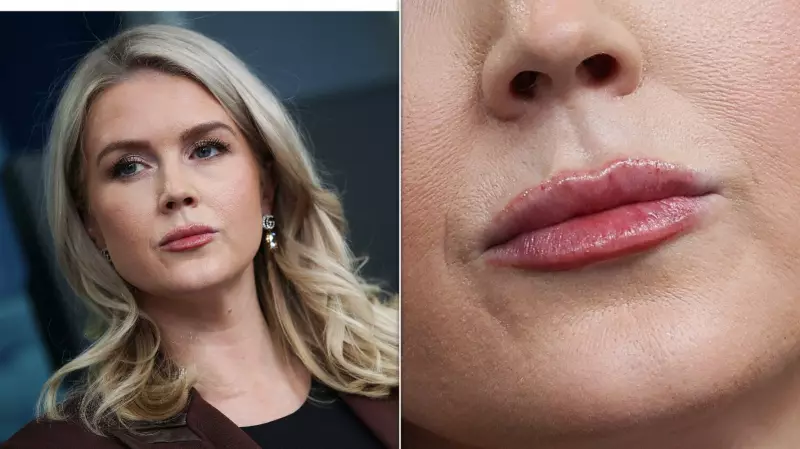
A strikingly close-up photograph of White House Press Secretary Karoline Leavitt in a recent Vanity Fair feature has ignited a fervent online discussion, not about policy, but about perceived cosmetic enhancements and politically coded beauty trends.
Decoding the Visible Marks
The intense focus on Leavitt's lips in the portrait, taken by photographer Christopher Anderson, led many social media users to point out what appeared to be small, distinct dots around the vermilion border. Comments on Vanity Fair's Instagram post ranged from sarcastic remarks about "injection marks" to ironic references to "gender-affirming care," a term that has become politically charged.
To understand the technical aspects, HuffPost consulted medical and beauty professionals. Dr. Corey L. Hartman, a board-certified dermatologist, suggested the red spots could be a vascular response to needle entry points from a soft tissue filler. "It looks like a serial puncture technique," Hartman noted, referring to a method of injecting along the lip line. He identified the marks as possible telangiectasias, tiny dilated blood vessels, which are not uncommon in the vascular lip area post-injection.

Plastic surgeon Dr. Anita Kulkarni concurred, speculating the marks were likely from very recent lip filler, perhaps administered the same day or day before the shoot. She pointed to the "picket fence" technique, where filler is injected vertically to add height. "The lips look swollen and lumpy, which would be consistent with fresh lip filler," Kulkarni said, advising a four-week buffer between such procedures and major events.
However, plastic surgeon Dr. Frederick Weniger offered alternative explanations. "More likely explanations include irritation from lip products or exfoliants, dehydration combined with gloss, cold weather, retinoid use or even recent dental work," he stated. He emphasized that harsh lighting and extreme close-ups can amplify normal texture, creating an illusion of an issue.
Makeup Choices Under the Microscope
Professional makeup artists who analyzed the photo argued that product selection and application significantly contributed to the visible texture. They noted that Leavitt, who had her own groomer present, opted for a sheer lip gloss, a choice that experts say highlights rather than conceals.
"The key is to use an opaque lipstick rather than a sheer gloss, which obviously highlighted the needle marks," said makeup artist Michelle Phillips. Artist Bryan Cantor agreed, recommending a lip pencil to correct shape followed by an opaque color for full camouflage. Kriss Blevens, who often conceals post-procedure marks, shared her professional secret: "I use a matte, long-lasting lip color that is pigmented but darker than the bruise... No one will know."
The critique extended beyond the lips. Artists pointed to a foundation that appeared "light and chalky," a lack of skin hydration making texture noticeable, and bronzer applied in a shade too orange and placed too high on the nose. The overall effect, they suggested, amplified dryness and harsh lines under the unforgiving close-up lens.
The Bigger Picture: Beauty as Political Signifier
This incident is not isolated. As noted in the original article and across social media platforms like TikTok, Leavitt's aesthetic has been highlighted as an example of "conservative girl makeup" and "Mar-a-Lago face." These terms describe a specific, politically associated look characterized by certain filler placements, tanning, and makeup techniques.
The experts universally emphasized that what is visible in the photos is likely temporary and not unusual in the realm of cosmetic procedures. However, the episode underscores a modern reality: in an age of ultra-high-resolution photography and relentless online scrutiny, every personal choice—especially for public figures—can be magnified and dissected.
"It is really challenging to be under incredible scrutiny and maintain your looks," summarized makeup artist Kriss Blevens. The conversation sparked by a single photograph ultimately reflects broader cultural intersections of politics, beauty standards, and the intense visibility of the digital era.