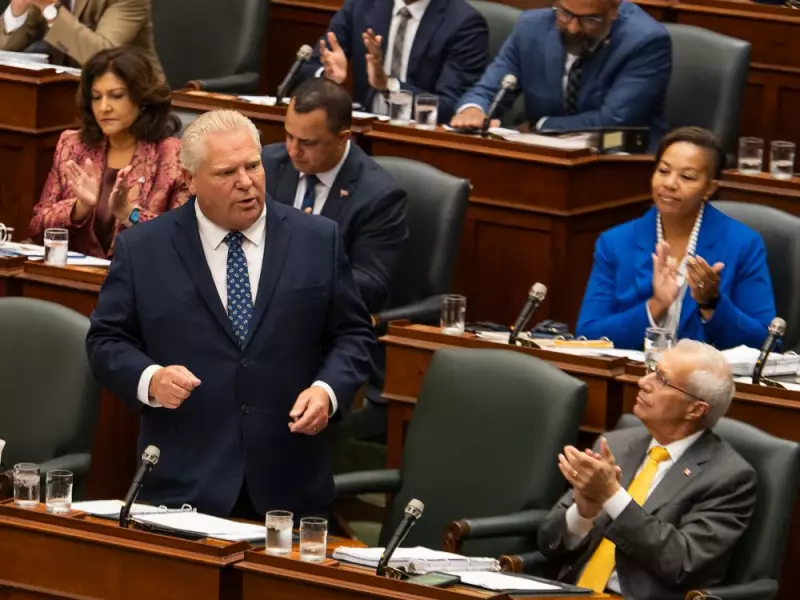
Ontario Premier Doug Ford has launched a sharp critique against a newly struck trade agreement between Canada and China, warning it poses a direct threat to the nation's automotive manufacturing sector and its workers.
The Core of the Controversial Deal
The agreement, aimed at thawing diplomatic and economic relations, involves a significant exchange of concessions. Prime Minister Mark Carney secured a major win for Canadian farmers, with China agreeing to slash its punishing tariffs on Canadian canola. The current rate, which sits at a prohibitive 85 percent, is expected to fall to approximately 15 percent by March 1, 2026.
In return, Canada has agreed to dramatically lower its barrier to Chinese electric vehicles. The federal government will permit 49,000 Chinese-made EVs to enter the Canadian market, subject to a tariff of only about 6 percent. This marks a stark reduction from the 100 percent levy that was previously in place, a policy originally implemented to align with U.S. trade actions under the Biden administration.

Ford's Fierce Opposition and Economic Warnings
For Doug Ford, premier of Canada's industrial heartland, the deal represents a dangerous gamble. "China now has a foothold in the Canadian market and will use it to their full advantage at the expense of Canadian workers," Ford stated unequivocally on Friday, January 16, 2026.
He argued that the federal government is "inviting a flood of cheap made-in-China electric vehicles" without securing guaranteed, immediate reciprocal investments in Canada's economy or auto supply chain. His gravest concern, however, extends beyond domestic competition.
"Worse, by lowering tariffs on Chinese electric vehicles, this lopsided deal risks closing the door on Canadian automakers to the American market, our largest export destination," Ford cautioned, predicting the move would hurt the economy and lead to job losses. Ontario's auto factories have already endured strain from recent U.S. trade tensions.
Diverging Provincial Views and the U.S. Wildcard
The deal highlights a clear divide between provincial interests. While Ford defends manufacturing, leaders from agriculture-focused Western provinces like Saskatchewan's Premier Scott Moe—who joined Carney on the landmark trip to Beijing—have been pushing for this exact kind of agreement to rescue canola exports.
Prime Minister Carney has defended the pact, anticipating it will drive considerable new Chinese joint-venture investment in Canada within three years. He believes partnerships with trusted firms can protect and create auto manufacturing jobs while building out Canada's EV supply chain.
A major unresolved question is the reaction from the United States. U.S. President Donald Trump has pressured Canada and Mexico to erect tariff walls against China, and a review of the North American trade deal is scheduled for later in 2026. Some analysts, like Bank of Nova Scotia economist Derek Holt, see Carney's shift as a pragmatic response to U.S. policies, stating, "Economic necessity is the main driver as the U.S. mistreats and abuses its Canadian relationship."
As the debate intensifies, the deal sets the stage for a pivotal conflict between Canada's industrial and agricultural sectors, with the stability of the North American auto industry and the future of U.S.-Canada relations hanging in the balance.