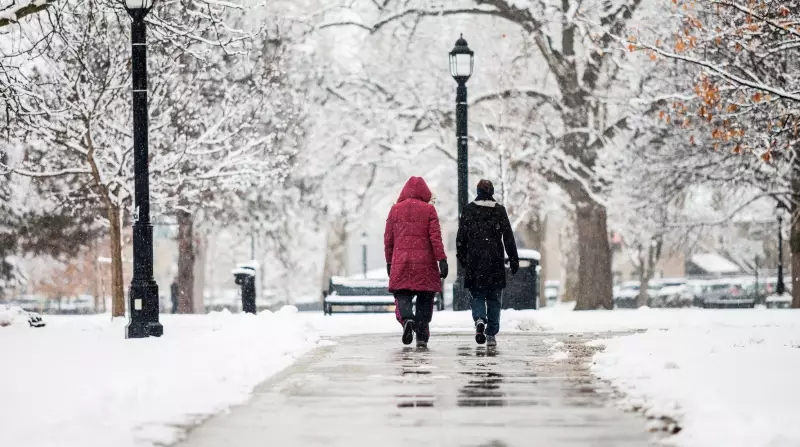
The Hidden Danger of Icy Walkways: A Major Public Health Concern
Each winter, icy sidewalks, driveways, and walking trails transform into hazardous zones, posing a significant threat to public safety. According to data from the prestigious Mayo Clinic, approximately 800,000 individuals suffer slip-and-fall incidents annually that necessitate professional medical attention. Even when a hospital visit is avoided, these accidents often result in painful consequences like scraped knees, bruised elbows, and various other physical ailments.
"These falls are quite frequent... 1 in 5 of them actually end up in an injury that requires care," emphasized Dr. Kariline Bringe, an orthopedic surgeon at the Mayo Clinic Health System in La Crosse, Wisconsin. "So, if we eliminate the fall, we'll eliminate those injuries." This stark statistic underscores the critical importance of proactive prevention during the colder months.
Master the 'Penguin Walk': A Simple, Life-Saving Technique
When it comes to eliminating dangerous falls on ice, experts unanimously highlight one particularly effective and memorable strategy: walking like a penguin. While it may sound humorous, this method is grounded in biomechanical principles designed to maximize stability.

"It's called penguin walking because you do kind of look like a penguin while you're doing this type of walk," explained Monica Leach, a physical therapist and board-certified clinical specialist in geriatric physical therapy at the Cleveland Clinic. The technique involves a deliberate modification of your natural gait to adapt to slippery surfaces.
Here is a step-by-step guide to performing the penguin walk correctly, as detailed by Leach:
- Bend Your Knees Slightly: Maintain a slight bend in your knees to assume an active, ready position. This posture enhances your ability to react swiftly if you begin to lose balance.
- Point Feet Outward and Extend Arms: Angle your feet slightly outward to create a broader base of support. Simultaneously, keep your arms out at your sides to act as natural counterbalances, improving overall stability.
- Adopt a Slow, Shuffling Step: Walk slowly using a flat-footed or shuffling step. Avoid lifting your feet high; instead, slide them gently along the surface to maintain constant contact with the ground.
- Center Your Gravity: Keep your center of gravity directly over your feet. You may need to lean forward just a little to achieve this optimal alignment, which prevents your weight from shifting dangerously.
The Science Behind the Shuffle: Friction, Gravity, and Momentum
The effectiveness of the penguin walk is deeply rooted in physics. "I think the big key here is slowing down, taking these small shuffling steps," Dr. Bringe noted. She elaborated on the underlying principles: "As it gets icy out there and things get slippery, the larger our steps, the more force you're coming across. It's going to increase the likelihood that you slip."
Conversely, adopting small, slow, shuffled steps significantly decreases slip risk. "If you do slip, you don't have so much momentum behind it. So you're less likely to slide a long way," Bringe added. With your center of gravity properly positioned above your feet, a minor slip is less likely to escalate into a catastrophic fall.
Keep Hands Free and Phones Away: Essential Auxiliary Advice
An often-overlooked aspect of safe winter walking is keeping your hands available. "Your arms are free and able to come out from your body — that will also help improve your balance and decrease those risks of falls," Bringe explained. "And, if you do fall, [it] gives you an opportunity to hopefully catch yourself before you bang your head."

Leach strongly advises against walking with hands in pockets, as it compromises balance and reaction time. Similarly, smartphone use presents a modern hazard. "I think the phone is an... extra piece to falls now, because all of us have our phone in our hand," Bringe observed. "We are checking our email, we're texting people, we're not looking at where we're walking, we're not examining that surface to make sure that there isn't ice there... and so putting that phone away when it's a little more hazardous is probably a good tip as well for avoiding those falls."
Comprehensive Winter Safety: Beyond the Penguin Walk
While the penguin walk is a cornerstone of icy terrain navigation, experts recommend a holistic approach to winter safety. Proactive preparation is paramount. "We are so fortunate to have great predictions from our weather teams. We know that these things are coming," Bringe stated. "So, being prepared — you know it's going to be snowing in two days, get that car filled up, make those trips to the grocery stores so you're not out unnecessarily... That makes it safer for you and safer for everybody who needs to be out there."
Additional critical tips include:
- Use Assistive Devices: If you rely on a walker or cane, ensure you have it with you. Do not leave these crucial aids at home.
- Wear Proper Footwear: The Mayo Clinic stresses the importance of shoes or boots with "deep-grooved, nonskid, rubber treads" to provide essential traction.
- Stay Cognizant of Your Surroundings: Leach advises maintaining vigilant awareness. Look ahead to avoid obstacles and glance down periodically to identify potential icy patches. "I'd say all dark, wet areas [are] probably slippery or icy," she noted. "Even if you're not sure, you might want to avoid those types of areas where you're walking."
- Stick to Cleared Paths: Avoid taking shortcuts through untrodden snow. Follow established, clear paths where the footing is more predictable.
Ultimately, the core philosophy of winter walking safety is patience. "It's better to be safe than sorry, so take your time," Leach concluded. By integrating the penguin walk technique with thoughtful preparation and situational awareness, individuals can dramatically reduce their risk of joining the hundreds of thousands who suffer needless injuries each year.