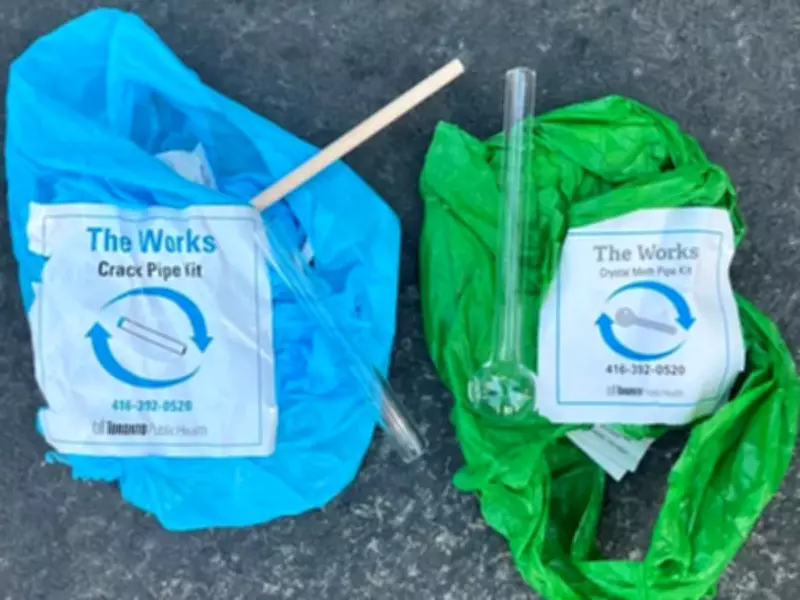
Toronto's Controversial Harm Reduction Program Under Scrutiny
Newly released data has revealed that the City of Toronto has distributed millions of crack and meth pipes through its harm reduction program over the past five years, raising serious questions about the program's effectiveness and accountability. The disclosure comes from a freedom of information request filed by advocacy group IntegrityTO, which obtained detailed procurement figures from Toronto Public Health.
Staggering Quantities of Drug Paraphernalia Distributed
Between 2021 and 2025, Toronto Public Health procured 2.34 million meth pipes and 3.45 million crack pipes through the Ontario Harm Reduction Distribution Program. Additionally, the program distributed 14.92 million syringes during the same period. These figures represent a massive investment in harm reduction equipment, all funded by provincial taxpayers.
When contextualized against estimated drug user populations, the numbers become even more striking. Based on national survey data suggesting approximately 15,000 meth users in Toronto, the city has been distributing an average of 31 meth pipes per user annually. For injection drug users, estimated at around 7,000 individuals, the program provided 419 syringes per user each year.

Lack of Evidence and Performance Tracking
Perhaps most concerning is the apparent absence of evidence supporting the program's effectiveness. When questioned about performance indicators and measurement tools used to evaluate the impact of distributing these drug paraphernalia, Toronto Public Health failed to identify any specific metrics. This suggests that outcomes are not being systematically tracked, despite the program's significant scale and cost.
Daniel Tate, executive director of IntegrityTO, expressed deep concern about the findings. "This truly astonishing disclosure left me feeling very disturbed," said Tate, who regularly receives photos of discarded drug paraphernalia in public spaces including libraries and areas where children congregate.
Questionable Policy Foundations
Toronto Public Health claims that distributing "safer inhalation equipment" is mandated by the Ontario Public Health Standards. However, a closer examination reveals that while the standards support "harm reduction services" broadly, they make no specific mention of crack or meth pipes. The associated 2018 Substance Use Prevention and Harm Reduction Guideline similarly fails to mention these specific items, instead supporting the distribution of needles "and other drug use supplies" which could include various harm reduction materials.
The agency cited a 2023 evidence review claiming that distributing clean crack and meth pipes has been "widely researched and proven effective at reducing and preventing the spread of infectious diseases." Yet critics argue that the supporting documentation doesn't substantiate these claims as strongly as presented.
Growing Concerns About Public Safety
The program's scale has raised questions about unintended consequences, particularly regarding public safety and environmental impact. The distribution of millions of drug pipes without clear evidence of benefits has sparked debate about whether resources might be better allocated to treatment and recovery programs rather than harm reduction alone.
As Toronto continues to grapple with substance use challenges, the lack of transparent data and measurable outcomes from this multi-million dollar program represents a significant gap in public health accountability. The disclosure highlights the need for more rigorous evaluation of harm reduction strategies to ensure they effectively serve both individuals struggling with addiction and the broader community.