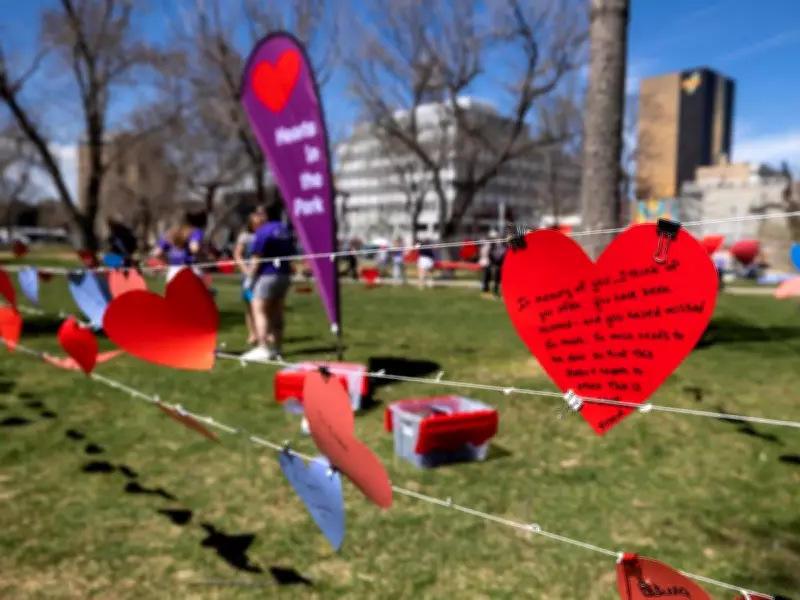
Paper hearts flutter on strings tied between trees as a warm breeze blows through Regina's Victoria Park. With names penned on them, they could be mistaken for Valentine's Day cards, but that occasion happened months ago.
"Mom." "Dad." "Aunt." "Sister." "Grandma." "Teacher." "My inner child." "Me." Bathed in sunlight, a passerby wouldn't suspect the darkness represented by each cutout. But then, such things often stay hidden.
Each heart-shaped paper cutout hung at the eighth annual Hearts in the Park event represented the life of someone impacted by interpersonal violence — a visual manifestation of the issue for which Wednesday's affair sought to raise awareness. Some survive, others don't.

Clare Wood didn't. A crowd that gathered in the park heard her story from Crystal Giesbrecht, director of research for the Provincial Association of Transition Houses and Services of Saskatchewan (PATHS).
Giesbrecht educated the crowd about Wood, who became a victim of domestic homicide in the United Kingdom and whose name was lent to laws now on the books in places like Saskatchewan. Clare's Law, she said, offers police the ability to disclose information about a person's potentially violent history with a present or past partner.
Speaking amid Victims and Survivors of Crime Week in Saskatchewan, Giesbrecht talked about the law's benefits and different ways it allows for information to be released. "For Clare's Law to be effective, people need to know that this is available," said Giesbrecht, who urged attendees to spread the word — noting that information is available on the PATHS website.
She then launched into an explanation of what's known as "coercive control," describing it as a pattern of behaviour that's separate from — but may or may not happen in conjunction with — sexual or physical violence. Saskatchewan recently amended its laws to add coercive control under the definition of interpersonal violence, which allows more people to access provincial supports, Giesbrecht said.
"This affects everyone," said Ann Perry, executive director of non-profit Circle Project, one of the event's participating organizations. The hearts on the string represent only a small sampling of the hurt that has and does happen in the community. But the details shared by those who participate is something the Circle Project collects so it can develop statistics and information for the public, Perry said.