New User-Friendly Lung Cancer Risk Calculator Launched in Canada on World Cancer Day
A groundbreaking online tool that simplifies lung cancer risk assessment for Canadians has been unveiled by the Lung Health Foundation. Launched strategically on World Cancer Day, this innovative calculator operates on a familiar principle: think mortgage calculator, but for lung cancer risk.
Democratizing Access to Health Information
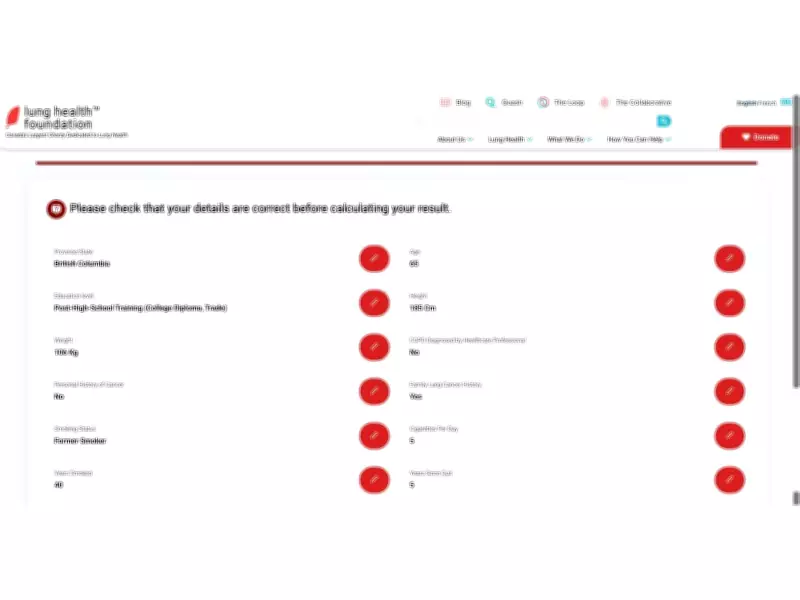
The calculator represents a significant advancement in making complex medical information accessible to the general public. Unlike traditional medical tools that require specialized knowledge or professional interpretation, this platform requires no medical background, paperwork, or special access. Canadians can complete the assessment in just two to three minutes by answering ten straightforward questions.
The tool provides a clear estimate of lung cancer risk without diagnosing cancer, determining screening eligibility, or providing automatic access to screening programs. Instead, it serves as an educational starting point that helps individuals understand whether booking a conversation with a healthcare professional represents a reasonable next step.

Built on Trusted Scientific Foundation
Behind the simple interface lies sophisticated scientific methodology. The calculator utilizes the PLCOm2012 lung cancer risk prediction model, a publicly available and widely validated model developed by researchers at Ontario's Brock University. This model has gained international recognition as the preferred method for calculating lung cancer risk.
The PLCOm2012 model estimates an individual's risk of developing lung cancer over the next six years based on multiple factors including age, smoking history, medical history (such as COPD or prior cancer), and body size. Until recently, this model was primarily accessible through a detailed spreadsheet-based calculator hosted by the university, limiting its practical use for both patients and healthcare providers.
Transforming Complex Data into Actionable Information
The Lung Health Foundation's innovation lies in packaging this complex data into an intuitive, user-friendly format for the first time. The tool is designed to support clinical judgment rather than replace it, providing clear, evidence-based information that can be incorporated into time-limited medical appointments.
"This calculator is about clarity, efficiency, user-friendliness, and access to everyone," explains Dr. Jessica Moffatt, Vice-President of Programs, Public Affairs and Research at the Lung Health Foundation. "It helps both Canadians and clinicians spend less time deciphering risk models and more time having meaningful communication about next steps."
Practical Features for Patients and Providers
The calculator includes several practical features designed to facilitate the healthcare journey:
- Complete confidentiality and nationwide accessibility
- A downloadable report that Canadians can bring to healthcare appointments
- Support for both individual users and healthcare professionals
- Free access without registration requirements
This approach helps individuals arrive at medical consultations briefed and prepared, though screening decisions always occur in consultation with healthcare professionals. From that initial conversation, screening follows a clear, guided process designed to ensure scans are offered thoughtfully and safely.
A Simple Tool with Significant Public Health Implications
The launch of this calculator represents more than just technological innovation—it signifies a shift toward patient empowerment in healthcare decision-making. By providing Canadians with accessible tools to understand their health risks, the Lung Health Foundation aims to facilitate earlier conversations about lung cancer screening, potentially leading to earlier detection and improved outcomes.
The tool's simplicity belies its potential impact on public health. As lung cancer remains one of the most common and deadly cancers in Canada, tools that bridge the gap between complex medical data and public understanding could play a crucial role in improving screening rates and ultimately saving lives.