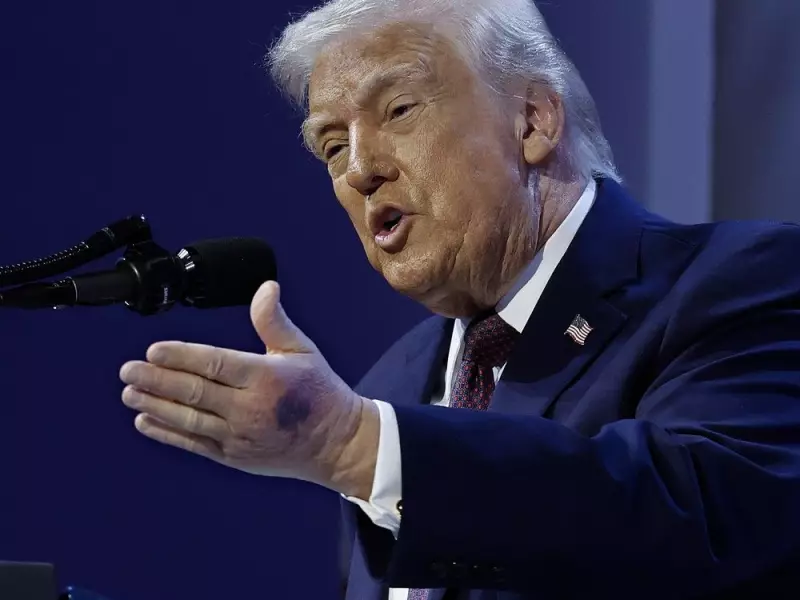
Trump Attributes Hand Bruise to Aspirin Use and Minor Injury
Former U.S. President Donald Trump has publicly addressed a noticeable bruise on his left hand, attributing it to a combination of minor physical contact and his daily aspirin regimen. The bruise was observed during his appearance at the World Economic Forum in Davos, Switzerland, sparking questions about his health and medication practices.
The Explanation Behind the Bruise
Trump explained to CNN reporters aboard Air Force One that he "clipped it on the table" while in Davos, causing the bruise to appear. He directly connected this visible injury to his daily consumption of aspirin, which he takes for heart health purposes. "I would say, take aspirin if you like your heart, but don't take aspirin if you don't want to have a little bruising," Trump stated during the interview.
The former president revealed he takes 325 milligrams of aspirin daily, a dosage he acknowledges exceeds what his physicians typically recommend. His personal physician, Navy Capt. Sean Barbabella, confirmed Trump takes aspirin to manage chronic venous insufficiency, a condition diagnosed in July 2025.

Medical Context of Aspirin and Bruising
Medical experts confirm that aspirin's blood-thinning properties can indeed increase susceptibility to bruising. According to the Mayo Clinic, aspirin works by preventing blood clots that could lead to heart attacks by slowing or stopping blood flow to the heart. This anticoagulant effect means that even minor bumps or injuries that might otherwise go unnoticed can result in visible bruising.
Harvard Health publications support this understanding, noting that "even slight bumps that you don't even notice can cause bruises" when taking aspirin. The medication can make individuals "bleed a little more easily," including the subcutaneous bleeding that manifests as bruises. Additional side effects may include prolonged bleeding from small cuts and increased gum bleeding during dental hygiene routines.
Trump's Medical History and Bruising Patterns
This is not the first instance of visible bruising for the former president. CNN reports that Trump has experienced bruising on his right hand for some time, predating his return to the White House. These previous bruises drew attention as Trump began using heavy makeup, bandages, and strategic hand positioning to conceal them from cameras.
The more recent left-hand bruise, spotted late last year, renewed questions about his health status. White House press secretary Karoline Leavitt supported Trump's explanation, connecting the bruising to his frequent hand-shaking activities combined with daily aspirin use that makes him more prone to bruising.
The Broader Medical Perspective
Daily aspirin therapy is commonly prescribed for cardiovascular protection, serving both primary prevention for those at risk of heart attack or stroke and secondary prevention for individuals with existing heart conditions. While effective for these purposes, the increased bruising tendency represents a well-documented side effect that patients and physicians must balance against cardiovascular benefits.
Trump's comments highlight this medical trade-off, with the former president emphasizing his preference for cardiovascular protection despite the cosmetic consequence of increased bruising. "I take the big aspirin, and when you take the big aspirin, they tell you, you bruise," Trump explained. "The doctor said, 'You don't have to take that, sir, you're very healthy.' I said, 'I'm not taking any chances.'"
This incident has brought renewed attention to the common side effects of aspirin therapy and the personal health management decisions of public figures, while also providing an opportunity for public education about medication effects and cardiovascular prevention strategies.