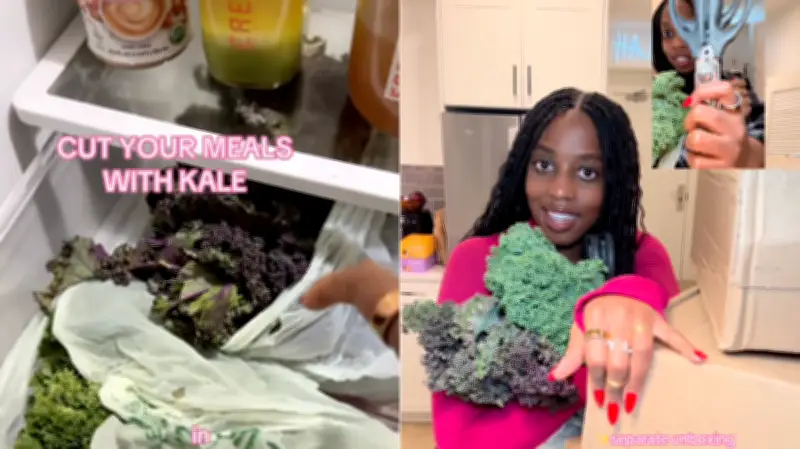
For singer/songwriter Aïchan Fall, including a little bit of kale into every meal is a non-negotiable. Kale, a hearty leafy green rich in fiber, potassium, and vitamins, became a staple of Fall's diet in 2022 after she was diagnosed with an autoimmune condition.
"I was making a breakfast burrito one day and decided to put kale in it and realized I could barely taste the kale," Fall told HuffPost. "After that, I tried mixing it with rice for my chicken tikka masala and the rest is history. Every single meal I'd eat at home I would warm up some kale, cut it up, and throw it in there."
Now, that little trick of cutting meals with kale has gone viral. A video Fall posted on Instagram and TikTok last month explaining how to "cut it with kale" has racked up more than 14 million combined views, she said.

"You don't need to change your entire diet. What you need to do is start cutting your meals with kale," Fall says in the clip before she gives her leftovers from Mr. Chow a makeover: She microwaves a handful of kale for 10 seconds, chops it into small, rice-sized bites with kitchen scissors, and mixes it into her glazed prawns and rice.
Why the Hack Works
It's a neat trick if you don't eat a lot of salad or find large servings of kale hard to stomach. Fall does the same kale "surgeries" on everything from leftover fettuccine bolognese to a Chipotle burrito. She says keeping her fridge stocked with kale has helped her better manage her autoimmune disease and provided other benefits.
This isn't the first leafy-green hack to take off online. Last year, TikTok users embraced "dinosaur time," a trend that involved stuffing fistfuls of spinach or romaine into your mouth before enjoying the rest of your meal. But munching on raw kale might be a tall order for some. Fall's food hack is sneakier; she swears you can hardly taste the kale when it's cut into tiny pieces.
Expert Insights on Health Benefits
Only 1 in 10 adults meets the daily recommendation for veggies: 2-4 cups a day. Mixing in superfoods with regular meals, like Fall does, is more sustainable, said Dr. Wendi LeBrett, a gastroenterologist and founder of ModernGut.
"People who don't regularly consume vegetables or don't enjoy eating vegetables may find this an easy way to incorporate more fiber in their diet," LeBrett said. Kale offers fiber, antioxidants, and compounds like sulforaphane and anthocyanins, which have cardioprotective benefits.
Fall has said the habit helped lower her hemoglobin A1C and cholesterol levels. According to Shannon O'Meara, a registered dietitian with Orlando Health, eating more fiber can slow digestion and help prevent sharp blood sugar spikes, leading to lower A1C. "The fiber is beneficial for cholesterol because it can absorb LDL cholesterol and excrete it from the body," O'Meara said.
Cutting it with kale could be especially beneficial for those struggling to meet daily fiber needs, prediabetic or diabetic individuals, those with elevated blood pressure or cholesterol, or anyone wanting to improve gut health.
How to Store and Prepare Kale
The best way to keep kale fresh is to store leaves in sealed gallon bags with a moist paper towel. O'Meara recommends buying a whole head, removing leaves from the stem, washing and drying them, then chopping to desired size. Pre-cut kale is convenient but may contain larger stem pieces and spoil faster.
The same strategy works with spinach, Swiss chard, and collard greens, said Lily Lichtenstein-Swain, an outpatient clinical dietitian at Tufts Medical Center.
Other Superfoods to Try
Why stop with kale? Mixing in a variety of superfoods can increase fiber diversity. LeBrett suggested beans, edamame, chia seeds, ground flax meal, and avocado. Fresh herbs like parsley, cilantro, basil, or mint also work, as do riced broccoli or cauliflower for smoothies, soups, and stir-fries.
"More broadly, I encourage people to focus less on 'superfoods' and more on consistently incorporating a variety of plant foods," Lichtenstein-Swain said. "Research suggests that dietary diversity may be one of the most important factors for supporting a healthy gut microbiome."