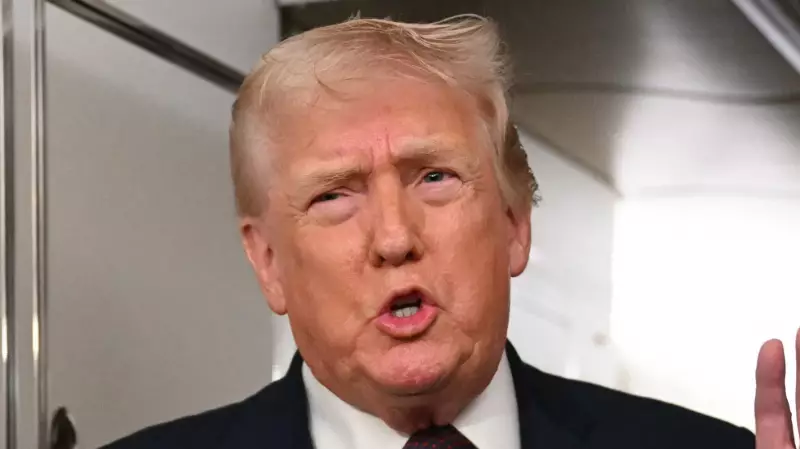
Former U.S. President Donald Trump launched a fresh verbal assault against a female journalist during an in-flight press briefing, dismissing her query as "stupid" and mocking her tone. The incident, which occurred aboard Air Force One on Sunday, January 11, 2026, is the latest in a documented pattern of aggressive behavior toward women in the media, prompting warnings from American studies and mental health professionals.
A Pattern of Personal Attacks on Women
The exchange began when a journalist, part of the network pool representing all major TV outlets, asked Trump about Iran's warning to consider U.S. military bases as "legitimate targets" should he intervene in the country's internal unrest. Trump responded with a characteristically stark threat, stating, "If they do that, we will hit them at levels that they’ve never been hit before."
When the journalist followed up by asking if he believed Iran took his threats seriously, Trump turned his ire directly on her. "I think so. Don’t you think so, CNN?" he retorted. He later added in a mocking tone, "She says — CNN — 'Do you think they take your threats seriously?'... What a stupid question."

This episode is not isolated. In recent months, Trump has called New York Times reporter Katie Rogers "ugly," referred to Bloomberg's Catherine Lucey as "piggy," labeled CNN's Kaitlan Collins "stupid and nasty" on Truth Social, and dismissed ABC's Rachel Scott as "the most obnoxious reporter."
Experts Analyze the Roots and Risks of the Behavior
Kari J. Winter, a professor of American studies at the University at Buffalo, argues that Trump's conduct reveals deep-seated prejudices. "He is bursting with contempt for women in the same way that he is red-in-the-face with hatred for Black and brown people," she told HuffPost. Winter suggests his explosive reactions indicate an inability to formulate reasoned responses, stating, "His violent flashes of anger suggest an unhinged mind... It’s especially alarming from someone who has a nuclear arsenal under his command."
Alexandra Cromer, a licensed professional counselor, links Trump's frustration to a foundational misogyny. "This is rooted in misogynistic thinking and posits that women are 'less than' not just him, but men in general," she explained. Cromer believes Trump "views women as having less self-worth and less capacity than men." She further analyzes his focus on appearance as an attempt to enforce a power dynamic, noting it stems from a "compulsively heteronormative and Caucasian viewpoint of attractiveness."
Professor Winter adds that the insults rely on classic misogynistic tropes: "Men who hate women constantly push the idea that the most important thing about a woman is her appearance. Attacking women’s intelligence is the second-most common move."
A Call to Action: Why Normalizing This Behavior is Dangerous
Both experts stress that public complacency is not an option. While numerous domestic and international crises demand attention, they insist Trump's treatment of female journalists is a critical front in the defense of civil society. "If the president’s behavior is not challenged and continues to be normalized, we could see women lose rights, respect, and we can even predict a potential increase in violence toward women as a whole," Cromer warned.
Winter drew a stark historical parallel, referencing the killing of 37-year-old Renee Nicole Good by a U.S. Immigration and Customs Enforcement officer on January 7. "If we want to live as moral, self-respecting people, we cannot allow his treatment of female reporters to go unchallenged any more than we can remain silent in the face of ICE’s murder of Renee Good," she said. She posed a provocative question: "Can you hope to live with a shred of dignity if you remain as silent as the Germans who were afraid to challenge Hitler? For the sake of our very souls, we have to draw the line and refuse to condone or collude."
The consensus from observers is clear: Trump's repeated, gendered attacks on journalists are more than mere insults; they are symptomatic of a deeper disdain that has tangible, dangerous consequences for public discourse and social norms.