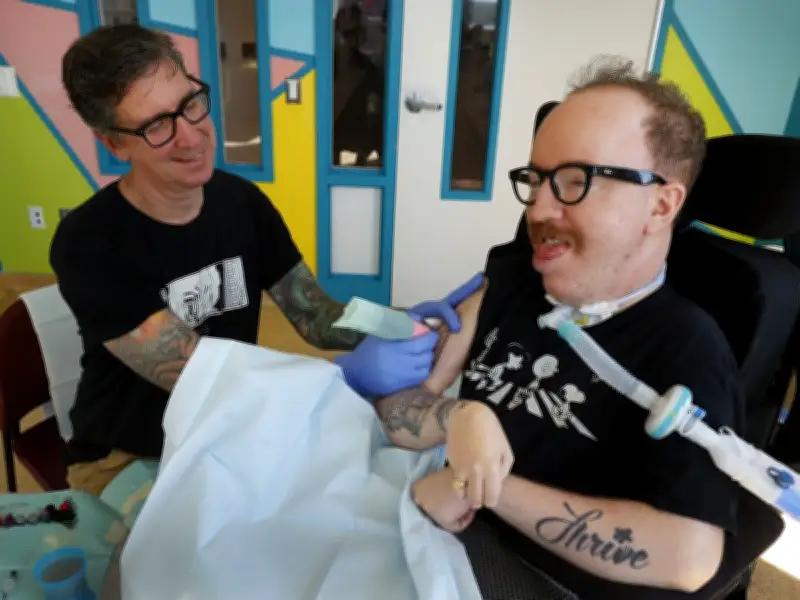
For three years, tattoo artist Glen Paradis has been making house calls to Bruyère Health's Centretown campus, offering long-term and palliative patients the chance to get inked. What started as a single request has become a meaningful tradition that brings a sense of normalcy to those living with complex medical conditions.
A Unique Service at Bruyère Health
On a recent afternoon in a family room on the fifth floor of the Bruyère Health Centretown campus in Chinatown, formerly St. Vincent Hospital, Hollis Peirce received his fifth tattoo. The new ink, on his right bicep, depicts an opened zipper revealing muscle tissue underneath. Paradis drew the design over a scar nearly four decades old, a remnant from when Peirce was six months old and diagnosed with congenital muscular dystrophy after a muscle biopsy.
When asked if the tattoo was meant to cover the scar, Peirce explained it was not. “I just want to unzip my history,” he said, embracing the scar as part of the design rather than hiding it.

The Beginning of a Tradition
Paradis has been visiting the fifth floor, specifically 5North where some of Bruyère’s most medically complex continuing-care patients live, for three years. He estimates he has done about a dozen tattoos on a handful of patients. Peirce was not only Paradis’ most recent client but also his first.
There is no official tattoo program at Bruyère—no funding, policy, or formal sanction. The tattoos exist because one patient wanted one, a chaplain decided to help, and a tattoo artist agreed to come. It began in 2023 when Peirce told Roshene Lawson, a clinical chaplain at Bruyère with tattoos of her own, that he wanted to get inked. Peirce had moved into the hospital a year earlier after his health needs increased, and he was still adjusting to life there.
Finding a Willing Artist
Lawson began calling and visiting tattoo shops to make it happen. About a dozen declined before she walked into Paradis’ Barnstormer Studio in the Glebe. She wasn’t asking for charity—Peirce would pay for the tattoo. She just needed an artist willing to make a house call. “He just wants to get a tattoo and feel normal for a day,” she recalls telling Paradis.
Paradis couldn’t think of a reason to say no. “Someone wants a tattoo? Cool. That makes them happy,” he said. “At the end of the day, it’s a small thing to do, right?”
Meaning Behind the Ink
The first tattoo Paradis inked on Peirce was the single word “Thrive” on his left forearm. For Peirce, it was both a rebellion and an inspiration. “The reason ‘Thrive’ is so meaningful to me is when my doctors diagnosed me, they told my parents that I would have an inability to thrive,” he explained.
Peirce’s tattoos are a way to reclaim his narrative and celebrate his resilience. Each design incorporates elements of his personal history, turning scars into art and challenges into symbols of strength.
A Growing Impact
While the number of tattoos done at Bruyère remains small, the impact is profound. For patients like Peirce, the experience offers a sense of autonomy and normalcy in a setting where medical routines often dominate. Paradis’ willingness to bring his skills to the hospital has opened doors for others to express themselves through body art, regardless of their health circumstances.
Lawson, who continues to support these efforts, sees the tattoos as more than just ink. “It’s about honoring who they are and what they’ve been through,” she said. “It’s a small act that makes a huge difference.”