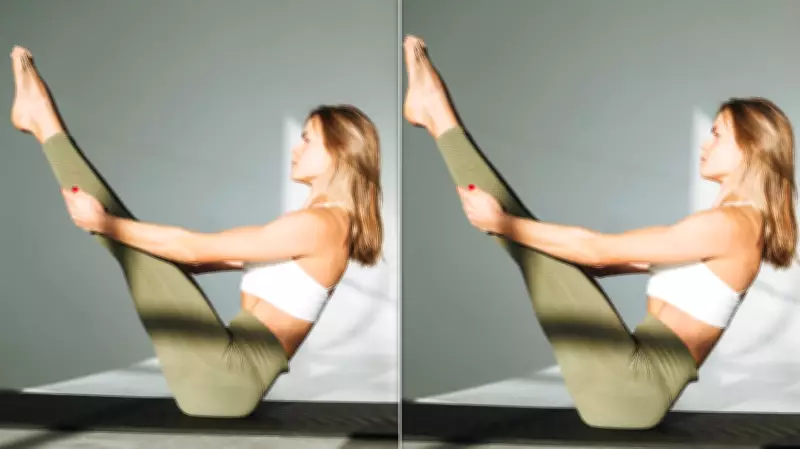
Bad news for anyone who loves Pilates: traditional men have discovered the exercise and taken a liking to the “Pilates girl.” Pilates – a low-impact, full-body movement method focused on core strength, control, alignment and breath – has surged in popularity in the past few years, especially among women. The celebrity-favorite workout can be done on a mat at home or with a specialized machine that uses springs and pulleys for resistance. Those who practice it swear by its ability to tone the body and reduce stress.
But Pilates also has a certain reputation it cannot seem to shake: people think it is for rich white women. Like yoga before it – the last “It” girl exercise of this scale – the practice is not inherently exclusionary, but the way it is marketed tends to center a narrow body ideal and women of a certain tax bracket. An average 60-minute group class typically costs $30 to $65.
Then there is the “look” it gives you. Instead of focusing on bulk, regularly practicing Pilates achieves a toned, lean and elongated body. You build strength, not muscle mass. All of this has made it appealing to a certain type of man, who, as The 19th recently reported, expects their partners to devote hours to the workout.

“If your girl goes to Pilates, wife her up immediately,” online business entrepreneur Christian Bonnier said in a recent viral Instagram Reel, deeming the exercise “wholesome” and “the biggest green flag ever for a girl.” In one video, Bonnier declares, “Bring back stay-at-home Pilates wives.”
“If your girl goes to Pilates, she’s probably staying in on the weekends so she can get up early and go to a Solidcore or BodyRok class,” he says in the clip. “And she’s going to come back from the Pilates class in a great mood because she went with her friends and didn’t get hit on by any creepy guys and got a great workout in.” In another video, which racked up 564,000 views, Bonnier declares, “Bring back stay-at-home Pilates wives.” He is not buying that women find greater fulfillment in a 9-to-5 job rather than staying home with their kids – but if they are working, it should be a job that leaves ample time to “tan by the pool, go to Pilates, go to farmers markets in a sundress and raise a family.”
Then there are the Pilates-girl-loving bros of reality television. During the most recent season of Netflix’s popular dating show “Love is Blind,” contestant Chris Fusco faced backlash online for breaking up with fiancée Jessica Barrett in part because she was not the type to do Pilates every day. “Love Is Blind, as Long as Love Does Pilates,” The Atlantic joked in an article about the debacle between Barrett, an infectious disease doctor, and Fusco, an account executive and Army National Guard member.
Then last month, “The Secret Lives of Mormon Wives” star Jessi Draper alleged that her estranged husband, Jordan Ngatikaura, told her he wanted her to do Pilates “every single day” – a request she said he tied to his want for a more traditional marriage. “He said, ‘I think I believe in traditional gender roles and I want to be more in my masculine and I want you to be more in your feminine,’” Draper said on the “Call Her Daddy” podcast.
How did Pilates – an exercise that has been around since the 1920s – get co-opted by gym bros with a trad wife complex? Pilates instructors have some theories.
“Pilates has a certain visual language such as long lines, control and softness that some men interpret as ‘feminine,’ ‘disciplined’ or ‘low-risk.’ That’s where the ‘green flag’ talk is coming from. But that’s projection, not reality,” said Sabrina Seymore, the owner and lead Instructor at Prevailing Pilates, the first Black-owned Pilates studio in North Carolina. What is happening now “feels like a mix of aesthetic culture, social media and old-school gender expectations,” Seymore told HuffPost.

It is a strange appropriation, though, she said, because Pilates was never designed to signal anything about a woman’s desirability or “values.” “It’s a system for strength, control, rehabilitation and full-body awareness for everyone,” she said. Joseph Pilates, a German gymnast and physical trainer, developed the system, originally called “Contrology,” while interned in British camps during World War I. Lacking proper equipment, Pilates improvised by attaching bedsprings to hospital bed frames. These makeshift devices allowed bedridden patients to perform resistance exercises, forming the blueprint for modern Pilates machines like the trapeze table and reformer.
Years later in the U.S., Kathleen Stanford Grant, a Black classical ballet dancer, played a pivotal role in establishing the foundation of the workout here. For Seymore, it is off-putting to see the restorative exercise she loves so much turned into a personality trait or a dating filter for “trad” men. It flattens women who practice Pilates into a lifestyle aesthetic, she said, and co-opts wellness into control language in a subtle, insidious way. “Personally, I don’t feel offended so much as protective of the practice,” she said. “Because Pilates, at its best, is about helping people feel strong, capable and at home in their bodies, not performing a specific kind of femininity for approval.”
Zhane Dadson, a Pilates instructor in Philadelphia who goes by Coach Zha online, feels similarly. “The women I see in Pilates are rebuilding themselves,” she told HuffPost. “It’s not about fitting into someone else’s idea of desirable. Pilates has always been about choosing yourself. Not being chosen.”
“It’s had a reputation as being for white women,” said Sonja R. Price Herbert, a Pilates instructor and founder of Black Girl Pilates, a space where Black female instructors can network.
The Deeper Reason Trad Men Are Into Pilates Girls Who Want The ‘Soft Life’
Mariel Barnes is an assistant professor of public affairs at the University of Wisconsin whose research examines the manosphere and its influence on U.S. politics. She is not surprised that this type of man gravitates toward women who do Pilates (or at least their weirdly retrograde image of women who do Pilates). “Manosphere types generally want someone who’s fit, slim, generally white and also generally young. It’s why they talk about women hitting ‘the wall,’” Barnes told HuffPost. (“The wall” is a Red Pill talking point for the age – usually put at around 30 – when they believe women lose their beauty, sexual appeal and high dating value.)
The manosphere likes to argue that feminism has ruined Western women, making them too demanding, pushy and assertive. It is the reason they prefer Eastern European and Southeast Asian women; they consider such women more compliant and less influenced by feminism. “Similarly, I think there’s this idea that women who do Pilates are perhaps a little bit softer or are into what young people are now calling the ‘soft life,’” Barnes said.
“Soft life” is just the latest right-wing pipeline for Gen Z women. On TikTok, creators promote rejecting hustle culture – and oftentimes work altogether – while encouraging women to pursue a life of ease and husband-provided luxury. One video from such a creator shows the woman grocery shopping, with the caption, “You woke up one day and realized you’re the Whole Foods-shopping, vacationing in Europe, Pilates-going wife.” This genre of influencers is the perfect companion to the trad husbands of the manosphere, because the women are willing to let men be in charge and run the household. Pilates and other “soft life” trappings are the latest window dressing for drawing women into the trad wife lifestyle.
“‘Pilates girl’ is almost a dog whistle now. Because if the manosphere were to say what they really wanted in a woman, it would come across very badly,” Barnes said. Saying you want a “Pilates girl” who values her health and staying fit sounds much better than saying, I need full control in the relationship and I am superficial and looks are the be-all, end-all for me, Barnes said.
Pilates Instructors Fight Back
The women of color Pilates instructors we talked to are not going to give their beloved exercise over to manosphere-adjacent types so easily, though. “The Pilates I know is adaptive, intuitive and rooted in making things work with what you have,” said Tay Milburn, the owner and lead instructor at Fringe Pilates in Brooklyn, New York. When Milburn sees Pilates reduced to whether it makes someone look “lean” or fit a certain aesthetic, it tells her that those people do not actually understand the method. “They’re engaging with it as an outcome for the male gaze, not as a wellness practice,” she said. “I think the current conversation is less about what Pilates actually is and more about how it’s been marketed. At its core, Pilates is a tool for connection, healing and strength.”
They are intent on making the exercise more welcoming, too. “It’s true that it has had a reputation as being for white women,” said Sonja R. Price Herbert, a Pilates instructor and founder of Black Girl Pilates, a space where Black female instructors can network. “When I started Black Girl Pilates in 2017, there was more intimidation felt due to the lack of Black instructors,” she told HuffPost. “Because of our advocacy and because of Black instructors, there are more safe spaces for all of us.”