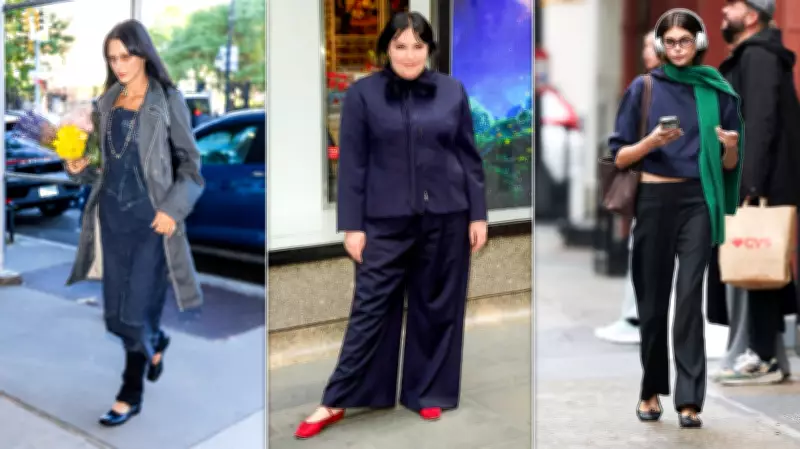
Podiatrists have long cautioned against wearing heels higher than 2 inches, but they also have warnings about other seemingly innocent shoe styles. 'When I'm discussing footwear with patients who have foot pain, the culprit is usually something completely flat with zero arch support or a shoe so narrow it's been compressing the forefoot with every step,' said podiatrist Dr. Anne Sharkey. The classic ballet flat, popularized by celebrities like Bella Hadid, Hailey Bieber, and Kaia Gerber, is a prime example.
The Hidden Dangers of Ballet Flats
While ballet flats may seem like a safe, comfortable choice, podiatrists warn they can cause significant damage. 'If I had to single out one category of style that causes problems, it's the ballet flat,' Sharkey said. 'They typically have no arch support, minimal cushioning, and a very thin sole. The foot is essentially landing repetitively on a glorified piece of cardboard with every step.' Over time, this can lead to arch collapse, chronic heel pain, stress fractures, Achilles tendon strain, and metatarsalgia—pain in the ball of the foot.
Dr. Adenike Sonaike added, 'Ballet flats lack foot and ankle support. Even with custom inserts, they won't prevent injury.' Dr. Suzanne Fuchs agreed, noting they overload the plantar fascia. 'If people understood what was happening to their feet structurally over months and years of daily wear, they'd think twice before reaching for unsupported ballet flats,' Sharkey said.

Pointed Ballet Flats Are Even Worse
The pointed toe style exacerbates problems. 'Narrow, pointy shoes are a major driver of bunions and nerve irritation,' Fuchs said. Sharkey explained that the narrow toe box forces toes into an unnatural position, contributing to bunion and hammertoe formation—structural deformities that may require surgery. Podiatric practitioner Marion Yau added, 'The narrow toe box squeezes toes together, creating corns and calluses. It can also cause toes to claw, damaging the nail plate and bed.'
How to Choose the Right Shoe
To avoid foot problems, start by getting your feet accurately measured. 'Many people have not had their feet measured since childhood and are shocked to discover they've been wearing shoes too small or narrow for years,' Yau said. Feet can lengthen and widen with age. 'Around half my patients are wearing the wrong shoe size,' she added. Measure both feet and shop for the larger one, Sharkey advised.
Look for a firm heel counter, proper arch support, and a wide toe box. 'If a shoe folds in half easily, it's not supportive,' Fuchs said. Ensure a thumb's width of space between your longest toe and the shoe's end. 'If a shoe causes pain in the store, don't assume it will break in,' Yau warned. 'Pain is the foot's way of telling you the fit is wrong.'
Price Isn't Everything
A high price doesn't guarantee foot health. 'I have patients who spend $400 on a designer shoe that offers nothing structurally, and others who spend $90 for supportive shoes that check every box,' Sharkey said. Rotate shoes and replace them when worn out. 'Many foot problems attributed to aging are actually the cumulative result of decades of poor footwear,' Sharkey concluded. 'It's never too late to make better choices.'