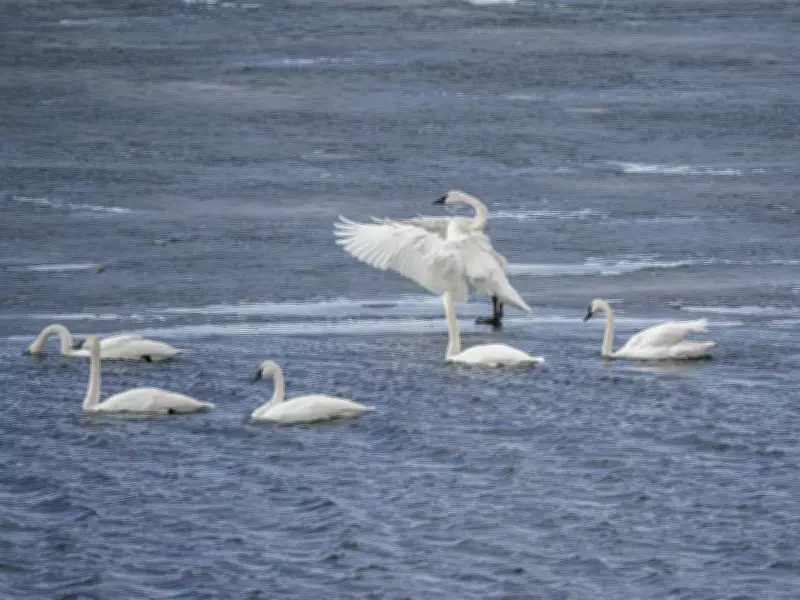
Trumpeter Swans Return to Alberta Fields, Signaling Spring's Arrival
The arrival of trumpeter swans in southern Alberta has become an unmistakable herald of spring, with their massive white forms creating striking contrasts against the brown fields near High River. These magnificent birds, among North America's largest flying species, have begun appearing in significant numbers as they return from their winter habitats along the Gulf of Mexico and Pacific coast.
Easy to Spot Against the Landscape
These impressive birds proved remarkably easy to locate, with initial sightings revealing approximately a dozen individuals in one grouping and nearly twenty in another. Their brilliant white plumage stands out dramatically against the earthy tones of the agricultural fields, making them visible from considerable distances even to casual observers.
"They were big and white and stood out brightly against the browns of the fields," noted one observer who ventured out after receiving reports of swan sightings east of High River. "There were maybe a dozen of them in the first bunch, closer to 20 in the second. They were trumpeter swans and I was so happy to see them."

North America's Largest Flying Birds
Trumpeter swans represent some of the most substantial avian species on the continent, dwarfing even Canada geese and various duck species in both size and presence. Only their close relatives, tundra swans, along with pelicans and whooping cranes approach similar dimensions, though trumpeters typically carry greater body mass despite slightly shorter stature than some crane species.
Their return marks what many consider the first authentic indicator of seasonal transition in the region. While a few resilient swan families maintain year-round residence along the Bow River near urban areas and upstream toward Exshaw, the majority migrate southward each autumn, making their spring reappearance a significant ecological event.
Family Groups and Feeding Behavior
Observers noted the birds' strong family connections, with individual groupings consisting of parents alongside their nearly-grown cygnets from the previous year. These young swans, still displaying some grey juvenile feathers despite having reached adult proportions, remained closely associated with their parents in the fields.
The swans demonstrated particular interest in pea fields, where they appeared to be feeding on leftover root systems from the previous autumn's harvest. "They really seem to like the roots left behind after last fall's harvest," one observer remarked. "This second bunch was really going to town on them. Must be a lot of good nutrients left behind."
Growing Numbers and Additional Wildlife
What began as sightings of a few dozen swans quickly expanded as observers explored the area, with numbers eventually exceeding one hundred of the impressive white birds across multiple locations. The mid-morning sun illuminated their bright feathers while creating dramatic backdrops against the snow-capped peaks visible on the horizon.
Beyond the swan spectacle, the region also hosted increasing numbers of raptors, including both bald eagles and golden eagles. While some eagle populations remain in southern Alberta throughout the year, March typically brings migratory individuals returning northward, coinciding with the emergence of Richardson's ground squirrels and the beginning of calving season on local ranches—both providing substantial food sources for these predators.
The simultaneous return of multiple migratory species creates a rich wildlife viewing opportunity in the High River area, with trumpeter swans serving as the most visually striking indicators of the seasonal transition now underway across the Alberta landscape.