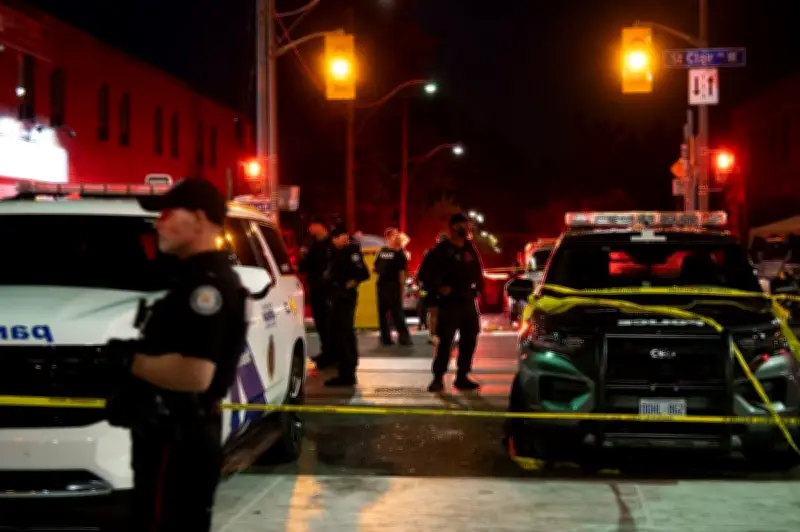
Two people are dead and multiple others injured after a mass shooting at the Salsa on St. Clair street festival in Toronto on Saturday night, July 11, 2026. Police responded to the intersection of St. Clair Avenue West and Arlington Avenue, where the popular outdoor event was taking place. Officers secured the area and urged the public to avoid the vicinity as investigations began. The tragedy has prompted a broader reflection on society's growing desensitization to violence.
Details of the Incident
The shooting occurred during the Salsa on St. Clair festival, an annual celebration of Latin music and culture that draws large crowds. According to police, two individuals died at the scene. Multiple others sustained injuries, though the exact number and severity have not been confirmed. Emergency services transported victims to nearby hospitals. Authorities are searching for suspects and have not yet released a motive. Witnesses described scenes of panic as festival-goers fled for safety.
This event marks another violent incident in Toronto, a city known for its diversity and relative safety. However, opinion columnist James Boyd, a retired paramedic and founder of STEPSLifeSafety.com, argues that such tragedies are symptomatic of a deeper cultural problem: the normalization of violence.

Cultural Desensitization to Violence
In an opinion piece published in the Toronto Sun, Boyd reflects on the shooting and its broader implications. He recounts asking a group of teenagers about the rise in shootings a few summers ago. Their response, he says, was not fear or outrage but rather: “It’s summer — it’s fun.” Boyd interprets this as a sign that young people have grown up in an environment where danger has become background noise.
He points to other examples of risk normalization, such as “burnout rings” where vehicles spin in circles at intersections while crowds film and cheer. “You see it in the way people pull out their phones before they pull each other to safety,” Boyd writes. “You see it in the way tragedy becomes content, and content becomes entertainment.” He argues that adrenaline has become a form of currency in a culture that rewards extremes, particularly through social media.
The Role of Social Media and Sensational Coverage
Boyd emphasizes that the Midtown shooting did not occur in isolation. “It happened in a cultural moment where risk is a spectacle, where adrenaline is currency, and where the shock reflex — the instinct that once kept people safe — is thinning,” he writes. He warns that sensational media coverage exacerbates the problem, as every dramatic replay or exaggerated detail risks inspiring copycats. “Copycats don’t emerge from statistics — they emerge from spectacle,” Boyd says.
He calls for a shift in how society responds to violence. After every shooting, leaders repeat ritual statements, but none address the root cause, according to Boyd. “We’re facing a continental shift in youth behaviour: a collapsed shock reflex, a normalization of violence, and an adrenaline-driven conflict culture amplified by social media,” he argues. He insists that until society confronts this cultural drift, incidents will continue regardless of laws or policies.
Call for Cultural Change
Boyd urges a move away from sensationalism toward truth without theatrics. “We acknowledge the tragedy without turning it into entertainment,” he writes. “We talk openly about desensitization, about the normalization of danger, about the cultural drift that makes shootings feel seasonal.” He believes public safety is not just about policing but also about psychology and culture — what society chooses to normalize or refuse.
The shooting at Salsa on St. Clair is a tragedy, Boyd concludes, but it is also a mirror. “If we have the courage to look into it, we may finally see what’s been there all along — a generation growing up in a world where danger feels ordinary, and a society that must decide whether it’s willing to accept that.”