Edmonton's Mature Tree Protection Bylaw Faces Criticism Amid Canopy Loss Concerns
Edmonton's urban planning committee recently heard alarming reports about the city's rapidly diminishing tree canopy, prompting discussions about a new bylaw that would require permits for cutting down mature trees on private property. While the initiative appears well-intentioned, significant questions have emerged about its effectiveness and the city's own role in canopy destruction.
The Canopy Crisis in Edmonton
Data presented to the committee reveals that Edmonton currently maintains only 13 percent canopy cover, significantly lower than other major Canadian cities like Montreal, Toronto, Ottawa, and Victoria, which all boast approximately 25 percent coverage. This disparity has raised concerns among environmental advocates and urban planners who view trees as essential for air quality, temperature regulation, and overall urban livability.
However, critics point out that comparing Edmonton to these eastern cities may be misleading due to fundamental geographical differences. As a Prairie city, Edmonton receives just 460 millimeters of precipitation annually, compared to Montreal's 1,200 millimeters, Ottawa's 930 millimeters, Toronto's 850 millimeters, and Victoria's 820 millimeters. This natural aridity creates inherent challenges for vegetation growth that cannot be easily overcome through policy alone.

Realistic Goals Versus Environmental Idealism
The city has set an ambitious target of increasing Edmonton's canopy cover to 20 percent by 2071, a goal that many experts consider achievable with careful planning and community effort. However, attempting to match the 25 percent coverage of wetter eastern cities appears unrealistic given Edmonton's climatic constraints.
"Compare Edmonton to Edmonton," argues one perspective. "The city already discourages traditional lawns in favor of rock beds and native plants to conserve water. Encouraging residents to water new trees extensively would likely draw criticism from environmentalists concerned about water resource depletion."
The True Threats to Edmonton's Tree Canopy
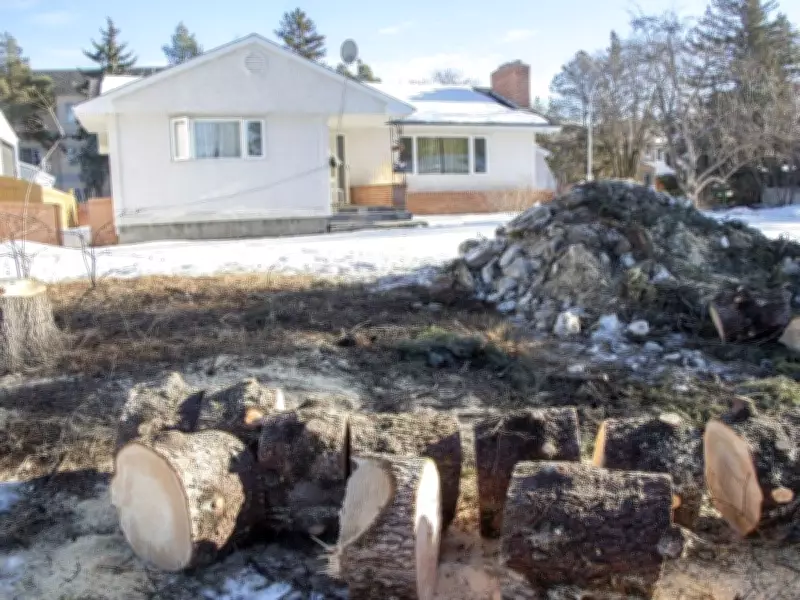
While the proposed bylaw focuses on restricting private developers from removing mature trees, evidence suggests this approach may be targeting the wrong culprits. Private developers of single-family homes represent a relatively minor threat compared to two much larger forces: municipal infrastructure projects and infill development.
The city itself has emerged as perhaps the most significant remover of mature trees through large-scale projects. For the west extension of the Valley Line LRT alone, Edmonton has already removed or plans to remove more than 1,200 mature trees. This single project eliminates more canopy than hundreds of single-family home developers would destroy over years of continuous work.
Infill developers represent the second-largest threat to Edmonton's tree cover. When constructing multi-unit condominiums on standard residential lots with minimal yard space, these developers typically clear most or all existing vegetation. Ironically, this type of dense development is precisely what the city has been actively promoting through various urban planning initiatives.
Balancing Protection With Practicality
Despite these complexities, most observers agree that protecting existing mature trees makes sense for Edmonton's future. Tree-lined streets enhance neighborhood aesthetics, provide shade during hot summers, and contribute to overall environmental health. With canopy coverage already so limited, preserving what remains becomes particularly important.
The proposed bylaw restricting removal of healthy, mature trees from private lots could represent a step in the right direction, but only if implemented alongside more comprehensive policies addressing the larger threats from municipal projects and infill development. Without this balanced approach, Edmonton risks creating regulations that appear environmentally progressive while failing to address the primary causes of canopy loss.

As Edmonton continues to grow and develop, finding sustainable solutions that acknowledge both environmental goals and practical limitations will be essential for creating a livable city that respects its unique Prairie character while protecting valuable natural assets.