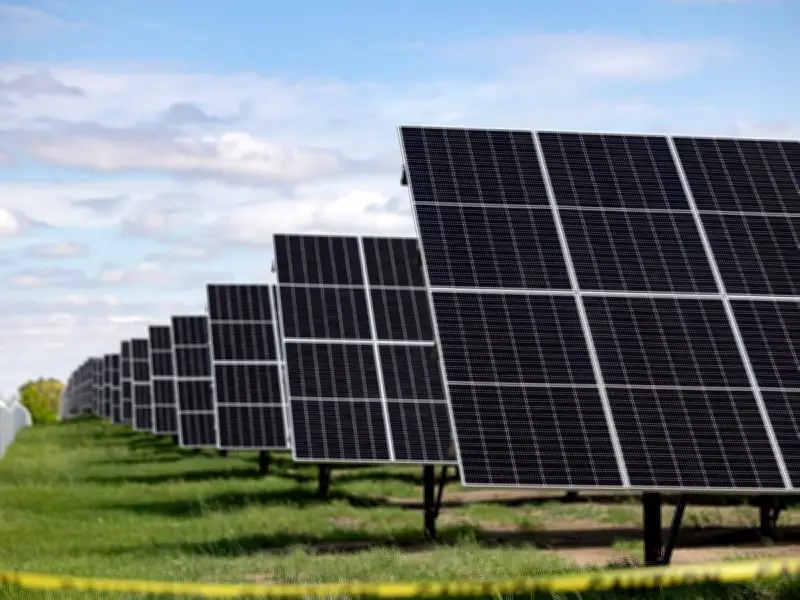
The sun emerged from behind the clouds just in time for the Dundonald Avenue Solar Farm to begin generating electricity in Saskatoon on Tuesday. The 14-acre facility, located between the CN rail tracks and Circle Drive, is expected to reduce greenhouse gas emissions by 23,000 tonnes over its 25 to 30-year lifespan. This reduction is equivalent to the emissions from 160 cars.
Mayor Celebrates Launch
Mayor Cynthia Block participated in the ribbon-cutting ceremony and pressed the button to start the facility. She highlighted that the project transformed underused land into a valuable asset for the city. "Here we are on Dundonald Avenue with the sun shining in bright and sunny Saskatoon, and it's shining brightly today," Block said.
Project Costs and Funding
The 2.8 megawatt project cost $7.3 million, partially funded by provincial and federal governments. This is less than the $8.46 million allocated last year but more than the original $4.25 million reported in 2021. Cost recovery is expected within 15 years. Trevor Bell, director of SL&P, noted the project came in under budget, attributing previous higher estimates to the novelty of developing such a site.

Technical Details
The solar farm comprises 4,500 solar panel modules divided into north and south sections. About 20% of electricity is generated on the south end and 80% on the north end. SL&P staff noted that the panels can generate electricity from both sides, utilizing sunlight reflected from snow. While operational year-round, peak generation occurs in summer. The project was originally planned for commissioning by last Christmas, but winter conditions caused delays.
Environmental and Community Impact
Angela Gardiner, the city's general manager of utilities and environment, stated that the solar farm is a major clean energy project, generating enough electricity to power over 400 homes—equivalent to a neighborhood like Richmond Heights. "These are real, measurable benefits to our community," Gardiner said. The city considers this a medium-sized project and plans to explore larger solar farms in the future. Last year, the city estimated a lifetime emission reduction of 19,380 tonnes, but Bell confirmed that current data shows they are meeting or exceeding expectations. Regarding potential cost reductions for power bills after the 15-year recovery period, Bell declined to comment.