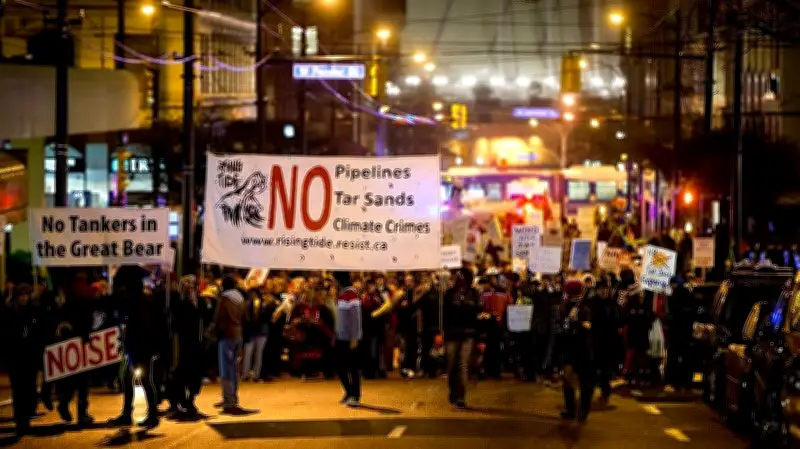
One day after the prime minister and Alberta’s premier announced next steps for an oil pipeline through southern British Columbia, the backlash has been fierce. Opponents of the West Coast pipeline project are mobilizing to protest the development, which they argue poses significant environmental risks to the region.
Growing Opposition
Environmental groups and Indigenous communities have voiced strong opposition to the pipeline, citing concerns over potential oil spills, greenhouse gas emissions, and impacts on local ecosystems. The project, which would transport crude oil from Alberta to the West Coast for export, has been a contentious issue for years.
According to Penny Daflos of VancouverNews, the announcement by Prime Minister Mark Carney and Alberta Premier Danielle Smith has reignited protests. “We are seeing a groundswell of opposition,” said a spokesperson for the Coastal First Nations alliance. “This pipeline threatens our lands, waters, and way of life.”

Political Reactions
Federal Environment Minister Steven Guilbeault stated that he “respectfully disagrees” with Prime Minister Carney over the pipeline project. Guilbeault has been a vocal advocate for climate action and has pushed for stronger decarbonization commitments. Meanwhile, the federal government has not confirmed whether Prime Minister Carney will raise human rights issues during his upcoming meeting with Saudi Arabia’s crown prince.
Experts warn that major hurdles remain for the pipeline, including regulatory approvals, legal challenges, and securing financing. “The project is far from a done deal,” said energy analyst Mark Jaccard. “There are significant obstacles that could delay or even halt construction.”
Environmental Concerns
Environmental groups have demanded a clear decarbonization plan as part of the pipeline’s approval. They argue that the project contradicts Canada’s climate commitments under the Paris Agreement. “We need to see a commitment to reducing emissions, not expanding fossil fuel infrastructure,” said a representative from the Sierra Club BC.
The pipeline would cross sensitive ecosystems, including salmon-bearing rivers and coastal areas. Indigenous communities have vowed to use all legal means to stop the project. “We will not stand by while our territories are destroyed,” said a leader of the Tsleil-Waututh Nation.
Economic Arguments
Proponents of the pipeline, including the Alberta government and industry groups, argue that it will create jobs and boost economic growth. They point to the need for energy security and access to international markets. “This pipeline is critical for Canada’s economy,” said Alberta Premier Danielle Smith. “It will support thousands of jobs and generate billions in revenue.”
However, critics counter that the economic benefits are overstated and that the risks outweigh any potential gains. A recent study by the Canadian Centre for Policy Alternatives found that the pipeline would create fewer jobs than claimed and could actually harm local economies in the event of a spill.
Next Steps
Opponents are planning a series of protests and legal challenges in the coming weeks. Environmental groups are coordinating with Indigenous communities to amplify their message. “We will be at every step of this process, holding the government and industry accountable,” said a spokesperson for Greenpeace Canada.
The federal government has not announced a timeline for final approval, but the project is expected to face intense scrutiny. As the backlash grows, the pipeline’s future remains uncertain.