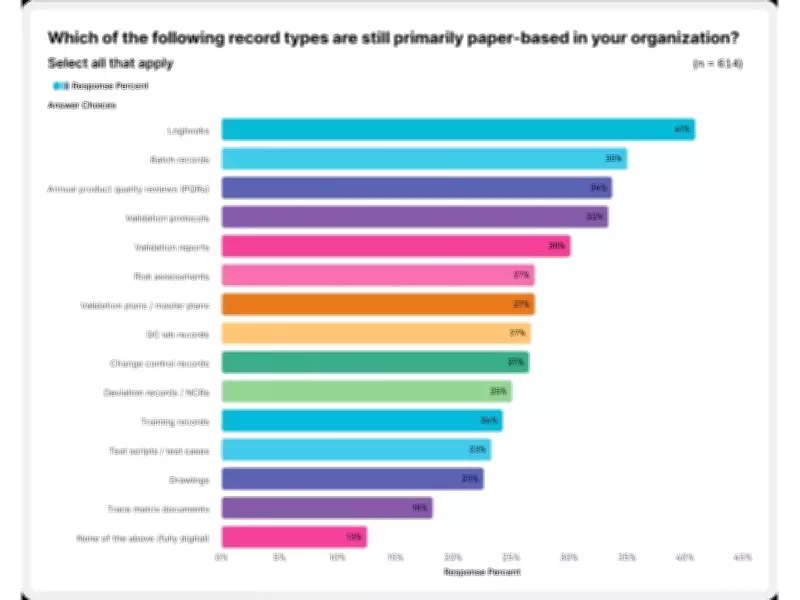
The 2026 State of Validation study, conducted by kneat.com, inc., has revealed that significant headroom remains for further digitization in the validation space. Despite nearly two-thirds of organizations either fully using or actively implementing a dedicated digital validation tool, only 13 percent report being fully digital across all record types. This indicates that full digital maturity is still limited, and considerable progress is needed.
Key Findings from the Study
The study, based on over 600 responses from validation professionals worldwide, highlights several critical trends and challenges facing the industry.
Persistent Paper Usage
Paper continues to dominate core GxP records in 2026. Forty-one percent of respondents say logbooks are still primarily paper-based, 35 percent say the same of batch records, and 33 percent cite validation protocols. This persistence of paper underscores the need for scalable and efficient digital solutions.

Increasing Validation Workload
Validation workload pressure is rising, with 80 percent of respondents reporting that their organization's validation workload increased over the past year. Forty-five percent described the increase as significant, reinforcing the need for more efficient operating models.
Digital Investment Yields ROI
Among organizations with implemented or in-progress digital validation systems, 74 percent say ROI has met or exceeded initial predictions. Within that group, 53 percent say ROI has exceeded expectations, including 30 percent who say it has significantly exceeded predictions.
AI Adoption in GxP Environments
AI is being adopted in GxP environments, with governed, human-reviewed use cases favoured over fully autonomous ones. Seventy-eight percent of respondents are confident that AI will become a standard part of validation by 2030, and nearly 40 percent of organizations are either using or actively evaluating AI in a GxP validation or quality setting. The most widely accepted use case is AI for drafting or summarization with mandatory human review, selected by 53 percent of respondents.
Acceptance of AI declines as autonomy increases: 38 percent consider AI decision support with human approval acceptable, 37 percent accept deterministic rules-based automation, 29 percent accept AI that executes workflow actions automatically with an audit trail, and 16 percent accept AI making or changing GxP decisions autonomously without human approval.
Digital Maturity as a Prerequisite for AI
Digital maturity is emerging as a prerequisite for responsible AI deployment in regulated environments. Among organizations that have fully implemented a digital validation tool, 64 percent are currently using or piloting AI in validation or quality activities, compared with 13 percent of those with no plans to adopt a digital validation tool.
Industry Response
Eddie Ryan, CEO of Kneat Solutions, commented: 'We thank every respondent who contributed their time and expertise to the 2026 study. These findings, drawn from professionals across six continents and more than 30 industries, paint a picture of a profession under pressure – but responding with growing sophistication, strategic investment, and a clear eye on what comes next.'
About Kneat
Kneat Solutions provides leading companies in highly regulated industries with unparalleled efficiency in validation and compliance through its digital validation platform Kneat Gx. The platform is fully ISO 9001 and ISO 27001 certified, fully validated, and 21 CFR Part 11/Annex 11 compliant. Optional AI capabilities within Kneat Gx accelerate the validation lifecycle while maintaining full GxP compliance, governance, and data integrity.