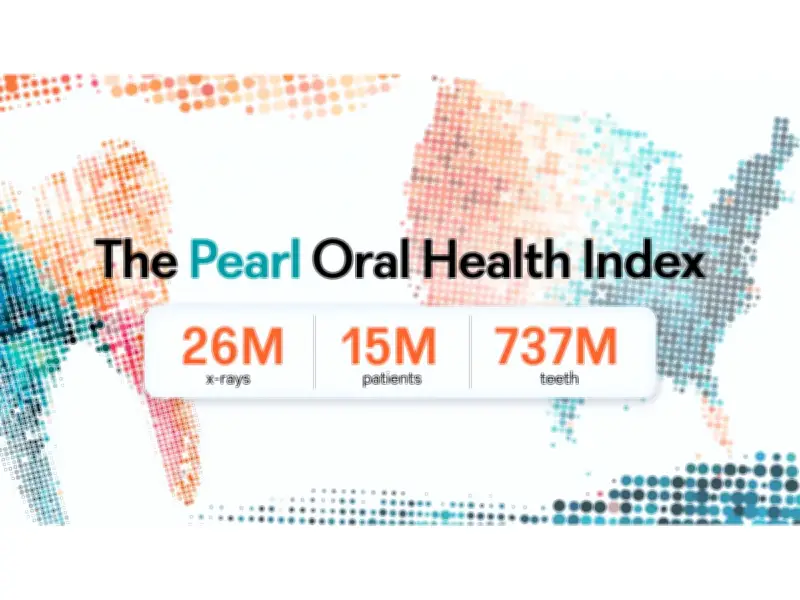
The Pearl Oral Health Index, the first radiographic census of the American mouth, reveals that the nation's cavity problem is at least 4.5 times worse than federal government data indicate. Based on an analysis of 26 million dental x-rays from 15 million patients and 737 million teeth, the index identifies and quantifies the impact in America's "dental deserts," where the tooth-loss gap exceeds 40 percent.
Pearl, the global leader in dental AI solutions, used its FDA-cleared AI platform to read dental x-rays at scale, creating the most comprehensive radiographic census of American oral health ever produced. The dataset is so vast that, for the first time in history, it has made the collective reality of the American mouth legible. The data both reveals and challenges assumptions about who gets sick, who gets treated, and why.
Key Findings: The X-Ray Gap
Until now, dental research has largely relied on small-sample surveys. X-rays, the single richest source of oral health information, have been locked away in tens of millions of isolated patient files, impossible to aggregate or compare. Pearl is the first dental AI platform to read, analyze, and measure them at population scale.

"For the first time, we can see what's actually happening inside the mouths of America, not through a survey, not through a sample, but through the raw radiographic truth of tens of millions of visits," said Ophir Tanz, founder and CEO of Pearl. "The picture is dramatically different from what the public data has told us for decades. There is more disease, more inequality, and more variability in care than anyone realized. AI didn't create this problem, but it finally let us measure it."
The CDC's National Health and Nutrition Examination Survey (NHANES), the gold-standard U.S. government oral health survey of just 25,000 participants, uses mirrors and probes in mobile clinics and estimates that roughly 21 percent of American adults have untreated decay. Pearl's AI, reading radiographs of 15 million participants, finds the real figure is at least 4.5 times higher.
Comparison of Key Metrics
Decayed teeth per patient: Pearl 6.07 vs. NHANES 0.7 — an 8.7x gap in detected decay. Missing teeth per patient: Pearl 2.16 vs. NHANES 2.0 — a near-perfect match that gives credence to Pearl's methodology, since empty sockets are visible to both a probe and an x-ray. Restored teeth per patient: Pearl 7.01 vs. NHANES 6.0 — again, restorations are generally visible to the naked eye, so the near-alignment supports Pearl's methodology.
X-rays can reveal demineralization at 30–60 percent mineral loss, which is well before a cavity is visible to the eye. The difference is not a methodological quirk; it is the cost of measuring the nation's oral health with instruments that were state-of-the-art in the 19th century. Of note, everyone in Pearl's dataset was already in a dental chair, meaning the true spread in the general population is likely even higher.
Age-Based Disparities
Young adults have the most neglected mouths, while older adults have the most managed. For ages 18–24, 52 percent or more than half of all dental disease is untreated — the most neglected mouths in the dataset. A crossover occurs between ages 35–44, when fillings finally overtake untreated decay. This is when most people evolve from neglect to managing their oral health.
For ages 75 and older, the number of teeth showing signs of decay, loss, or restoration rises to 19.14 out of 28 teeth, meaning over two-thirds of teeth have had an issue. Only 28 percent of that damage is untreated. By the time a person hits 75 years old, their mouth is not healthier, but it is more managed.
Dental Deserts and Inequality
The index identifies and quantifies the impact in America's "dental deserts," where the tooth-loss gap exceeds 40 percent. These regions suffer from a lack of access to dental care, leading to significantly higher rates of tooth loss compared to areas with better access. The data underscores the inequality in oral health across the United States.
The Pearl Oral Health Index provides a new benchmark for understanding oral health at a population level, challenging long-held assumptions and highlighting the need for improved measurement and intervention strategies.