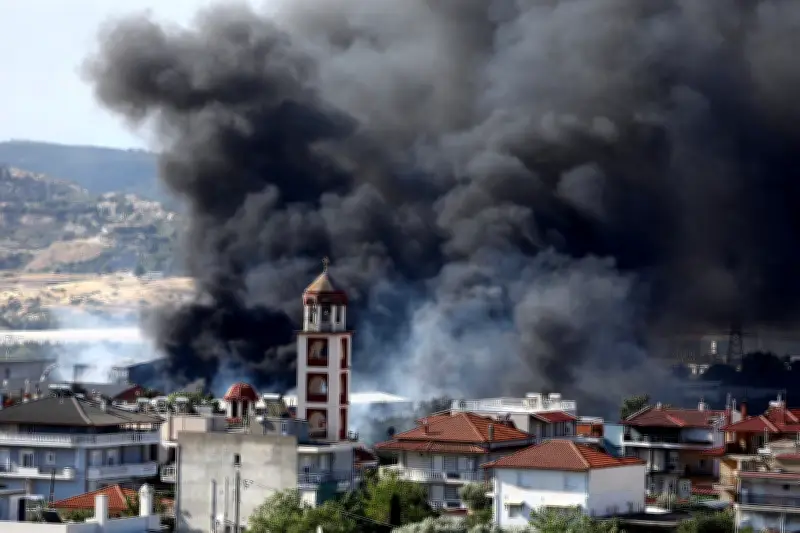
Thick smoke billowed above the Filothei settlement on the outskirts of Thessaloniki, Greece, as a wildfire raged Sunday, July 5, 2026, marking another day of devastating blazes across southern Europe. The fires, fanned by extreme heat, have forced evacuations in Portugal, Spain, and Greece, with emergency services struggling to contain the flames.
Greece Battles Blaze Near Thessaloniki
In Greece, the wildfire near the northern city of Thessaloniki prompted authorities to evacuate several settlements as flames approached residential areas. Firefighters, aided by water-dropping aircraft, worked through the night to protect homes and infrastructure. According to the Greek Fire Service, more than 200 firefighters and 50 vehicles were deployed to the scene. No casualties have been reported so far, but officials warned that the situation remains volatile due to strong winds and high temperatures.
Portugal and Spain Also Hit
In Portugal, wildfires broke out in the central and northern regions, forcing the evacuation of several villages. The Portuguese Institute of the Sea and Atmosphere reported temperatures exceeding 40°C in parts of the country. Meanwhile, in Spain, fires raged in the regions of Extremadura and Andalusia, with thousands of hectares of forest burned. Spanish authorities confirmed that at least 1,500 people had been evacuated from their homes as a precautionary measure. “The combination of drought, high temperatures, and strong winds has created extreme fire risk,” said a spokesperson for the Spanish Ministry of Ecological Transition.

Extreme Heat Wave Fuels Fires
The wildfires are part of a broader heat wave gripping southern Europe, with temperatures soaring above seasonal norms. Climate scientists have linked the extreme conditions to climate change, noting that heat waves in the region are becoming more frequent and intense. According to the European Forest Fire Information System, the number of wildfires in southern Europe has increased by 25% over the past decade, with 2026 projected to be one of the worst years on record.
Impact on Communities and Environment
The fires have caused significant damage to ecosystems and property. In Greece, the smoke plume from the Thessaloniki fire was visible from satellite imagery, drifting over the Aegean Sea. Local authorities have set up emergency shelters for evacuees, and the Greek government has requested assistance from the European Union’s Civil Protection Mechanism. In Portugal, the National Authority for Emergency and Civil Protection reported that 10,000 hectares of land had been burned since the start of the fire season in June. “We are facing an unprecedented situation,” said a Portuguese official. “Our resources are stretched thin, but we are doing everything we can to protect lives and property.”
International Response and Prevention Efforts
The European Union has mobilized firefighting aircraft and personnel to assist affected countries. In addition, local governments are implementing preventive measures, including fire bans and public awareness campaigns. However, experts argue that long-term strategies, such as improved forest management and climate adaptation, are essential to reduce the risk of future wildfires. “We need to invest in fire prevention and resilience,” said a climate policy analyst. “The current approach of fighting fires after they start is no longer sustainable.”