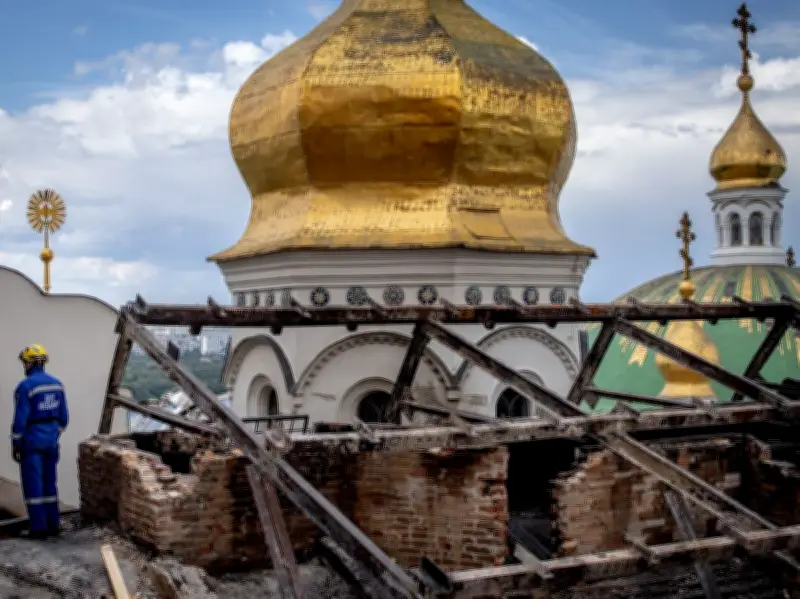
On Sunday night, Russia vandalized Ukraine’s religious and cultural heritage by bombing a thousand-year-old monastery in central Kyiv. The holy site is among the most revered in Eastern Orthodox Christianity, equivalent in significance to Paris’ Notre Dame, yet that provided no protection against Moscow’s nihilistic war machine.
A Thousand Years of History at Risk
Nestled in the very centre of the Ukrainian capital, the Kyiv Pechersk Lavra — also known as the Monastery of the Caves or the “jewel of the Orthodox world” — is a compound of creamy white and turquoise towers, topped with hammered golden domes overlooking the Dnipro river. Its elegant buildings, adorned with crosses and painted icons, sit above ancient labyrinths of underground crypts and chapels where one can find frescos and Christian artefacts.
The “lavra” (a term reserved for the highest echelon of Orthodox monasteries) is widely beloved by Ukrainians and an essential landmark for foreign visitors. Yet, over its thousand year history, it has suffered repeated destruction at the hands of eastern invaders.

Historical Destruction by Invaders
The holy site was first built in the 11th century when the Kyivan Rus — a Slavic proto-Ukrainian state — was among the powerful forces in Europe and Moscow was still undeveloped swampland. Architects from Constantinople designed the original monastery, and, though their work was plundered by Turkic raiders shortly after, the lavra was repaired and became an early bastion of Slavic Orthodox Christianity.
Two hundred years later, in the mid-13th century, the Mongols razed Kyiv to the ground, massacring over 90 per cent of the city’s inhabitants and leaving the lavra ruined for decades. The Rus was fragmented into squabbling, semi-autonomous principalities while the city withered into a provincial town of marginal importance.
Though the lavra was again ravaged by Turkic powers in the 1400s — first the Golden Horde, then the Crimean Khanate — Ukrainians obstinately repaired it each time.
Russian Imperial and Soviet Repression
In the 1600s, Kyiv experienced a cultural revival under Lithuanian-Polish rule, but control over the city was soon handed over to the Russian Empire. Local Ukrainian elites sponsored the lavra’s restoration and expansion during this period, building the compound’s now-distinct baroque architecture, but Russia placed the holy site under the authority of the Moscow Patriarchate and enacted a policy of Russification.
Under a regime of strict censorship, references to Ukrainian language and culture were banned within the lavra. The compound’s printing house, previously a beacon of Ukrainian nationhood, was repurposed in service of Moscow’s colonization.
Centuries later, after the Bolshevik Revolution, Russian-led Soviet authorities desecrated the lavra by turning it into a communist museum of anti-religious propaganda. Then, amid the Second World War, Russian secret police blew up the lavra’s main cathedral as they retreated from the city, blaming the destruction on the approaching Nazis.
In the final decades of Soviet rule, Moscow permitted religious worship insofar as it could be used for social surveillance, and filled the Russian Orthodox Church with spies and informers. The lavra, by extension, became an instrument of secular repression and government control.