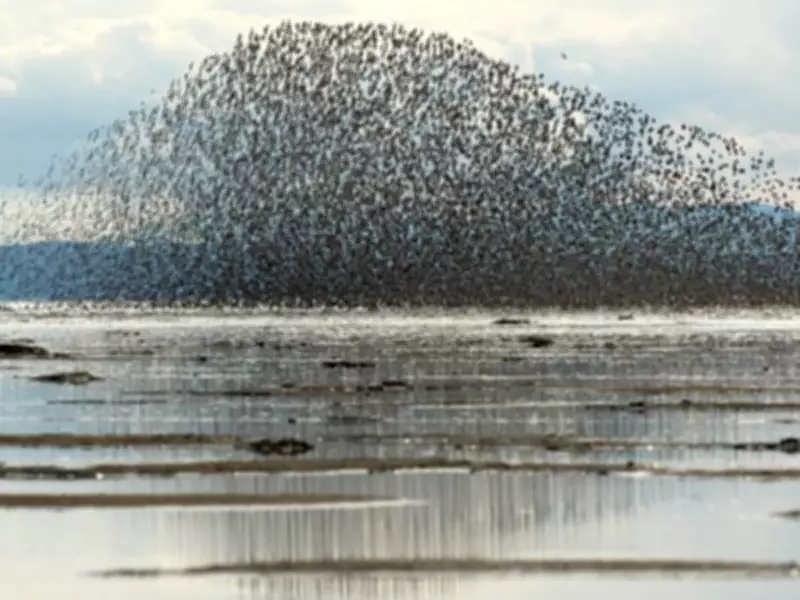
When Isabelle Groc first saw the migratory western sandpipers at Roberts Bank in Delta, she was crouched in a barren, goopy mudflat. 'I found myself in the middle of something spectacular,' said the filmmaker behind Sandpiper's Last Supper, a documentary that explores the threat to the species' habitat posed by the Roberts Bank Terminal 2 port expansion.
The $3.5 billion project, which will double the size of the Deltaport shipping terminal, is expected to increase container shipping capacity by 30 percent and bring an extra 2.4 million 20-foot equivalent units of container capacity per year to Roberts Bank. That is where 3.5 million of these tiny shorebirds pass through annually to feed and refuel during their northward migration along the Pacific Flyway. As Groc crouched in the mud, thousands of them swooped in synchronized murmurations above her, rustling and whooshing. 'It was a life changing experience,' said Groc.
Irreplaceable Feeding Ground
Although the western sandpiper is not yet considered endangered, Groc and members of the scientific community believe the expansion will irreversibly damage the Fraser River estuary and mudflats, where the sandpipers stop on their spring migration from South America to Alaskan breeding sites. Marine biologist Pat Baird said the mudflats in the Fraser River Estuary might appear to be a desolate wasteland but they are actually an irreplaceable feeding ground with a unique biofilm that contains vital micro-organisms, called diatoms, on which the sandpipers feed, and are not available to the birds anywhere else.

If the port expansion goes ahead as planned, with a manmade island and structure perpendicular to the outflow of the Fraser River, the estuary could be destroyed. 'The biofilm that is there now will disappear,' said Baird.
Government Approval and Conditions
The expansion project received the go ahead from federal and provincial governments in 2023. Federal government approval is contingent on strict conditions that include 370 environmental protection measures, such as infrastructure for safe passage of fish, noise monitoring to protect killer whales, consultation to create new biofilm habitat, and a commitment to monitor the habitat for 36 months after construction. That consultation work is underway.
Sean McNulty, regulatory and permitting director with the Vancouver Fraser Port Authority, said the port authority has been collecting environmental data at the site for the last 15 years on a range of topics, including western sandpiper and biofilm. 'Three or four weeks ago, we had about 30 individuals on site collecting data not just on biofilm, but on a range of other topics to support the monitoring project,' said McNulty. The goal was to establish a baseline, as part of the long-term monitoring program that are obligations under the conditions for government approval of the project, so that once the project is under construction, comparisons can be made.