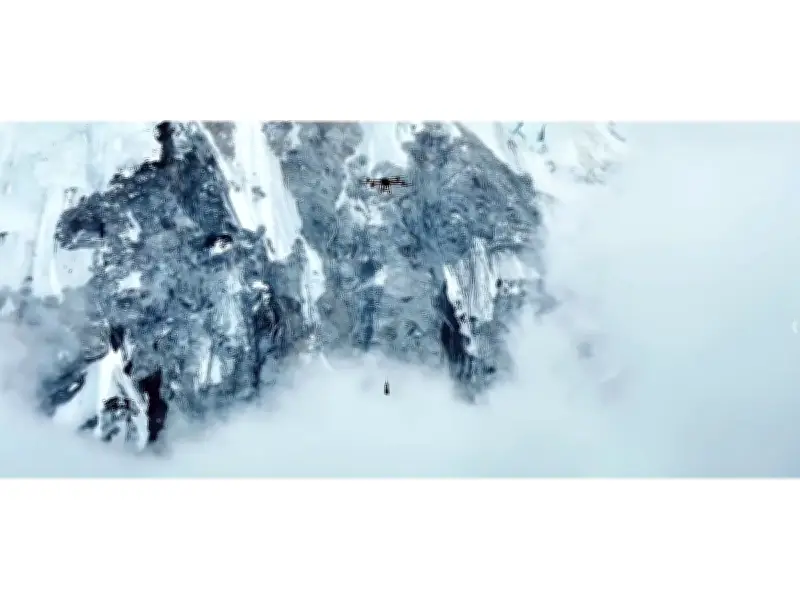
DJI, the world leader in civilian drones and camera technology, announced the successful completion of three groundbreaking missions on Mount Qomolangma (Mount Everest), demonstrating new capabilities in high-altitude delivery, mapping, and atmospheric research. The missions employed the DJI FlyCart 100 for cargo transport and the DJI Matrice 4E for mapping on the South Slope in Nepal, while DJI’s first eVTOL delivery drone, the EV50, supported long-distance deliveries for atmospheric chemistry research on the North Slope in China.
Record-Breaking Delivery Operations
The DJI FlyCart 100, a heavy-lift drone capable of carrying up to 100 kg at sea level, was tested in partnership with local Nepalese drone company Airlift. The tests evaluated high-altitude performance, including payload capacity, transmission range, RTK positioning accuracy, signal stability, and battery endurance in sub-zero temperatures ranging from -15°C to 5°C. The drone carried climbing expedition gear such as oxygen tanks, ropes, and ladders between Base Camp and Camp 1.
During the tests, the DJI FlyCart 100 demonstrated the ability to carry up to 47 kg at altitudes exceeding 6,300 m. In total, the drone transported 10,073 kg of supplies and waste between Base Camp and Camp 1, comprising 7,215 kg of climbing supplies and 2,858 kg of waste removed from the mountain. A single one-way flight took just eight minutes, compared to the traditional six-to-eight-hour trek by Sherpas through the hazardous Khumbu Icefall.

Supporting Sustainability and Safety
“Our team remains dedicated to making the world’s highest mountain safer and cleaner for Sherpas and mountaineers worldwide,” said Christina Zhang, spokesperson for DJI. “The success of our latest operations marks a proud milestone, and we hope our ongoing collaboration with the scientific community will further advance drone technology—saving lives and supporting conservation efforts across the globe.”
The DJI FlyCart 100 will continue to support the Nepalese climbing community’s goal of transporting approximately 5,000 oxygen cylinders each climbing season between Base Camp and Camp 1. On return trips, the drone will assist in removing about 10,000 kg of waste from higher camps that previously could not be cleaned up. On average, each climber leaves about 8 kg of trash on the mountain. This effort aligns with Nepal’s sustainability initiatives, including the Nepal Mountain Association’s “Zero Waste Initiative 2027.”
Decades of Drone Innovation on Everest
These milestones build on DJI’s long history of testing drone technology on the world’s highest peak. In 2009, DJI tested an unmanned helicopter equipped with its self-developed XP3.1 flight control system. A year later, the DJI Ace One flight control system successfully operated above 4,700 m. In 2022, a DJI Mavic 3 reached the summit and captured the first drone footage at 8,848.86 m. In 2024, the DJI FlyCart 30 completed the world’s first drone delivery tests from Base Camp to Camp 1 on the South Slope.
Advancing Mapping and Climate Research
The DJI Matrice 4E mapping drone was deployed to create high-resolution 3D maps of the glacier terrain, improving mountaineering safety by identifying crevasses and unstable ice. Meanwhile, the EV50 eVTOL drone conducted long-distance deliveries of scientific equipment for atmospheric chemistry research on the North Slope, collecting data on air composition and pollutants at extreme altitudes. These efforts contribute to climate change research and better understanding of high-altitude ecosystems.