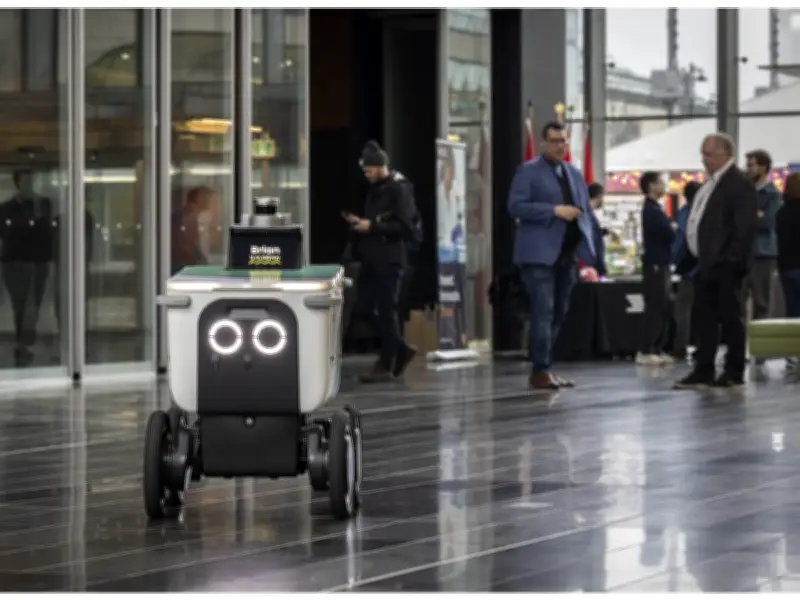
Imagine a small cube-shaped robot rolling along a crowded sidewalk, weaving between patio tables, cyclists, utility poles, and pedestrians carrying groceries or pushing strollers. Soon, scenes like this may become part of everyday life in Vancouver.
City council recently approved a six-month pilot program allowing autonomous delivery robots to operate in parts of Kitsilano and downtown this fall. Supporters describe the machines as innovative, efficient, and environmentally friendly. Critics warn about accessibility, safety, and labour impacts.
But beneath the debate over food delivery lies a larger urban question. This is not really a story about robots. It is a story about sidewalks.

For most of modern urban history, sidewalks have been understood as civic infrastructure — spaces for walking, gathering, accessibility, protest, and public life. They were never transportation corridors. They were among the few parts of the city designed primarily around people rather than machines.
Yet sidewalks have never been neutral. In wealthier neighbourhoods, they are wider, greener, and better maintained. In poorer or historically marginalized areas, they are more likely to be cracked, obstructed, or missing altogether. Decisions about maintenance, curb ramps, and pedestrian safety reveal whose movement cities prioritize — and whose they do not.
Over the past two decades, sidewalks have quietly begun changing. Cafe patios expanded into pedestrian space. Ride-hailing transformed curb behaviour. E-scooters, bike-share stations, and mounting delivery demands increasingly pushed sidewalks away from being places people gather and toward being routes where goods travel. Delivery robots are simply the latest step in that shift.
The language surrounding the pilot program reveals something important. Proponents describe the robots as a “last-mile delivery” solution — a phrase borrowed not from urban planning, but from logistics and supply-chain management. That distinction matters. When city space is described in the language of shipping and efficiency, sidewalks gradually stop being places where public life happens and start being just another part of the delivery network.
This shift is not simply about technology. It is about economics. Delivery robots are emerging within a system that rewards speed, lower labour costs, and frictionless shopping. The issue is not merely that new technologies exist, but that cities increasingly bend themselves to fit the demands those systems create.
One of the most striking things about the robot debate is how unthreatening the machines initially appear. They are small, electric, and framed as greener alternatives to delivery vans. Their supporters are not entirely wrong. But new technologies rarely stay contained — they gradually reshape how cities behave, what gets prioritized, and what gets built.
The robots proposed for Vancouver may prove useful, limited, or short-lived. But they are a signal of something larger already happening across North American cities: public space being gradually reshaped around the needs of delivery, efficiency, and online commerce. As the pilot program moves forward, it is worth asking not just whether robots can share the sidewalk, but what kind of city we are designing — and for whom.