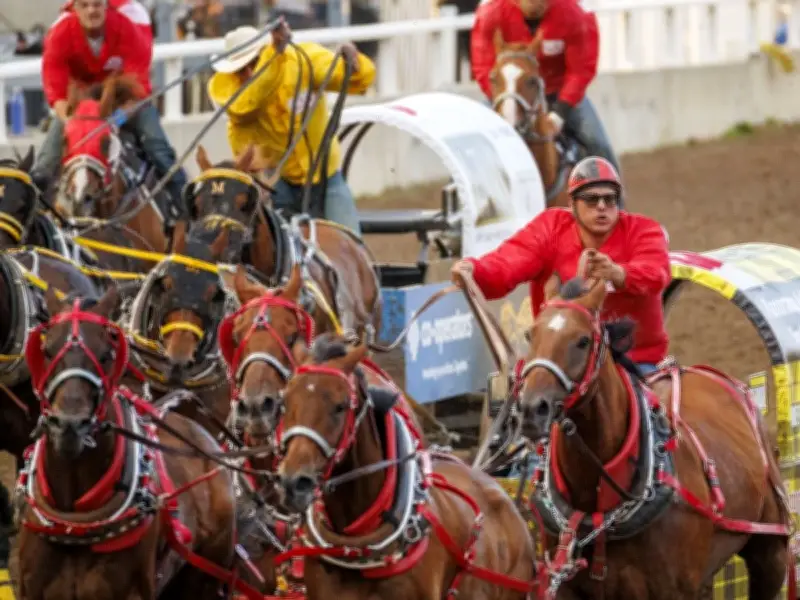
Chuckwagon racing at the Calgary Stampede, first held in 1923, has evolved over the decades but retains its core principles. According to chuckwagon historian and commentator Billy Melville, the sport's objective has remained unchanged since its inception. “Even though it’s gone through a number of changes, there are three underlying principles that have guided the chuckwagon races since Day 1,” Melville said. “What they are is that a chuckwagon race does three things: No. 1 is that it tests the skill of the driver; No. 2 is that it tests the skill of the outriders; and No. 3 it demonstrates the speed of the team. It’s really no more complicated than that.”
Origins and Evolution
The modern Rangeland Derby traces its roots to actual working ranch cook wagons that would race between camps, with the winner being the first to set up camp and light a fire. Justian Wylie, volunteer chair of the Calgary Stampede Chuckwagon and Relay Committee, explained, “It was probably one of the most iconic Western sporting events in Canada and it really evolved from kind of real, working ranch cook wagons who race from camp to camp and who could set up camp fastest and light fire.” In early races, competitors had to jump out of their wagons at the finish line to build a fire.
Wylie added that the race format evolved into a track event: “Really it evolved from where you had wagons, similar to a track and field event, that would start from a standing position. The horn would go, similar to the gun going off in a in a track event, they would make a figure eight of barrels in the infield and it really evolved around who was the safest and fastest to get around the track and back to the finish line the quickest.” The race also involves a stove thrown into the back of the wagon and outriders who ensure safety.

The Role of Outriders
Outriders play a critical role in each race. At the start, one outrider holds the reins of the lead team (the front two horses) to steady them, while the other prepares to throw the stove into the wagon when the klaxon sounds. “Outriders have specific tasks that they have to perform and they have to perform them to perfection, otherwise their team is going to get penalized,” Melville said. He noted that his younger brother Eddie was an accomplished outrider before retiring. “A good start is your best chance to get the desired result, so that’s where a good lead outrider comes in … set ’em straight, set ’em tight so that the driver has the best chance of getting off to a fast start and being in a spot where he can make the best turn, because a lot of times the race is won or lost at the barrels.”
After completing their tasks, outriders must leap onto their horses and follow the driver around the track, known as the “Half Mile Of Hell.” Melville emphasized, “When you get on the racetrack, you’re only as fast as your slowest horse, but if you can shave some time off in the barrels, that’s a lot of times where the race is won or lost.”
Modern-Day Rangeland Derby
Today’s chuckwagon races at the Calgary Stampede continue to draw large crowds, with drivers and outriders competing for top honors in the Rangeland Derby. The event remains a highlight of the Stampede, blending tradition with high-speed excitement. As Wylie noted, the sport has evolved from its practical origins into a thrilling spectator event that still honors its heritage.