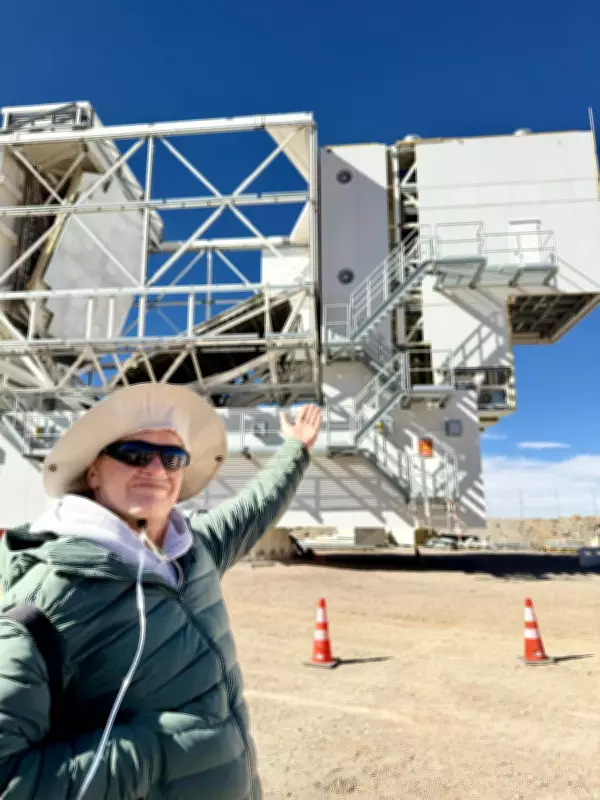
A groundbreaking telescope high in the Chilean Andes is now operational, thanks to Canadian-developed technology that promises to unlock secrets of the universe. The Fred Young Submillimeter Telescope, situated at an altitude of 5,600 meters in the Atacama Desert, is equipped with advanced instruments designed by a team led by Dalhousie University astrophysics professor Scott Chapman.
Canadian Innovation in Astronomy
The telescope's sophisticated detectors and optics, crafted by Canadian engineers and scientists, enable it to capture faint signals from the early universe. This technology allows astronomers to study the formation of galaxies, stars, and planetary systems with unprecedented clarity. Chapman, a key figure in the project, emphasized the collaborative effort that made this possible.
"This is a testament to Canadian expertise in submillimeter astronomy," said Chapman. "Our team has worked tirelessly to develop these components, and seeing them perform at such a remote and extreme site is incredibly rewarding."

Probing the Cosmos
The Fred Young Submillimeter Telescope, named after a prominent supporter of the project, is designed to observe the universe in submillimeter wavelengths, a range that reveals cold, distant objects otherwise invisible to optical telescopes. Its location in the Atacama Desert, one of the driest places on Earth, minimizes atmospheric interference, providing exceptionally clear data.
Initial observations have already yielded promising results, including detailed maps of interstellar dust and gas clouds that are the birthplaces of stars. Scientists hope the telescope will also shed light on dark energy and the cosmic microwave background, the afterglow of the Big Bang.
International Collaboration
The project is a joint effort involving institutions from Canada, the United States, Europe, and Chile. Canada's contribution includes funding from the Natural Sciences and Engineering Research Council and the Canadian Space Agency, alongside academic partnerships with universities across the country.
As the telescope begins its scientific mission, the global astronomy community eagerly anticipates discoveries that could reshape our understanding of the cosmos. Chapman and his team remain at the forefront, analyzing data and fine-tuning the instruments to maximize their potential.