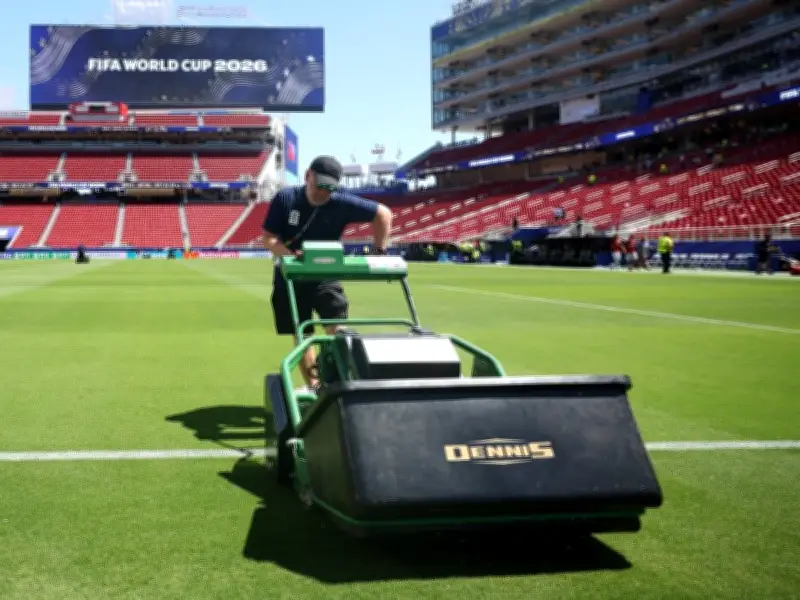
John Sorochan, a distinguished professor of turfgrass science and management at the University of Tennessee at Knoxville, spent eight years perfecting the grass surfaces for all 16 FIFA World Cup 2026 stadiums. The Calgary native was tasked by FIFA’s Senior Pitch Management Manager Alan Ferguson with creating turf that would perform consistently across vastly different North American climates, from Vancouver to Mexico City.
Developing grass for diverse climates
Sorochan knew that a single grass type wouldn’t work for the entire tournament. “From Vancouver to Mexico City is completely different and everything in between,” he told Inside Higher Ed. “So I knew that the summer tournament, you would have to have different grasses.” For stadiums in warm climates like Miami, Bermuda grass was chosen, while cooler venues like Boston received a blue rye mix of cool-season grasses.
The challenge was to make these different grasses play and perform as similarly as possible for the World Cup. Sorochan had already researched turfgrass for Major League Soccer when FIFA approached him. He and a graduate student studied how a ball bounces on different surfaces, guided by FIFA’s Natural Turf Guidelines, which require a ball dropped from two metres to bounce between 60 centimetres and one metre.

Overcoming concrete and drainage challenges
Many stadiums, such as those in Dallas and Houston, have concrete floors beneath the turf. Sorochan’s team investigated how to build a pitch above concrete that would feel natural for players. “We learned that if you have a minimum of three inches of sand and a drainage layer, you can’t pick up the feel of the concrete below that surface,” he said.
Approximately 30 to 40 research projects over five-plus years went into creating optimal conditions. Traction was another key factor. “When you have players that have played in England and they only play on ryegrass, which is a cool-season grass, and it’s always cool and damp, they always wear screw-in cleats to give them extra footing attraction,” Sorochan explained. “When you go onto a surface that’s Bermuda grass, the way that Bermuda grass grows is going to give you more traction.”
Legacy and future impact
FIFA invested significantly in this research, and Sorochan credits Ferguson’s vision of evidence-based science for creating safer playing surfaces. “He went and sold it to the leadership at FIFA all the way up to the president, and their investment in this is going to leave a huge legacy,” Sorochan said. “It’s also enabled me, as a professor at the University of Tennessee, to come up and help advance ideas that I was doing before.”
The turf at each stadium has been built to FIFA’s exacting standards, ensuring that players from 48 countries competing in the tournament experience consistent, high-quality surfaces. Sorochan’s work is expected to influence future soccer pitch design and improve player safety worldwide.