Minneapolis Photographer's Desperate Toss Saves Equipment During Federal Confrontation
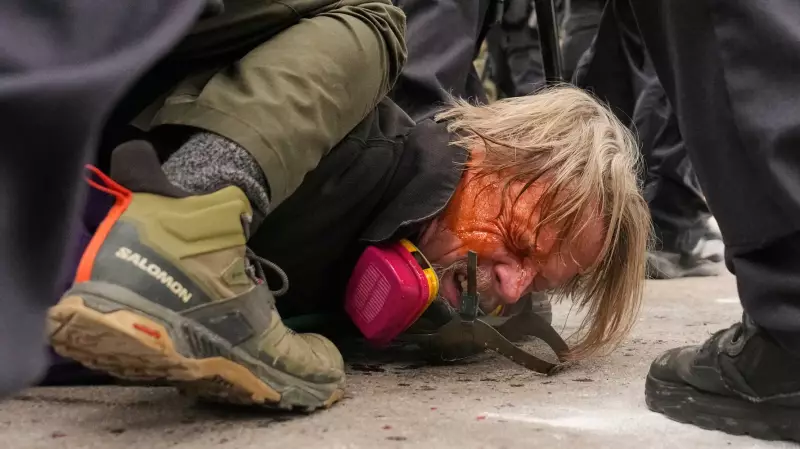
John Abernathy, a photographer based in Minneapolis, found himself pinned to the ground with the knees of at least one federal officer pressing into his back. As commands to place his hands behind his back echoed around him, his arms remained partially trapped beneath his body. The scene was chaotic, with dozens of officers deploying what he believes was tear gas, creating a thick haze that impaired vision and made breathing a struggle. Nausea and the threat of losing consciousness loomed large in his mind.
A Split-Second Decision to Protect Vital Evidence
Amidst the confusion, Abernathy's primary fear crystallized: the potential confiscation of his photographic equipment by federal agents. In a moment of quick thinking, he locked eyes with another photographer nearby. Without hesitation, he hurled his camera – a Leica M10-R fitted with a 28-millimeter lens – toward his colleague. Shortly after, he pitched his cellphone away from his body as well.
Fellow photojournalist Pierre Lavie, a member of the National Press Photographers Association who had traveled from New Orleans to cover the unrest, managed to snatch the Leica by its strap and secure it. As he reached for Abernathy's phone, which had landed just a couple of feet away, a federal officer attempted to stomp on it repeatedly. "I had to Hungry Hippo my hand in and out to avoid my hand getting stepped on, and I managed to finally grab it and get it away," Lavie recounted in an interview.

The Context: Documenting ICE Crackdowns and Protest Tensions
This tense scenario was, unfortunately, familiar territory for both journalists. Abernathy, whose previous work includes assignments for advertisements and magazines, had set out to document protests in Minneapolis. These demonstrations were sparked by Immigration and Customs Enforcement's crackdown in the city and the killing of Renee Good. His mission was simple: to show the unfolding events to a wider audience.
The incident occurred on Thursday, January 15, outside the Bishop Henry Whipple Federal Building in Minneapolis. This facility has recently been used to hold individuals detained by ICE officers. Abernathy reported seeing what he described as "agitators" – pro-ICE demonstrators – carrying bear spray. Concerned for his safety, he grabbed a can from someone and discarded it to prevent it from being discharged near him.
He speculates that this action led federal agents to target him. They allegedly yelled that they saw him spraying the crowd, though Abernathy maintains they provided no evidence to support this claim after handcuffing him and taking him inside the federal building. He received a citation but has not yet been given a court date.
A Terrifying Struggle and Echoes of Past Tragedies
As federal agents restrained him on the ground, Abernathy fought for breath. "I couldn't breathe. I screamed my name because I didn't know what was about to happen, and I also sort of subconsciously screamed 'I can't breathe,' and right when it came out, I thought of George Floyd, and I thought, 'Oh shit, this is getting real,'" he said, drawing a chilling parallel to the 2020 killing that ignited global protests.
Lavie, who has traveled extensively across the United States in recent months to document ICE activities, observed that officers in Minneapolis exhibited harsher tactics than those he witnessed elsewhere. He cited examples such as shooting pepper spray into vehicle air intakes to force occupants out. "They're very threatening right away, instead of de-escalating a situation," Lavie noted. He expressed deep concern over this approach, adding, "Their unprofessionalism worries me as an observer because I just see it as a short distance to travel to having somebody really hurt. It's reckless and dangerous."
Injuries and a Determined Recovery
Abernathy sustained multiple injuries from the encounter, including a chemical burn in his eye, wounds from pepper bullets, and abrasions from being forced to the ground. Remarkably, after being released from custody, he did not immediately seek hospital treatment. Instead, his first priority was to locate his missing phone and camera.

Disoriented from the chemical agents used on him, he had no clear memory of who might have retrieved his equipment. "I found some guy with a bullhorn, and I asked him to walk up and down and ask if anybody has my camera, and nobody had it," he explained. He enlisted his wife's help to use the Find My iPhone feature, while Lavie had already passed the equipment to another journalist. That colleague attempted to locate the owner using contact information from the phone's Medical ID.
The two photographers finally reunited at a hotel, meeting in person for the first time. "He hopped out of the car and gave me a big handshake and a hug and said, 'thank you so much,'" Lavie recalled, describing Abernathy as "a little beat up, but he's obviously a tough dude and quick-thinking, and he seemed good."
Retrieving the Story and Moving Forward
Only after retrieving his camera did Abernathy visit a hospital. There, he discovered the last few images he had captured before being taken down by officers – poignant frames of the protest scene. Despite his ordeal, Abernathy reported feeling fine overall, though he acknowledged lingering effects: fatigue and a constant, unexplained shakiness. "I don't know if it's a nervous system response to stress or something with tear gas or what," he mused.
Lavie noted Abernathy's resilience, observing that he was back out documenting events by Saturday, just two days after the Thursday confrontation. "We don't like to stop," Lavie stated simply.
For Abernathy, the experience was a first: he had never before been tackled, handcuffed, or pepper-sprayed. Yet, his commitment to his work remains unshaken. "The world needs to see it, not just people here," he asserted, "because the whole world has to come down on this." His determination underscores the vital role of photojournalists in bearing witness to contentious moments in public life, even at significant personal risk.