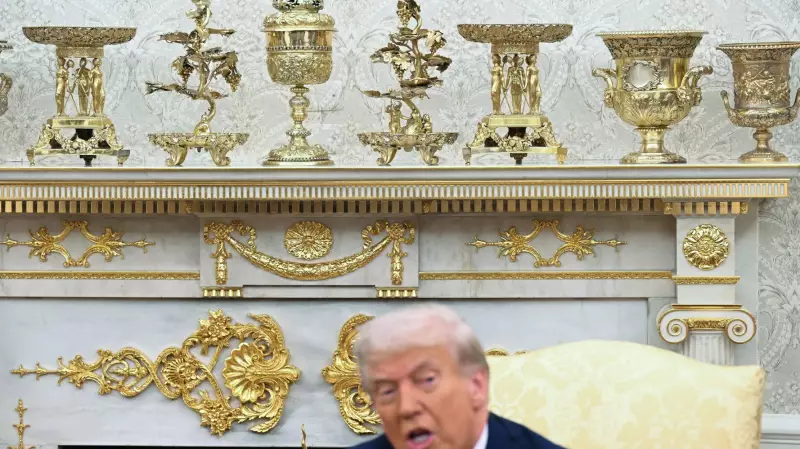
The recent and dramatic overhaul of the White House's Oval Office under President Donald Trump has ignited a firestorm of attention and criticism. The extensive use of gold ornamentation, alongside renovations to the presidential bathroom and a controversial ballroom project, introduces a distinctive aesthetic that many experts argue fundamentally conflicts with the historic building's architecture.
A Clash of Styles: Versailles Meets the People's House
Interior designers and art historians consulted for this analysis were nearly unanimous in their assessment. Sarah Boardman, an interior designer, stated her first impression was that the redesign "completely ignored the architecture it sits inside." She explained that the White House is a blend of Palladian and Georgian neoclassical design, featuring restrained Irish influences, soft curves, and elegant proportions.
"This redesign goes in the opposite direction," Boardman continued. "The gold isn't integrated into the architecture—it's layered on top of it." She and others noted the new decor has far more in common with French Baroque and Rococo styles, specifically the era of Versailles, than with the White House's actual design lineage. Art historian Robert Wellington, author of a book on luxury and power from Louis XIV to Donald Trump, confirmed this connection.

"Trump has long shown an interest in the Louis XIV style," Wellington said. He sees Trump drawing from a tradition of European palace design meant to signal princely magnificence, a strategy later adopted by America's Gilded Age elites. Interior designer Kelley Wagner also drew parallels to images of Vladimir Putin's purported residence, noting both are 'palaces' not designed as public spaces.
Symbolism of Spectacle Over Substance
Experts believe the primary goal of the gold-heavy design is to create a spectacle that conveys wealth, power, and a specific personal brand. Zoe Warren, an interior design expert, noted that throughout history, heavy gold use has been designed to convey wealth and power. "For Trump, the use of gold is about conveying a sense of success in both business and politics," she said.
This approach, however, transforms the space from a working office into a theatrical set. Boardman likened the effect to casinos, which use high-gloss gold to create a sense of spectacle and heightened reality. She pointed out the addition of elements like red ropes and staged lighting, which make the room read "more like a soundstage than the People's House."
Wellington highlighted the performative quality. "Trump can hold meetings with a foreign leader in front of the mantle that he's decorated with all the gold trappings, and it's the backdrop for his performance of a successful businessman who is now president," he explained.
Philosophical and Aesthetic Disconnect
The criticism extends beyond mere taste to a philosophical disagreement about the room's purpose. Boardman emphasized that the Oval Office is a public room and the inner sanctum of American leadership, historically designed to project restraint, steadiness, and quiet confidence. Trump's redesign, by contrast, communicates "exclusivity and hierarchy" and suggests the public no longer has a place there, she argued.
Interior designer Liz Potarazu observed a disconnect between the intended projection of prestige and the actual effect. "It reads less like confident leadership and more like performative authority, an aesthetic of dominance rather than an office grounded in collaboration and policy-building," she said.
Several experts also critiqued the specific execution. Diana Lombard, an interior designer, argued that the high-shine, plated gold appears showy rather than distinguished. "Real brass has depth, variation and subtlety... and more accurately represents craftsmanship and true luxury," she noted. Others pointed out that some decorative elements resemble inexpensive polyurethane decals available on mass-market websites.

Divergence from Modern Design Trends
The Trump administration's aesthetic also stands in stark contrast to contemporary design movements. Lombard suggested the visceral public reaction is partly because the redesign diverges so drastically from current trends. "In a world saturated with AI and social media... people are gravitating toward natural, organic materials and textures that convey authenticity," she said.
Boardman noted that contemporary design has moved toward softer palettes, matte finishes, and calm, grounded spaces. Trump's Oval Office, she said, has more in common with luxury casinos and themed resorts than with any current design movement. Potarazu observed a strong industry shift toward 'quiet luxury' and timeless metals, describing the Oval Office look as quintessentially 'new money.'
Ultimately, experts conclude the design reflects Trump as a brand rather than a leader of people. Isabella Segalovich, a designer and artist, summarized that the most telling aspect of Trump's design sense is "not that it's flamboyant, but rather, that it's soulless." The redesign prioritizes personal iconography and a demand for attention over the historical weight and public purpose of one of America's most symbolic rooms.