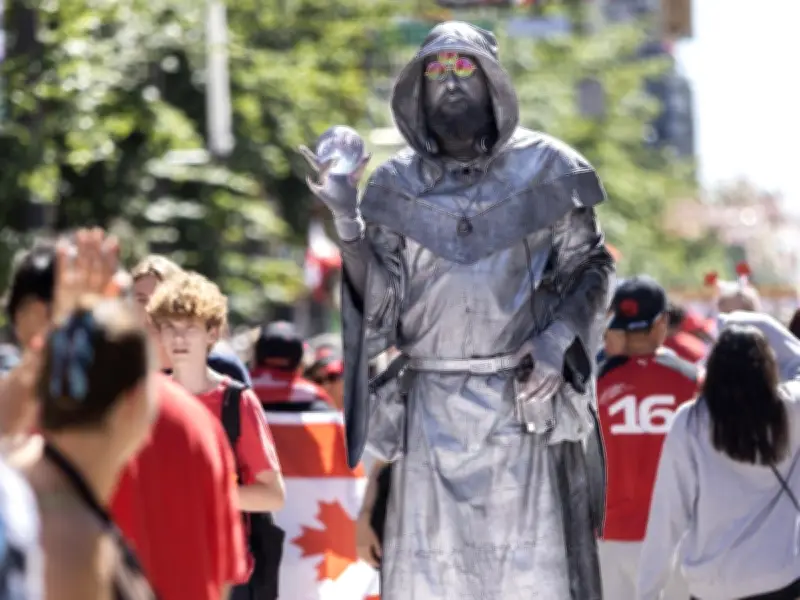
Vancouver street busker Araucaria Ever Green, known as the Silver Sorcerer, stood motionless on Granville Street one afternoon in June, frozen as a living statue while thousands of World Cup soccer fans streamed past. Fellow performer Cole Schisler, 29, a freestyle rapper, dropped a $5 bill into Ever Green's donation bucket—which read “your donation gives me life”—and asked for permission to set up under a nearby theatre marquee. Without breaking character, Ever Green, 41, slowly gave a mechanical thumbs-up.
Informal system under strain
Among Vancouver’s street performers, an unwritten rule of first come, first served applies. But with an estimated 350,000 spectators descending on the city for the World Cup, that informal system has scaled up dramatically. Musicians, painters, living statues and acrobats have spread across downtown, turning sidewalks into stages and drawing some of the largest crowds many have ever seen.
Performers say the tournament has exposed both the demand for street art and a gap in how the city supports them. They argue Vancouver’s system—built around permits, restrictions and designated locations—hasn’t kept pace with the scale of demand during major events.

Need for structured integration
“Here, when people think of street performers, they think you’re just a person on the street begging for cash,” said vocal artist Sam Chimes, 37, who has busked in Vancouver for eight years, blending jazz, hip-hop and Afro-beats. “Street performers are part of the infrastructure of a city. It paints a city, whether through live shows or art, and there needs to be some sort of structure to support that throughout the city.”
Chimes was hired by FIFA to entertain fans along the “Last Mile” spectator route to B.C. Place on the False Creek seawall. This area is one of the few stretches where busking is typically allowed without a permit, but during the Cup it became permit-only, along with Library Square and Science World. Chimes said his performance pushed close to the city’s 70-decibel limit. “I pushed my speaker’s limits,” he chuckled.
Permit costs and restrictions
Chimes, who regularly performed at Waterfront SkyTrain Station and other downtown locations before the tournament, noted the opportunity highlights the calibre of local talent. “FIFA gave me a tent with my name on it,” he said. “Since that gig, people from all around have been recognizing me.”
In Vancouver, buskers operate under a controlled system of designated areas and restrictions to manage congestion and noise. Performances are limited to one hour per spot, and vocal amplification is banned. Instrumental amplification is allowed only through low-volume, battery-powered systems. The city tightened rules for the World Cup, requiring permits on more city sidewalks and banning performances near several major transit hubs and tournament venues. Chimes and other local buskers paid $53.59 for a four-month permit to perform on city sidewalks during the Cup, plus $75 to busk inside SkyTrain stations.
Call for civic programming
Performers say Vancouver should consider more structured integration of street art into civic programming, similar to models in other cities. The World Cup has demonstrated that street performers can draw record crowds and enhance the urban experience, but the current permit system is outdated for large-scale events. As the city rethinks its approach, buskers hope for a framework that recognizes their role in the city’s cultural infrastructure.