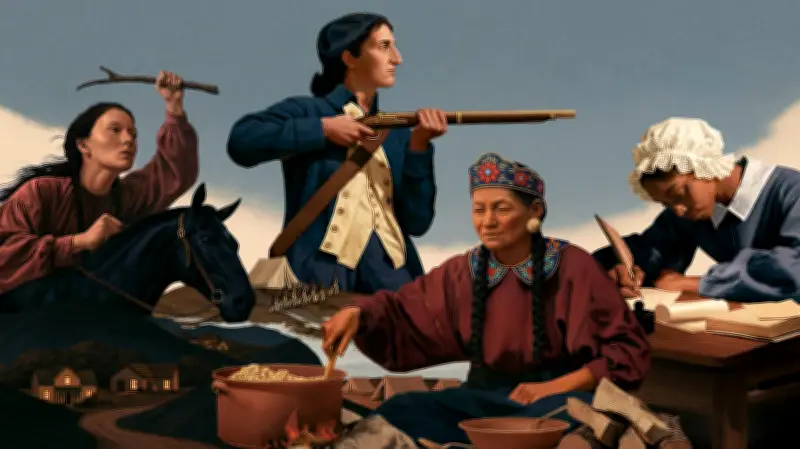
Women's Contributions to the American Revolution
As the United States marks 250 years, Americans would be remiss to celebrate without reflecting on the people who got us here. The Founding Fathers are due their credit, of course. They were the well-known politicians, brave military men and bold thinkers who led our country through the Revolutionary War, formed a new system of government and shepherded the United States to freedom. But where were the women? Turns out they were right there all along.
Thousands of women contributed to the American Revolution, though history tends to forget their stories. Their efforts might not have made it into textbooks or resulted in buildings being named after them, but our Founding Mothers helped build the United States too.
Deborah Sampson: The Woman Who Disguised Herself as a Man to Fight
In 1782, 21-year-old Deborah Sampson disguised herself as a man so she could enlist in the Continental Army. She had tried to join once before but was caught, scandalizing her town. The second attempt was a success. Sampson called herself “Robert Shurtliff” and served alongside fellow soldiers in the 4th Massachusetts Regiment. She scouted territory, conducted raids and fought in skirmishes as part of her role in a light infantry company. Months after enlisting in the Army, Sampson helped lead 30 men during a raid on a British loyalist’s home. There, Patriot forces captured 15 men.

Sampson kept her true identity hidden for more than a year, though not without difficulty. During a skirmish, she was struck by a sword and shot in the leg. Rather than be treated for her injuries and risk revealing her true identity, Sampson pulled out the shrapnel from her own body. Some accounts suggest she was unable to remove it all and lived with musket ball shards embedded in her thigh.
Sampson’s ruse lasted until she became sick during an epidemic and was brought to a hospital, where she later lost consciousness. Despite the secrecy, Sampson’s contributions to the war effort could not be questioned. She was given an honorable discharge and returned home to Massachusetts. Sampson would later become the only woman to receive a full military pension for her service in the Revolutionary War, though she didn’t live to see the money. Sampson died in 1827, but her husband petitioned the government to collect payment as a veteran’s spouse. Congress agreed on the grounds that the war “furnished no other similar example of female heroism, fidelity and courage.”
Phillis Wheatley: Poet and Patriot
Phillis Wheatley, the first African American woman to publish a book of poetry, first came to America aboard a slave ship in 1761. She had been kidnapped from West Africa at just 7 years old. She was purchased by the Wheatley family in Boston and learned to read and write English in their home. Her talents were recognized early on, and she wrote poems that appeared in local newspapers by her early teens. In 1773, Wheatley published “Poems on Various Subjects, Religious and Moral” in London and became a free woman shortly after.
Wheatley’s work in the late 1700s was both brilliant verse and powerful political statement. A believer in the Patriot cause, she glorified the military but also argued for abolition alongside American independence. In her poem “On the Death of General Wooster” (1778), she wrote: “But how, presumptuous shall we hope to find / Divine acceptance with th’ Almighty mind – / While yet (O deed ungenerous!) they disgrace / And hold in bondage Afric’s blameless race?”
After gaining international acclaim, Wheatley sent a poem directly to Gen. George Washington in 1775. “His Excellency General Washington” not only boosted morale but also encouraged more troops to join the Patriot effort. Washington applauded the poem and Wheatley in a response, even inviting her to meet him at his headquarters. Wheatley would continue to write in support of American independence for the duration of the Revolutionary War. To publish anything in support of the Patriots was considered treason against the British crown. As a Black woman in America, the risk to Wheatley was tenfold — but she put her life and liberty on the line anyway.

Polly Cooper: The Oneida Woman Who Fed Washington's Troops
Polly Cooper was a woman from the Oneida Indian Nation, the indigenous community that considers itself “America’s first ally.” In 1778, she trekked more than 250 miles to bring aid to Washington’s troops at Valley Forge. The Oneidas sided with the Patriots during the Revolution, and Washington had requested help from Native American scouts who were familiar with the land. Cooper joined more than 40 Oneida warriors on the journey from upstate New York to southern Pennsylvania. The group is said to have brought somewhere between 60 and 600 bushels of white corn with them to feed the troops, who had endured a harsh winter and were near starvation.
Once she arrived at Valley Forge, Cooper prepared meals for the troops and taught them how to cook the corn themselves. The food was likely a boon for the soldiers, who otherwise had measly rations. Oneida oral legend says that, along with the group of warriors, Cooper refused any payment for the supplies or her help. But on a trip to Philadelphia, she admired a shawl in a store window. Washington’s wife, Martha, later gifted the shawl to Cooper in a show of gratitude. To this day, it remains in the possession of Cooper’s descendants.
Sybil Ludington: The Female Paul Revere
In 1777, 16-year-old Sybil Ludington rode her horse through the night to warn hundreds of people that British troops were approaching. The mission was reminiscent of Paul Revere’s famed midnight ride two years prior, except Ludington rode her horse through pouring rain for 42 miles — more than three times the distance that Revere traveled. Ludington’s father, a colonel in the Army, got word that British troops were traveling to Danbury, Connecticut. They planned to lay siege to the city, where the Continental Army had a stockpile of supplies.
Catching up to the Tories would prove difficult. Col. Ludington’s troops were largely made up of farmers turned militiamen. They had already disbanded for planting season, during which military campaigns were often paused. While her father strategized, Ludington took off into the night, banging a stick against homes to warn: “The British are burning Danbury!” Her efforts helped rally the separated troops, and while they couldn’t save Danbury, Patriot troops were able to push the British back to Long Island Sound.