Centennial of Black History Month Highlights Enduring Struggle and Local Heroes
As Black History Month reaches its 100th anniversary milestone, two prominent Montreal advocates from different generations and backgrounds are united in their message: resistance remains as crucial today as it was a century ago. Hip-hop artist and historian Aly Ndiaye, known professionally as Webster, and author-activist Fred Anderson may have followed distinct paths, but they share a profound commitment to advancing Black history and confronting contemporary challenges.
Celebrating a Pioneer: The Gloria Clarke Baylis Exhibition
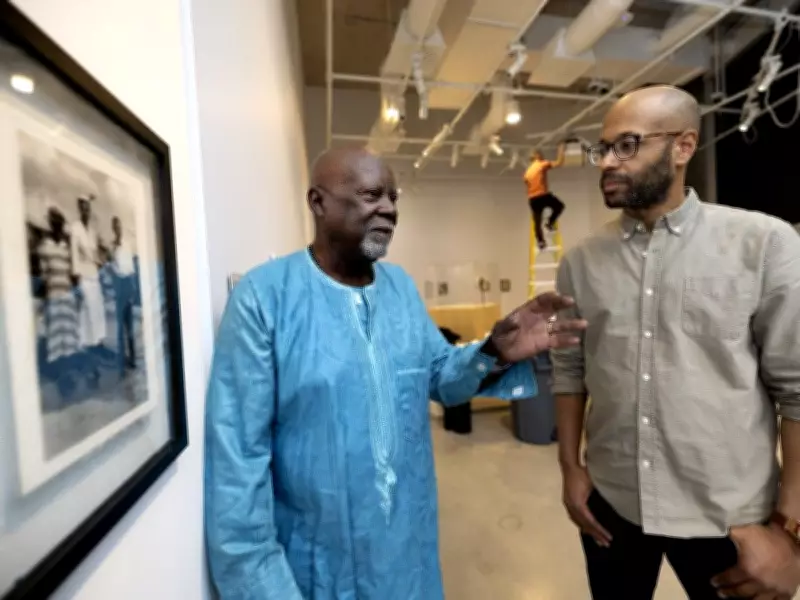
Aly Ndiaye has meticulously curated an exhibition titled Triomphe: The Story of Gloria Clarke Baylis, which runs until March 8 at Montreal's Centre Sanaaq. This retrospective commemorates not only the 100th anniversary of Black History Month but also its 35th year in Montreal. Through a rich tapestry of archives, photographs, illustrations, and personal artifacts, the exhibit offers an immersive look into the life of Clarke Baylis, a Barbadian nurse who evolved into a civil rights trailblazer and successful entrepreneur in Quebec.
Clarke Baylis, who passed away in 2017, was the mother of Frank Baylis, a notable contender in last year's federal Liberal leadership race. Her story exemplifies the resilience and contributions of Black Canadians, serving as a powerful reminder of the local history that often goes unrecognized.

Bridging Generations: The Friendship of Ndiaye and Anderson
Fred Anderson, a somber yet insightful observer at the exhibition, praises Ndiaye's work, reflecting a deep bond that has formed between the two over recent years. Despite their disparate origins—Ndiaye, 46, is a Quebec-born hip-hop artist and historian, while Anderson, 78, is a Mississippi native and former Student Nonviolent Coordinating Committee field secretary—they converge on a shared vision for the future.
Anderson's journey brought him to Montreal in 1966 as a Vietnam War resister, where he lived under the alias Clifford Gaston until 1977. He has since become a respected community spokesperson and activist. His newly published memoir, Eyes Have Seen: From Mississippi to Montreal, provides an unflinching account of growing up Black and impoverished in the segregationist South, his involvement in the civil rights movement alongside figures like Martin Luther King, and his life in Canada. Ndiaye is currently translating the book into French, a testament to their collaborative spirit.
"I owe a tremendous amount of gratitude to Aly," Anderson acknowledges. "When I was finishing the book and pursuing a publisher, I sent the manuscript to Aly, who immediately took it to Baraka Books and championed it to them. So that's how I was able to get it published."
The Imperative of Resistance in Modern Times
Both advocates stress that resistance is not a relic of the past but a vital tool in today's societal landscape. Anderson articulates this perspective with clarity: "The principal thing we've both learned over the years is that resistance matters, and I think that the lesson people have to carry is that resistance will mean even more under our daily circumstances," he states. "We are truly going through the looking glass here. I'm discouraged by what I see, but I'm not resigned."
He emphasizes that Black History Month should transcend mere celebration, linking historical lessons to actionable resistance and progress maintenance. "One of the messages I have been giving to Black youth over the last 20-plus years is that it's a mistake to take for granted the gains that have been made and yet not to be fully aware of the danger that progress can be stopped and that the price people have paid could be rolled back," Anderson adds.

Ndiaye echoes this sentiment, drawing from his own experiences with Islamophobia and racial profiling in Quebec City. "Racism is racism no matter when or where it occurs," he asserts. "Fred and I have lived different kinds of lives, but being Black in North America, there are lines where our lives intersect. In order to resist, we need to be informed and we need to be inspired. Resistance was the tool against slavery. Now it is required when it comes to everything from organizing in the community to the arts to taking a stand."
Fostering Local Black History Awareness
Ndiaye is passionate about bridging the gap between international and local Black history. While he has long been fascinated by the U.S. civil rights movement, he now focuses on elevating Montreal's own narratives. "But now Fred's story has become part of Black history in Montreal," Ndiaye notes. "What I'm trying to do with all my projects is to teach people about local Black history. We tend to follow what's going on in the United States, but we don't know our own Black history here. My goal is to connect that part of our Black history, relating both to anglos and francos, to all Black history, because too often here there is a disconnect."
Anderson has fully embraced his life in Montreal, becoming a devoted Canadiens fan and learning to skate, symbolizing his integration into the city's fabric. "When I first came here, I pined for the day I could return to the United States and Mississippi. And when Jimmy Carter declared the amnesty in 1977, I made that first trip back home and I knew within days that Mississippi and the United States was no longer my home. I will forever be away and forever be in Canada," he reflects.
Upcoming Engagements and Events
The duo will continue to share their insights through various Black History Month events:
- Aly Ndiaye will speak on February 8 at 2 p.m. at Bibliothèque du Plateau-Mont-Royal.
- Fred Anderson will deliver a lecture on February 9 at 2 p.m. at Concordia University's J.W. McConnell Building.
- They will appear together in conversation on February 12 at 6:30 p.m. at Librairie Livresse.
Additional recommended events include performances by Ensemble Obiora, soprano Marie-Josée Lord, film screenings at the National Film Board, and shows by Les Ballets Africains, all contributing to a rich tapestry of cultural celebration and education.
As Black History Month enters its second century, the voices of Ndiaye and Anderson remind us that honoring the past necessitates active engagement in the present, ensuring that the legacy of resistance and progress endures for generations to come.