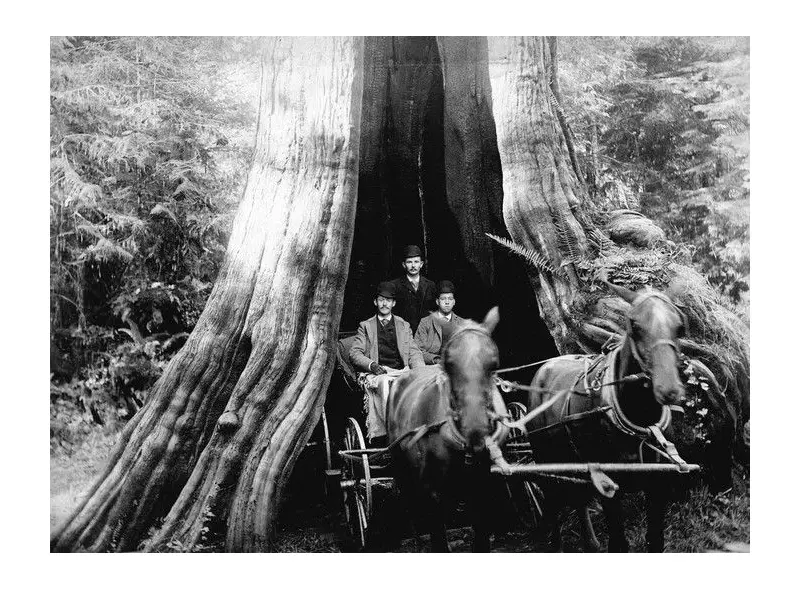
Banker's 1936 Critique Targets Vancouver's Beloved Hollow Tree
On January 24, 1936, the Vancouver Sun reported a surprising attack on one of the city's most iconic natural landmarks. W.M. Sellens, a banker with the Imperial Bank of Canada, wrote to the Vancouver park board with a blunt assessment of Stanley Park's famous Hollow Tree.
Describing the ancient western red cedar stump as "an eyesore," Sellens argued that the tree had "outlived its attraction." He urged officials to remove road signs directing tourists to the site and instead promote living trees within the park.
Park Commissioners Agree With Critical Assessment
The park commissioners surprisingly agreed with Sellens' assessment. According to contemporary reports in The Province newspaper, commissioners stated that "the tree is only a glorified stump" and that calling it the "Big Tree" on signage was a misnomer.

This criticism came during Vancouver's 50th anniversary celebrations, known as the Golden Jubilee. Despite financial constraints during the Great Depression, the city and park board were seeking improvements throughout Stanley Park to mark the occasion.
Newspaper Editorial Defends Historic Landmark
The Vancouver Sun published an editorial defending the Hollow Tree with nostalgic language. "The Hollow Tree has gone to its fathers, to become one of the legends of time," the editorial stated, while acknowledging that thousands of living giant trees remained in Stanley Park.
The editorial suggested that among these living giants, "a fit successor for the grizzled old chief" could be found to replace the decaying stump that had made "the world stop and wonder."
From Tourist Attraction to Controversial Monument
The Hollow Tree became a popular tourist destination after 1889 when the first road was completed around Stanley Park. Its convenient location near the English Bay side provided easy access for visitors.
What made this particular tree special was its unique hollow interior, large enough to accommodate several people, or even a horse and buggy. While other impressive trees existed in Stanley Park, including a group known as the Seven Sisters, the Hollow Tree's distinctive character made it the park's primary tourist draw.
Modern Preservation Efforts and Continued Debate
The sign directing visitors to the Hollow Tree was presumably removed following the 1936 controversy, and the tree continued to weather and shorten over the decades. However, it never lost its public appeal.
When a storm damaged the tree in December 2006 and the park board voted for its removal, public outcry forced reconsideration. In June 2009, the 13-meter tall stump was stabilized with metal rods and straightened using a crane.
Bruce MacDonald of the Hollow Tree Conservation Society explained the preservation perspective: "We say it's not a tree in the woods, it's not a tree from nature. It's dead. It's always been a monument to trees that used to cover all of Vancouver."
Ongoing Controversy Over Conservation Priorities
Not everyone supported preserving the approximately 1,000-year-old stump. Dale Laird wrote to The Province expressing strong opposition: "It is nothing more than a glorified piece of firewood — a disgrace to the park. And we are a disgrace to humanity for spending money on it, instead of on more parks and amenities for Vancouver's Downtown Eastside."
This 1936 episode reveals how Vancouver's relationship with its natural landmarks has always involved tension between practical concerns and sentimental attachment. The Hollow Tree, despite being declared an eyesore nearly nine decades ago, continues to stand as a testament to the city's complex relationship with its natural heritage.