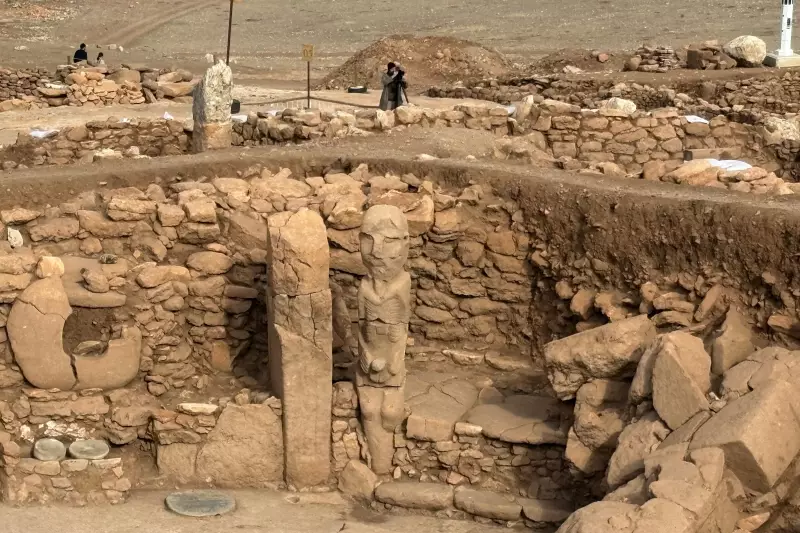
Archaeologists in southeastern Turkey have made a significant discovery that is reshaping our understanding of early human communities. At the site of Karahantepe in Sanliurfa, researchers have unearthed a collection of ancient carved faces and statues, providing unprecedented insight into the social structures and artistic practices of a Neolithic society.
A Monumental Discovery at Karahantepe
The findings, which include a detailed pillar and a human statue, were documented on site on November 26, 2025. The Karahantepe site is part of the Taş Tepeler region, a collection of Neolithic settlements that is often described as the "zero point of history" due to its age and significance. The carved faces, with their expressive and detailed features, are believed to be more than 11,000 years old, dating back to a time when humans were transitioning from hunter-gatherer lifestyles to settled farming communities.
This discovery is not merely an artistic curiosity. Experts suggest that the scale and sophistication of the carvings indicate a highly organized society with complex social rituals and a shared belief system. The effort required to create such monuments implies a level of social coordination and specialized labour previously underestimated for this era.

Redefining Neolithic Social Complexity
The artifacts from Karahantepe challenge previous assumptions about Neolithic life. The presence of large, communal structures and monumental art points to a society capable of large-scale collaboration. The carved human faces and figures may represent ancestors, deities, or community leaders, offering clues about the spiritual and hierarchical frameworks of these early people.
Researchers are particularly interested in what these finds say about social identity and community cohesion. The deliberate act of creating and displaying these faces in a shared space suggests a collective consciousness and a desire to document or honour specific individuals or concepts, marking a profound step in human cultural development.
Implications for Global Archaeology
The ongoing excavations at Karahantepe and surrounding sites continue to position southeastern Turkey as one of the most important centres for understanding the dawn of civilization. Each discovery adds a new piece to the puzzle of how humans began to build permanent settlements, develop agriculture, and create complex social networks.
For archaeologists and historians worldwide, the carved faces serve as a powerful reminder of the Neolithic period's innovation. They underscore the idea that our ancestors were not merely surviving but were actively engaged in creating meaning, expressing identity, and building communities through shared artistic and architectural endeavours. The work at Karahantepe ensures that the story of humanity's earliest chapters is still being written, one remarkable discovery at a time.