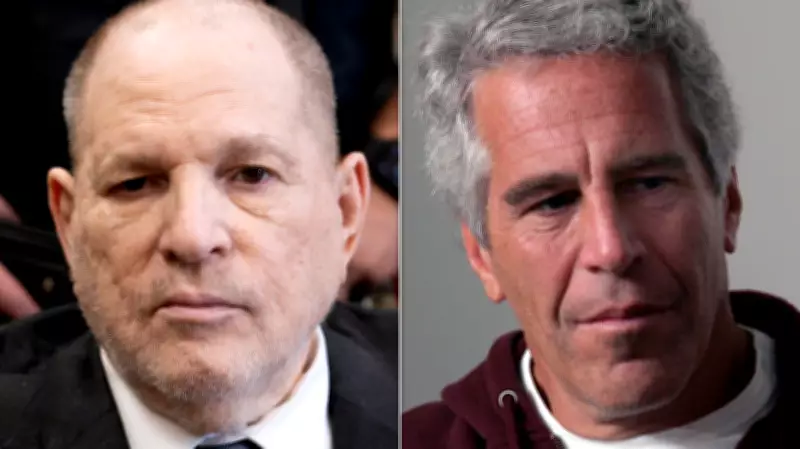
Harvey Weinstein Denies Close Ties to Jeffrey Epstein in Prison Interview
Disgraced movie producer Harvey Weinstein has attempted to minimize his connections to the late financier Jeffrey Epstein in a comprehensive new interview with The Hollywood Reporter, despite mounting evidence suggesting the two convicted sex offenders were far from strangers.
Weinstein's Direct Denials
During the prison interview published on Tuesday, Weinstein was asked directly if he knew Epstein. He responded, "No. I maybe ran into him once or twice. He didn't travel in my circles. We certainly were not friends."
Weinstein further distanced himself when the interviewer compared the media attention both men received and inquired whether Weinstein believed Epstein might have been "unfairly accused" of sexual predation, similar to Weinstein's long-standing claims about his own case.

"No. I just know what I read in the papers — I can't say one way or another," Weinstein stated. "I don't have a lot of faith in the media. Or prosecutors, either. But the crimes he's charged with are really awful. They're nothing at all like mine."
Contradictory Evidence Emerges
Despite Weinstein's denials, substantial evidence indicates the men inhabited overlapping wealthy and powerful social circles. Both were part of a group of investors who attempted to purchase New York magazine in 2003, and each maintained close ties to publicist-turned-Hollywood-exile Peggy Siegal.
Siegal recently told New York magazine that the film producer "hated Jeffrey," though she did not elaborate on the reasons behind this animosity. While Siegal never formally represented Epstein, Department of Justice files released in the Epstein investigation include over 5,000 emails between the two. In one correspondence, Siegal describes her client as a "world-class bully."
Siegal revealed she even attempted to leverage Epstein's relationship with Andrew Mountbatten-Windsor, the former British prince, to secure royal family exposure for Weinstein's 2010 film The King's Speech, though she apparently did so without Weinstein's knowledge.
Allegations of Direct Conflict
Attorney Brad Edwards, who represented late Epstein accuser Virginia Giuffre, claimed in his 2020 memoir Relentless Pursuit that Epstein and Weinstein experienced a significant falling-out. According to Edwards, the conflict occurred after Weinstein became physically aggressive with one of Epstein's "favorite girls" during a massage at Epstein's French apartment.
"Jeffrey viewed the aggressive mistreatment as disrespectful to him," Edwards wrote. "Jeffrey then came into the room, got in Harvey's face, and kicked him out of his house, delivering the message that he was never to come back."
Documentary Evidence of Connections
The Department of Justice's Epstein files contain multiple references to Weinstein, including:
- Records from an FBI informant alleging Epstein trafficked her to Weinstein
- Emails Epstein sent to top Kremlin official Sergey Belyakov requesting assistance silencing a woman who was allegedly attempting to blackmail "a group of powerful [businessmen] in New York"
- A handwritten note from March 2005 indicating Weinstein attempted to contact Epstein by telephone
- Multiple emails in which Epstein inquired about the sexual assault allegations against Weinstein that surfaced in late 2017
In one particularly revealing email, Epstein asked Brad Karp, then-chair of law firm Paul, Weiss, "How bad does the harvey weinstein story get?"
Weinstein's Current Legal Status
Weinstein remains detained at Rikers Island Correctional Facility while awaiting retrial on one of three rape charges overturned in 2024. During a separate retrial last June, he was reconvicted on one charge and acquitted on another. The third charge, scheduled for retrial beginning April 14, previously ended in a mistrial.
In a separate California case, Weinstein was found guilty in 2022 of rape, forced oral copulation, and third-degree sexual misconduct, resulting in a 16-year prison sentence.

While no criminal charges have resulted from the Epstein file allegations specifically, and Weinstein's attorney Arthur Aidala declined to comment on the FBI memo, the documentary evidence paints a picture of connections that contradict Weinstein's recent claims of minimal acquaintance.