Tom Brady's Sunday Social Media Activity Sparks 'Crush Fishing' Conversation
This past Sunday, former quarterback Tom Brady engaged in what many would consider typical weekend behavior: relaxing at home and sharing moments on social media. However, his posts quickly captured attention for their familiar, almost nostalgic quality that many social media users recognized immediately.
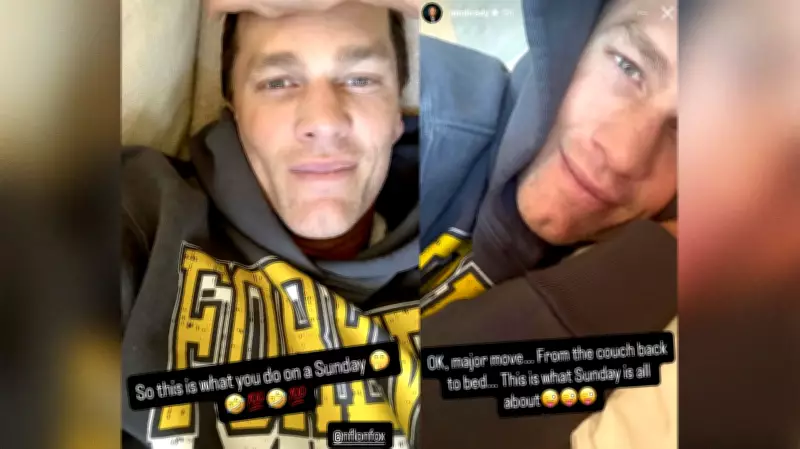
"So this is what you do on a Sunday," Brady wrote in his first selfie, accompanied by numerous emojis and The Killers' "Mr. Brightside" as background music. His subsequent post, which he later removed, featured another cozy selfie with the caption: "OK, major move... From couch back to bed...This is what Sunday is all about," complete with tongue-out emojis.
The 'Crush Fishing' Phenomenon Explained
Observers were quick to note that Brady's posts resembled behavior commonly called "crush fishing" - when someone shares content publicly that's actually intended to attract attention from a specific person while maintaining plausible deniability. This digital flirting strategy sits somewhere between subtle hinting and more overt "thirst traps."

"He's posting like a girl who has a crush," one X user commented, sharing screenshots that garnered over 83,000 likes. The observation tapped into a widespread recognition of this particular social media behavior pattern.
Relationship Experts Weigh In on Digital Flirting Strategies
Certified dating coach Sabrina Zohar explained to HuffPost that crush fishing represents "a way to shoot your shot without actually shooting your shot." She elaborated: "You're putting yourself out there just enough that if they respond, great - but if they don't, you have plausible deniability. 'That story wasn't for you.' But it was. And you know it was. And they probably know it too."
Julie Nguyen, a certified dating coach at Hily Dating App, described this behavior as "playful signaling" that functions like an "Easter egg" for the intended recipient. "Brady is doing something we do that feels familiar and human," Nguyen noted. "That looks like posting an Instagram story at a restaurant you know your crush likes, or doing a hobby they're interested in."
When Subtle Signaling Becomes Problematic
Both experts caution that crush fishing becomes concerning when it replaces direct communication entirely. "If someone is consistently posting for a specific person but never actually engaging with them, it stops being playful," Nguyen warned. "The flirting turns into a low-risk, low-vulnerability game. At that point, it's not confidence, it's avoidance masquerading as confidence."
Zohar identified the core issue: "The problem isn't the behavior itself - it's what it's replacing. If this is your warm-up before actually saying something, fine. But if this IS your strategy, you're practicing avoidance."
The Psychological Roots of Crush Fishing Behavior
According to relationship experts, this behavior stems from universal human impulses that have simply adapted to digital platforms. "These impulses always existed, just with less intensity," Nguyen explained. "People lingered in shared spaces. They dressed with a specific person in mind. They 'accidentally' showed up where a crush would be."
Zohar identified fear of rejection as the primary driver: "It appeals because rejection feels survivable this way. If they view your story and don't respond, you can tell yourself they just didn't see it as an invitation. Your ego stays intact."
Breaking the Crush Fishing Cycle
For those who recognize themselves in this pattern, experts recommend developing more direct communication skills. "We've confused being visible with being vulnerable, and they're not the same thing," Zohar stated. "Posting a cute selfie hoping someone sees it is not courage. Sending a message that says 'hey, I'm interested in you' is courage."
Nguyen suggested self-monitoring as a helpful strategy: "If you start monitoring reactions obsessively or if you're using posts to provoke jealousy or control attention, it's time to stop fishing and actually speak."

Both experts agree that occasional crush fishing isn't inherently harmful, but honesty with oneself is crucial. "If you're going to do it, at least be honest with yourself about what you're doing," Zohar advised. "Don't post the selfie and then pretend you weren't checking every two minutes to see if they viewed it. Own it."
Tom Brady's seemingly casual Sunday posts have inadvertently sparked a broader conversation about how we navigate attraction and connection in the digital age, revealing that even celebrity social media behavior can reflect universal human experiences with modern dating dynamics.