A Russian court has delivered a landmark ruling against the internationally recognized punk protest collective, Pussy Riot, formally branding it an extremist organization. The decision, handed down on December 15, 2025, represents one of the most severe legal designations available under Russian law and signals a dramatic intensification of the state's campaign against political dissent and activist groups.
The Court's Decision and Its Immediate Impact
The ruling by the Russian judicial body effectively outlaws Pussy Riot's activities within the country. The label of 'extremist organization' carries severe legal consequences, including potential criminal charges for anyone associated with the group. This move places Pussy Riot in the same legal category as banned terrorist groups, severely restricting its ability to operate and placing members and supporters at significant risk of prosecution.
The court's decision did not occur in a vacuum. It follows years of tension between the provocative art collective and Russian authorities. Pussy Riot first gained global notoriety in 2012 for a performance in a Moscow cathedral criticizing President Vladimir Putin, leading to the imprisonment of several members. Their activism, often blending punk music with political protest against government policies, has consistently challenged the Kremlin's authority.

Pussy Riot's Activities and International Presence
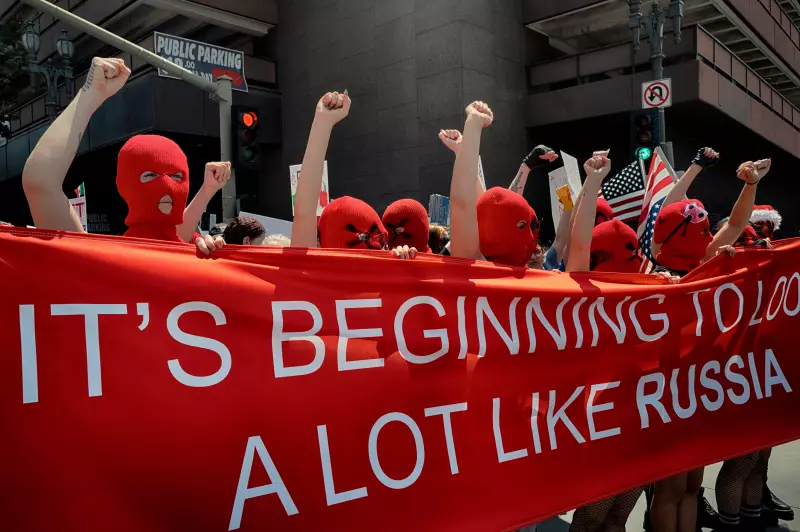
Despite facing persistent pressure at home, Pussy Riot members have remained active on the international stage. As recently as June 14, 2025, members were photographed participating in a 'No Kings' protest in downtown Los Angeles. In an image captured by AP Photo/Richard Vogel, they carried a sign directly referencing Russia, demonstrating their continued focus on political issues in their homeland even from abroad.
The group's methodology, which uses performance art and public demonstrations to critique authoritarianism, corruption, and the suppression of LGBTQ+ rights, has inspired activist movements worldwide. However, the Russian state has increasingly framed such dissent as a threat to national security and traditional values, paving the way for the extremist label.
Broader Context of Political Crackdowns
This ruling is part of a broader pattern of legal and extra-legal measures used to silence opposition within Russia. In recent years, numerous non-governmental organizations, independent media outlets, and opposition figures have been designated as 'foreign agents' or 'undesirable organizations,' facing fines, restrictions, and forced closures. The extremist designation for Pussy Riot is a more severe step in this continuum.
Legal analysts suggest the move is intended to create a powerful deterrent effect, not just against Pussy Riot, but against any form of artistic or political protest that the state deems subversive. It grants authorities sweeping powers to investigate and penalize any perceived affiliation with the group, potentially chilling a wide range of activist expression.
The international community, including human rights organizations, is likely to condemn the court's decision as a blatant infringement on freedom of expression and association. For Pussy Riot, the extremist label solidifies their status as exiles and marks a definitive end to any legal form of their protest within Russia's borders, forcing their struggle into an entirely new and more dangerous phase.