Grammys 2026: Stars' Political Protest Against ICE Draws MAGA Ire, Exposing Double Standards
The 2026 Grammy Awards in Los Angeles became a platform for political protest as numerous high-profile celebrities used the ceremony to speak out against the Trump administration's immigration policies. Artists including Billie Eilish, Kehlani, Joni Mitchell, and Justin and Hailey Bieber wore pins reading "ICE OUT" to denounce what they described as the violent actions of U.S. Immigration and Customs Enforcement.
Celebrity Voices Amplify Immigration Criticism
During her acceptance speech for Best R&B Performance, Kehlani delivered a powerful message to the audience, stating, "We are stronger in numbers to speak against all the injustice going on in the world right now." The artist continued, "I hope everybody is inspired to join together as a community as artists and speak out against what's going on. And I'm going to leave this and say, fuck ICE," as the crowd erupted in cheers.
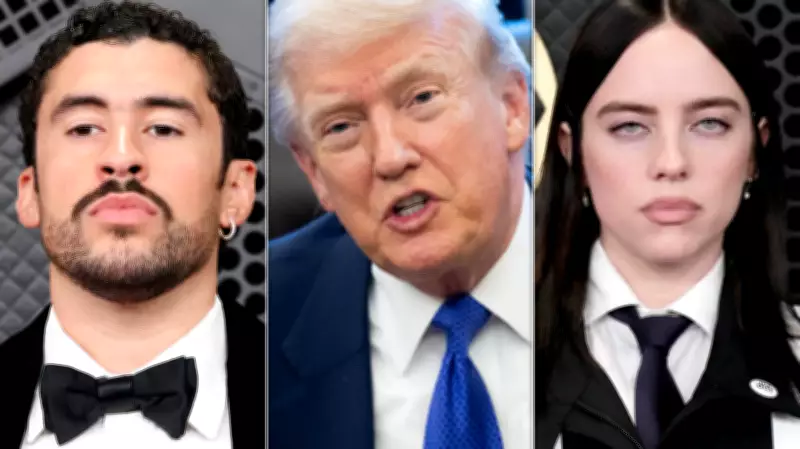
Billie Eilish echoed this sentiment when accepting the Song of the Year award, declaring that "no one is illegal on stolen land" before adding her own "Fuck ICE" statement. The political commentary extended to Bad Bunny, who accepted the Grammy for Best Música Urbana Album and condemned ICE directly from the stage. "Before I say thanks to God, I'm going to say: ICE OUT. We are not savage. We are not animals. We are not aliens. We are humans, and we are Americans," the Puerto Rican superstar proclaimed.

MAGA Backlash and Selective Outrage
Following the ceremony, numerous right-wing accounts on social media platform X criticized what they termed "Hollywood elites" for their political statements, dismissing the anti-ICE speeches as mere "political stunts." Many conservatives suggested that artists should confine themselves to entertainment and avoid political commentary altogether.
However, experts in political science and public humanities point to a significant hypocrisy in this criticism. Deepak Sarma, inaugural distinguished scholar in the public humanities at Case Western Reserve University, noted the irony in MAGA discourse that routinely condemns "Hollywood elites" while simultaneously investing heavily in celebrity as a form of political authority.
"Many of the most visible figures in the Trump era are themselves media elites," Sarma explained. "They are merely self-styled influencers, brand managers, and aspirational celebrities whose legitimacy is derived less from governance than from visibility."
Historical Context of Celebrity Politics
Sarma traced the phenomenon of celebrity politics in American conservatism back to the Reagan presidency, which "normalized the translation of screen charisma into executive authority." The scholar cited examples including former Alaska Governor Sarah Palin's "performative, media-saturated style of right-wing populism" and actor-turned-California Governor Arnold Schwarzenegger, whose "political appeal was inseparable from an exaggerated masculinity cultivated through popular culture."
This trajectory, according to Sarma, reached its most "explicit expression" in Donald Trump, "whose political credibility rested on a carefully staged television persona, one that presented the fantasy of business acumen while obscuring the reality beneath it."
Selective Embrace of Celebrity Endorsements
The selective nature of MAGA's criticism becomes particularly evident when examining their enthusiastic embrace of celebrities who support their cause. Alvin B. Tillery Jr., a professor of political science and African American studies at Northwestern University, observed, "Conservatives routinely rail against 'Hollywood elites' and celebrity political interventions — except when a celebrity can be framed as validating Trump. At that point, the critique disappears."
This dynamic is exemplified by the MAGA movement's recent celebration of rapper Nicki Minaj's support for Trump. Despite her past criticism of the president, Minaj has publicly aligned herself with the MAGA movement in recent months, appearing in videos on official White House accounts and speaking at administration events.

Academic Analysis of Political Hypocrisy
Tabitha Bonilla, an associate professor of political science and human development and social policy at Northwestern University, stated plainly that MAGA's criticism of celebrities making political speeches at the Grammys is "of course" hypocritical. "But pundits do hypocritical things, and this has long lent itself to a pattern of distrust of political elites by the public," she noted.
Bonilla emphasized that much of the conservative discourse fails to engage with the substantive criticisms of ICE or examine why there has been such a strong, visible response to the agency's actions. "By dismissing any reason that people might be upset, this becomes part of a tactic to draw attention away from why people are upset," she explained.
The Importance of Celebrity Political Engagement
Experts argue that celebrity engagement with political issues serves an important democratic function, particularly in times of political polarization. Bonilla stressed that "when the very basis of democratic accountability is under question, it makes perfect sense that celebrities and public figures engage these types of concerns."
She further warned that "silence — among celebrities and average citizens alike — can normalize democratic erosion in ways that make it more difficult to fight."
Shaun Harper, a professor of public policy, business and education at the University of Southern California, offered a demographic perspective, suggesting that "given its lack of demographic diversity, perhaps MAGA might find more support at the Country Music Awards. But not at the Grammy Awards."
Context of Recent ICE Actions
The Grammy protests occurred against the backdrop of recent controversial ICE actions, including the fatal shooting of 37-year-old mother Renee Good and 37-year-old ICU nurse Alex Pretti by federal agents in Minneapolis the previous month. Sarma suggested that MAGA's outrage over the Grammys stems partly from discomfort among those "within the GOP coalition who have begun, however tentatively, to question the moral coherence of MAGA politics, made more fragile thanks to the recent murders by ICE in Minneapolis."
Sarma characterized MAGA's angry reaction as defensive — "not as a response to what was said, but to the unsettling possibility that the spell might be weakening."
Civic Responsibility in the Public Sphere
Despite the controversy, Sarma emphasized that those with public visibility have a "civic obligation" to "use their platforms responsibly" by speaking out against concerning policies. "The United States finds itself at a critical juncture in its relatively short history," they stated. "When those with the loudest voices decline to speak, they do not remain neutral. Instead, they tacitly enable the conditions under which democratic institutions weaken."
The 2026 Grammys thus became more than a celebration of musical achievement — it transformed into a cultural battleground where questions of celebrity political engagement, immigration policy, and democratic discourse converged, exposing fundamental contradictions in contemporary American political rhetoric.