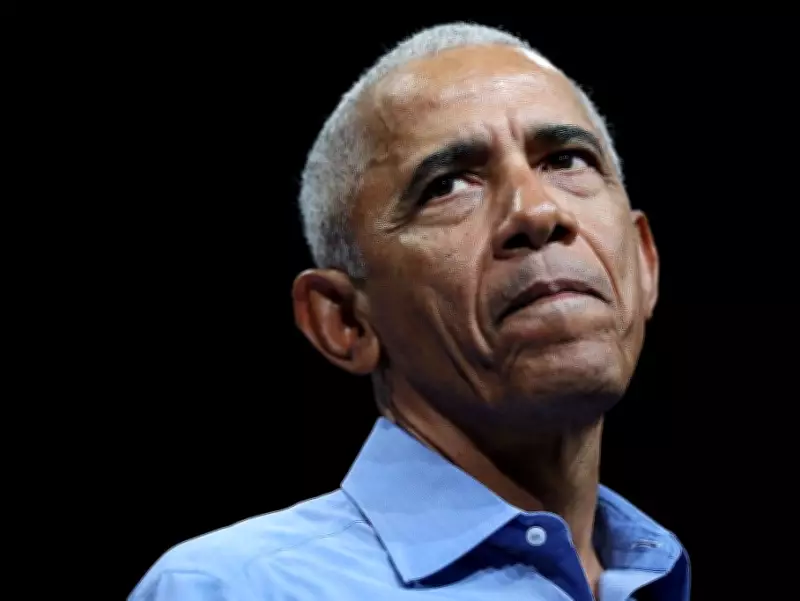
In a scathing critique, columnist Larry Elder has labeled former President Barack Obama as America's most influential race hustler, surpassing figures like Rev. Jesse Jackson and Rev. Al Sharpton. Elder's analysis centers on Obama's recent eulogy at Jackson's funeral, where he allegedly ignored the family's request to avoid politics and instead delivered a divisive message.
Obama's Eulogy Sparks Controversy
During the funeral service, Obama spoke out against what he described as a climate of fear and inequality in America, stating, "Every day you wake up to things you just didn't think were possible. Each day, we're told by those in high office to fear each other, and to turn on each other. And that some Americans count more than others." Elder argues that this rhetoric is consistent with Obama's long-standing pattern of injecting racial division into public discourse.
From Unifier to Divider
Elder recalls Obama's famous 2004 Democratic National Convention speech, where he declared, "There is not a Black America and a White America and Latino America and Asian America — there's the United States of America." This line initially inspired hope for racial unity, with polls in 2008 and 2009 showing that both Black and white Americans believed race relations would improve under his leadership.

However, by the end of Obama's presidency in 2017, surveys indicated that majorities or pluralities of both groups felt race relations had deteriorated. Elder attributes this decline to Obama's repeated use of the race card throughout his eight years in office.
Key Incidents Highlighted by Elder
Elder points to several specific events where Obama allegedly fueled racial tensions:
- 2009 Cambridge Incident: Obama criticized the Cambridge police for "acting stupidly" in arresting Harvard professor Henry Louis Gates Jr., turning a local encounter into a national debate on racial profiling.
- 2012 Trayvon Martin Case: Obama personalized the shooting by saying, "If I had a son, he'd look like Trayvon," despite a jury later finding the shooter not guilty and jurors stating race was not a factor.
- 2014 Ferguson Speech: At the United Nations, Obama cited Ferguson, Missouri, to discuss America's racial issues, even though the "hands up, don't shoot" narrative about Michael Brown's death was later debunked.
- Embracing Black Lives Matter: Obama supported the movement's rhetoric against police, despite evidence suggesting officers are more hesitant to use force on Black suspects.
White House Ties and Reparations Debate
Elder notes that Obama invited Al Sharpton to the White House over 70 times, more than any other civil rights figure. Additionally, Obama once argued that "a theoretical case" could be made for slavery reparations, a stance Elder criticizes as divisive.
Media Double Standard Alleged
Elder contends that the media gives Obama a pass that no Republican president could ever receive. He imagines the outrage if a Republican had engaged in similar behavior, such as cozying up to a figure like Sharpton or supporting a movement like "White Lives Matter." Elder asserts that such actions would lead to relentless headlines and justified criticism.
Legacy of Victimhood
According to Elder, Obama's legacy on race promotes a narrative of Black Americans as eternal victims, oppressed by a rigged system from birth to death. Elder finds this message counterproductive, especially given Obama's own extraordinary rise to the presidency, which contradicts the idea of systemic barriers.
With Obama still relatively young and active in public life, Elder warns that he has "decades ahead to remain a loud voice in the public square" and a "warehouse full of race cards ready to be played." Elder concludes by calling this a waste of potential, arguing that Obama's actions have divided rather than united Americans.