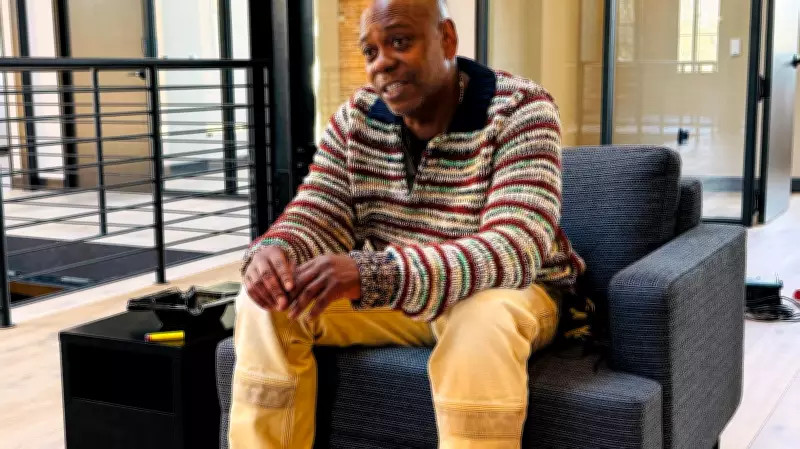
For years, comedian Dave Chappelle has built a significant portion of his brand around transphobic jokes, drawing consistent and vocal criticism from trans activists. Despite boycotts and public callouts, Chappelle has repeatedly doubled down on his material, defending it as mere comedy. However, a recent interview with NPR has revealed a shift in his perspective, as he voiced discomfort over how some Republicans are taking his jokes seriously and using them to advance anti-trans policies.
A Turning Point in Capitol Hill
In a widely circulated clip from the NPR interview, Chappelle described a visit to Capitol Hill where conservative U.S. Representative Lauren Boebert asked him for a photo. After he hesitantly agreed, Boebert posted the picture on social media with the caption, “Just two people that know that it’s just two genders.” This moment, Chappelle explained, made the situation feel “a little too real.” He expressed feeling that his comedy was being weaponized, stating, “I felt like they were doing a weaponized version of what I was doing... I lit her ass up for doing that.”
The Gap Between Comedy and Consequences
The space between the comedy Chappelle believes he is creating and the actual impact of his words is crucial to examine. Trans activists have long warned about the harm caused by his rhetoric, but Chappelle often minimized these concerns, arguing that his jokes were taken out of context or clipped unfairly. Many comedians uphold the belief that nothing should be off-limits in comedy, asserting that joking about vulnerable groups is not inherently malicious. Yet, Chappelle appears to be growing aware that this is not always the case, especially in a political climate where transphobic administrations are enacting laws that make life harder for trans Americans, who constitute about 1% of the U.S. population.

Freedom of Speech in a Real-World Context
Freedom of speech, including comedy, does not exist in a vacuum. As one of the most famous comedians in the country, Chappelle has played a role in mainstreaming trans jokes and empowering individuals in positions of political power. At a certain point, comedy stops being about pushing boundaries or provoking thought and becomes part of a larger cultural narrative that dehumanizes the trans community and facilitates legislation against them. This raises important questions about responsibility and the line between humor and harm.
Looking Toward the Future
Perhaps in the distant future, the United States will achieve a society where trans people have equal access to voting, job opportunities, and healthcare. Until then, the impact of words and jokes remains profound and deeply consequential. Chappelle’s recent reflections highlight a growing recognition that comedy can have serious real-world implications, challenging the notion that it is always harmless or detached from societal issues.