Tucker Carlson's Public Apology for Trump Support Ignites Widespread Debate
In the wake of conservative commentator Tucker Carlson's public apology for his vocal support of former President Donald Trump during the 2024 election cycle, social media platforms have become battlegrounds of conflicting opinions regarding his sincerity. The reaction spectrum has been remarkably broad, with users expressing everything from skepticism to cautious acceptance of Carlson's mea culpa.
Carlson Joins Growing List of Conservative Figures Distancing from Trump
Carlson now finds himself among a notable group of conservative public personalities who have recently severed or distanced their connections with the former president. This roster includes media figures like Megyn Kelly, Joe Rogan, Alex Jones, and Candace Owens, all of whom have taken steps to separate themselves from Trump's political orbit.
The commentator had previously endorsed Trump for the 2024 presidential election and conducted a significant interview with the former president when Trump opted to bypass the first Republican primary debate in August 2023. Carlson's reversal has left many observers questioning his motivations and authenticity.

Psychological Analysis of Public Apologies
Cindy Frantz, a social psychologist at Oberlin College, explains that skepticism toward public apologies is virtually inevitable. "Whenever a public figure apologizes, there's always a substantial contingent of people who immediately question its sincerity," Frantz noted. "This reaction stems from the complex web of motivations that might prompt such an apology, making it genuinely difficult for the public to discern authentic regret from strategic positioning."
Frantz, whose research includes studying how timing affects apology effectiveness, observed that many public apologies fail to properly assume responsibility. "Frequently, these apologies take the form of 'I'm sorry people were offended' or 'I'm sorry my intention was misunderstood'—essentially deflecting rather than accepting blame," she explained. However, Frantz acknowledged that Carlson appeared to take more explicit responsibility than is typical in such public statements.
The Podcast Apology: Mixed Messages and Body Language Cues
During Monday's episode of "The Tucker Carlson Show," the commentator addressed his brother, Buckley Carlson, with revealing language: "You and I and everyone else who supported him—you wrote speeches for him, I campaigned for him—I mean, we're implicated in this for sure." Buckley Carlson confirmed on the podcast that he had indeed written speeches for Trump during the 2016 presidential campaign.
"I want to say I'm sorry for misleading people," Carlson told his audience. "It was not intentional."
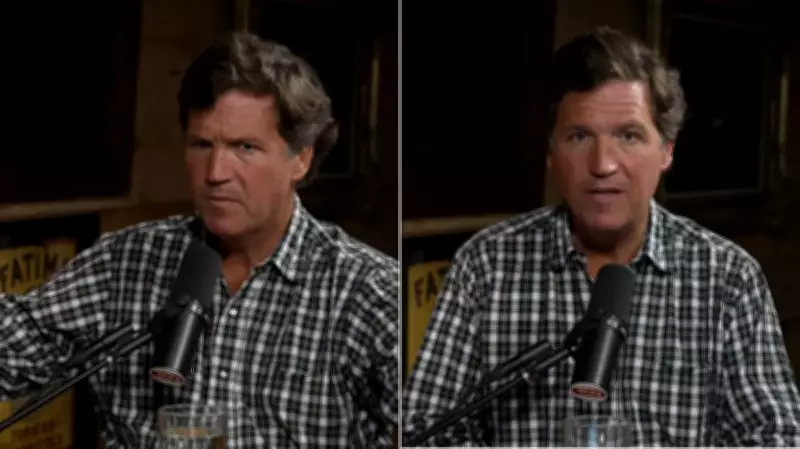
Body language expert Susan Constantine provided HuffPost with a detailed analysis of Carlson's nonverbal communication during the apology. "He transitions between introspective and performative modes," Constantine observed. "This back-and-forth dynamic creates mixed messages for viewers because he's essentially presenting two conflicting signals simultaneously."
After reviewing multiple older videos of Carlson to establish his baseline behavior, Constantine identified several telling patterns. "His language shifts from 'I' to 'we' at the very beginning," she noted. "He essentially says, 'It wasn't just me, we all did this,' which dilutes personal responsibility."
Constantine pointed to specific physical cues: "When Carlson presses his lips together and crosses his arms, it could indicate genuine reflection on the situation. However, when he looks up to the ceiling and begins to laugh, it suggests he might be dismissing the seriousness of his own comments. This oscillation basically communicates that he's holding something back—experiencing internal conflict or restraining himself from saying something more."
Critical Elements Missing from the Apology
According to Frantz, two crucial components could have significantly strengthened Carlson's apology. First, the commentator failed to outline any concrete actions for making amends. "What substantially undermines his apology is that many people could reasonably conclude he should have known better all along," Frantz argued. "There's no effort to make amends, nor much acknowledgment of the situation's magnitude."

The second missing element involves the inherent limitations of public apologies. "There's no interpersonal relationship here," Frantz explained. "Carlson is a public figure speaking through a camera lens, creating multiple barriers to genuine trust. In face-to-face interactions with someone we know reasonably well, we can pick up various clues that help us develop confidence in their sincerity. That's essentially impossible in a public apology context."
This absence of personal connection explains why social media users instinctively search for ulterior motives rather than accepting Carlson's words at face value. Numerous theories have circulated online, suggesting motivations ranging from financial considerations to potential political ambitions. (Carlson has not formally announced any political campaigns, and his team had not responded to HuffPost's request for comment at the time of reporting.)
Language Analysis and Historical Context
Constantine emphasized that even the apology's wording creates distance. "He says, 'I want to say sorry,' rather than directly stating, 'I'm sorry,'" she pointed out. "This phrasing allows him to maintain separation from direct ownership of his actions."
The relationship between Carlson and Trump has always been complex and occasionally contradictory. In an April 6 podcast episode, Carlson criticized Trump's Truth Social post from Easter morning, in which the former president wrote provocatively about Iran. "Who do you think you are?" Carlson questioned. "You're mocking the religion of Iran... No president should mock Islam. That's not your job. This is not a theocracy."
Yet in March, Carlson told Status' Oliver Darcy, "There are times I get annoyed with Trump, right now definitely included, but I'll always love him no matter what he says about me." This statement contrasts sharply with court filings made public in March 2023, which revealed that the then-Fox News host had texted an unnamed recipient in January 2021: "We are very, very close to being able to ignore Trump most nights. I truly can't wait. I hate him passionately. I can't handle much more of this."
The tension between these private sentiments and public positions continues to fuel speculation about Carlson's true feelings and motivations, leaving both experts and the public divided on how to interpret his recent apology and what it might signal about the evolving landscape of conservative media and politics.