As the 250th birthday of the United States nears, I miss my dad and I miss my country. On the same day that Trump threatened to obliterate a whole civilization in Iran, my mother and brother made a discovery in the attic of our family home. They opened a dusty box, labeled “Decatur,” my late father’s hometown in Illinois. Inside, they found my dad’s eighth-grade U.S. history project, from 1960. The colors of the illustrated front cover had faded slightly, but otherwise it was pristine. My brother handled it carefully, like the treasure it was. He took photos of the 50-page report and texted them to my sister and me.
A Time Capsule from 1960
As soon as the scanned photos came through, I got teary, seeing handwriting that even at 13 was recognizable as our father’s. His report’s table of contents written in cursive ― slanted and fluid ― matched the handwriting in his letters to us, his three kids, later when we were at summer camp, in college and beyond. I found the content poignant, too: It wasn’t just a civics class assignment and cursive practice. It was a time capsule ― his report covered the presidents, ending with Dwight D. Eisenhower, and population growth up until 1960’s 187 million. And you could feel my dad’s patriotism and optimism on the page, especially in his artwork.
My husband and daughters joined me as I opened the files on a bigger computer screen. My husband and I immediately recognized an artistic gift he had passed on to our daughters, especially our 13-year-old, who writes graphic novels. “We draw alike!” my daughter said, and she was right. They both mastered the same slightly comic urgency in their drawings. My dad’s project included two scenes — people arguing in front of the Supreme Court and scenes showing the electoral process. And both he and my daughter notice the details: My dad drew a citizen, wearing a plaid suit and fedora, with a closed umbrella hooked over his arm, putting his ballot into the ballot box.

Who My Father Became
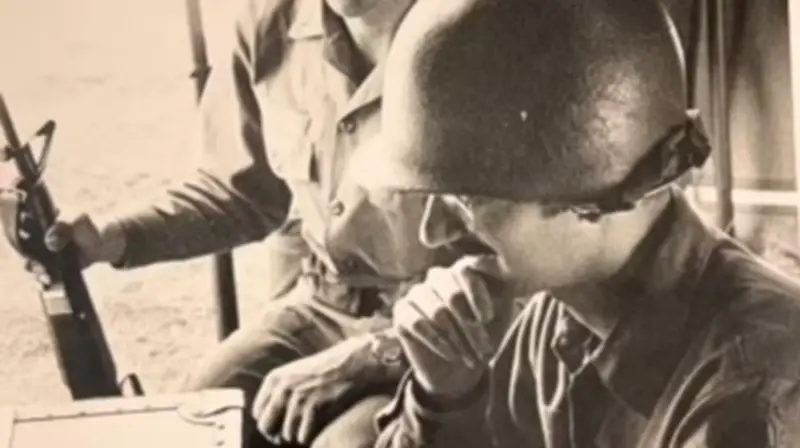
Looking at my dad’s drawings as a teen feels like a window into who he would become: a justice-seeking, art-appreciating history buff and attorney who architected on the side for fun, designing my childhood home. He loved our country. In graduate school, he attended the contentious 1968 Democratic National Convention in Chicago, and sat with Julian Bond and the Free Georgians. After the shooting at Kent State in 1970, he was called up to the National Guard. Though a lifelong Democrat, he most admired Republican Abraham Lincoln and his team of rivals. He believed in an inclusive America, the rule of law, the American dream and the separation of church and state. He believed in the First Amendment. A free press. That no one is above the law. He and my mom shared those beliefs and passed them down to us, their children. He died in early 2022 after a long battle with Parkinson’s disease.
I miss him every day, but I am simultaneously glad that he is not witnessing the daily destruction of our beloved country, as it would have broken his heart — to learn about the “secret police” our current president and his Cabinet have released onto the streets to profile people based on the color of their skin, demanding they show their papers or be thrown into detention camps. To love this country right now feels like deep grief ― for what it was, and for what I hope and pray it can be again. I stare at the pictures of my dad’s report, which I now have on my desk, and think about how he — and our forefathers, for that matter ― would feel about the erosion of freedom of the press, about voter suppression and gerrymandering. About the current president enriching himself and his family, making a mockery of the Emoluments Clause. About the murky, painted reflecting pool perfectly reflecting the state of things.

What Would the Founders Think?
Knowing what we know now, would our forefathers have rewritten the Constitution? “Just to be totally clear, we don’t think American citizens should be shot and killed in the streets of an American city in broad daylight, just for exercising their First Amendment rights to protest.” Or “No, Congress, we REALLY mean it: You serve the country, not your party. Your oath is to this Constitution, not to one man who used to be a game show host on TV.” Maybe they would add something about convicted felons not being able to run for the highest office in the land? (I’m just spitballing here.)
My dad’s report inspired me to reread the Declaration of Independence, which defends breaking away from the King of England, listing his “repeated injuries and usurpations.” How would its authors feel about the fact that our country’s current president has committed many of the same acts they detail as unacceptable? (Such as: “He has refused his assent to laws … obstructing the laws for naturalization of foreigners … He has excited domestic insurrections among us.”)
Hope Amid Grief
Long after Parkinson’s stole my dad’s words, a nurse in his assisted living center had to wheel him away from the common room because he was yelling at the TV screen during the contentious 2020 election. They had to change his in-room TV to the Hallmark Channel during the Jan. 6 insurrection because his heart rate was too fast when CNN was on. I think of him daily as I write to Congress, send postcards to rally voters and paint to try to calm my nervous system and get my mind off my feelings of helplessness. As its 250th birthday approaches, I am mourning the country I love, the country my father loved and held such pride in as an eighth grader.
One of my daughters just finished eighth grade ― she came home from school, eager to share what she had learned about U.S. history. She talked about three equal branches of government, checks and balances. “Yes,” my husband and I said. “That’s how it’s supposed to work, and how we hope it will again.” I know my dad would try to find hope, as I do. He would remind us, as Michelle Obama did last week at the Obama Library opening, that “hope is all we have.” Like my mom, he would remind me that they got through the division and violence of the 1960s and we will overcome this, too. Just as my father’s empathy, morals and principles live on in me and my family, our country will hopefully live on in the tenets our forefathers intended. Like the architects of our nation, I believe the USA is a work in progress, and like the 1853 abolitionist Theodore Parker, I believe “the moral arc of the universe is long and bends toward justice.” I know my dad would say we — himself included — took democracy for granted prior to the 2016 election. He would understand people’s desires to “protect their peace” and tune out the daily barrage of crimes and zone-flooding, but he would also chastise complacency. Democracy is not a spectator sport, I can almost hear him say. Don’t look away.