How a forgotten, 'misfit' team put Canada on the FIFA World Cup map 40 years ago
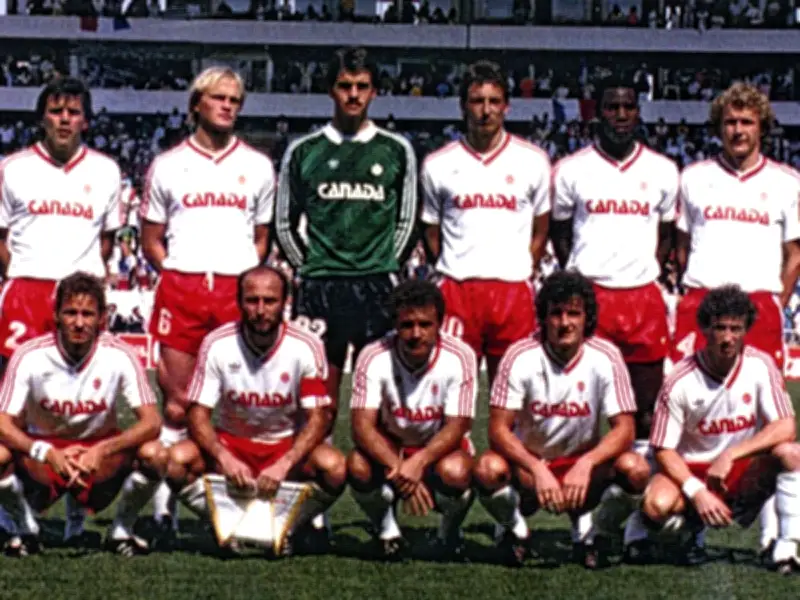
As Canada gets set to host FIFA World Cup 2026, we look back at the squad that Canada sent to the tournament in 1986.
Standing on the pitch in St. John's, Newfoundland, Bob Lenarduzzi had to admit it was smaller than he remembered. In his mind, it had been the stuff of legends. The stadium itself was little more than a local park, but temporary stands had been erected around the field so that it felt like the centre of the soccer world. For one afternoon in 1985, it was. King George V Park on the east edge of downtown had been packed with fans, mostly Canadian because the bulk of Honduras' cheer section had mistakenly gone to the wrong city and ended up watching the match in a bar in Saint John, New Brunswick.
"In retrospect, it could not have been a better choice for where to play the game," the former right back said. When he returned decades later, though it all seemed slightly smaller than he remembered, one thing was certain: legends were born there. On Sept. 14, 1985, it was the place where Canadian soccer changed forever when Canada defeated Honduras 2-1 to qualify for their first FIFA Men's World Cup.

"It is a shame that the story has not been told in a bigger way," said Carl Valentine, who also played on the team. "It really is a bunch of misfits that came together and qualified for the biggest stage in the world."
Why was Canada's qualifying so unlikely?
From a modern perspective, it is difficult to appreciate just how unlikely Canada's qualification was. Today, the country is preparing to co-host a World Cup, boasts three Major League Soccer clubs and has produced global stars such as Alphonso Davies and Jonathan David. In 1985, the landscape looked very different. Canada was competing for a single CONCACAF berth at a 24-team World Cup and many of the players were balancing soccer with careers away from the game.
"We didn't have one professional outdoor player on that team," Valentine said. While countries such as Honduras and Costa Rica had established domestic leagues, Canada's roster was pieced together from indoor soccer clubs, former North American Soccer League players (the league had folded a year prior to the qualification game) and amateurs. George Pakos, who scored Canada's opening goal in the decisive 2-1 victory over Honduras, worked as a water metre reader in British Columbia.
"He'd never played at any professional level," Valentine said. Yet, somehow, a group assembled from across the country found a way to qualify for the biggest tournament in the sport. The team lacked the star power of its rivals, but it made up for it with organization and belief. Much of that has been credited to coach Tony Waiters, who led the Vancouver Whitecaps to a Soccer Bowl title in 1979 before taking charge of the national team.
After leading Canada to the quarterfinals of the 1984 Olympic Games — where the team lost to Brazil in a penalty shootout — Waiters faced a new challenge. There was no professional league in Canada and no guarantee the group would stay together long enough to mount a World Cup qualifying campaign. According to Valentine, Waiters secured funding to keep the team playing and training together after the Olympics, laying the groundwork for the run to Mexico.
Lenarduzzi said Waiters convinced a group of players from vastly different backgrounds that they could compete with the best teams in the region. "Tony was so good at getting everyone organized and knowing their roles," Valentine said. "That's the only way we could compete. We didn't have any top, top players, so in order to compete, everyone needed a role and every game we had to make sure we never got outworked."
It was a formula that carried Canada through a qualifying campaign few thought possible. "That team overcame incredible odds," Lenarduzzi said. The accomplishment would grow in significance with each passing year but, in the immediate aftermath, there was little time for reflection. There was only the realization that Canada was headed to its first World Cup. "It was every player's dream," Valentine said. "Then all of a sudden, we'd done that."

What was the 'Welcome to the World Cup' moment?
If qualifying for the World Cup felt improbable, arriving there felt surreal. Canada set up camp in Abasolo, a small resort town between Leon and Irapuato. The players lived largely in isolation, watching matches on television and preparing for a group that included France, the Soviet Union and Hungary.
"We were kind of in the middle of nowhere," Dolan said. "We had our own chef, had our own people. It was an awesome setting for team camaraderie." Removed from the tournament's biggest stages, the magnitude of the event was easy to forget. That changed on game day. "You're all on your own until you drive into the stadium," Dolan said. "Then you get the sense that we're in something big here."
Fans lined the path into the stadium, gesturing to the Canadian bus and predicting how many goals the underdogs would lose by. Then came the walk through the tunnel. France was the reigning European champion and among the favourites to win the tournament. Waiting beside Canada was French captain Michel Platini, widely regarded as the best player in the world at the time. "That's when you knew that, wow, this is it," Dolan said. "You are going out to play one of the best teams in the world."
These were players that much of Team Canada had grown up watching from afar. "The tunnel was so narrow that you could reach across and touch them and you kind of had to resist doing that because that would have been a bit weird," Lenarduzzi said. He didn't have long to sit with that emotion, soon another feeling took its place. "I do remember feeling very, very anxious," he said. "The predictions were that we were going to get hammered."
What was it like facing France?
Instead, Canada spent much of the match proving the doubters wrong. Facing a French side packed with stars from Europe's biggest clubs, Canada defended resolutely and frustrated one of the tournament favourites. For more than 70 minutes, the underdogs kept the match scoreless and within reach. "We held them at bay really well," Dolan said. "The defence in front of me was outstanding."
As the clock wound down, thoughts of a draw began to creep in. "We were about 10 minutes away from a historic draw against France," Dolan said. Then came a long cross to the back post. Dolan thought he had it covered. "I thought I had a bead on the cross and I didn't because it continued to carry in the altitude," he said. "The ball flies further and longer than it does at sea level." Jean-Pierre Papin met the ball and scored the only goal of the match, giving France a 1-0 victory.
The result was disappointing, but the performance earned respect. Valentine remembers the Canadians leaving the field believing they belonged on soccer's biggest stage. "We knew we could compete," Valentine said. "We'd just gone toe-to-toe with one of the best teams in the world." Canada would go on to lose 2-0 to Hungary and 2-0 to the Soviet Union, finishing the tournament without a win, point or a goal. From the box score, it would be easy to dismiss the campaign as a disappointment. But the players see it differently.
"If we'd gotten blown out in every game, I probably wouldn't be talking to you today," Valentine said. Instead, Canada left Mexico believing it had justified its place on soccer's biggest stage. The team was competitive in all three matches and proved it could stand alongside countries with far deeper soccer traditions and infrastructure. "We didn't score a goal, we didn't win a game, but we felt like we put in a good performance," Dolan said. For a group of players assembled from indoor leagues and the remnants of a collapsed professional league, simply qualifying had been an extraordinary achievement. Leaving Mexico with their heads held high felt like another. The significance of that accomplishment would only grow with time. Canada would not return to the men's World Cup for another 36 years.
What is the team's impact today?
The impact of Canada's 1986 World Cup team extended far beyond the three matches it played in Mexico. In the years before qualification, soccer occupied a very different place in the Canadian sports landscape. The sport had passionate supporters, but professional opportunities were limited and television coverage was sparse. Following the World Cup often required determination. Dolan remembers watching the 1978 World Cup at Vancouver's Pacific Coliseum, where fans sat inside a hockey arena and hoped the satellite feed would hold.
"The satellite would cut in and out all the time," he said. Even while soccer remained a niche sport across the country, young players across the country were beginning to dream bigger. "I always wanted to be a Whitecap," Dolan said. He attended his first Whitecaps game in 1975 and bought season tickets a year later, owning them until the league folded. Looking back, players from that era believe Canada's appearance in Mexico helped plant the seeds for the growth that followed. "The growth in youth soccer really was spurred on by that World Cup team," Dolan said.
The progress was not always linear. Canada would not qualify for another men's World Cup for 36 years, a drought that often left the 1986 team feeling like a forgotten chapter in the country's sporting history. While their accomplishment now looks like the first brick in what would become a soccer cathedral, at the time it was hard to track the growth. "That first brick was a very lonely brick for the longest time," Lenarduzzi said. Forty years later, it no longer stands alone and their contributions aren't lost on the current squad, who will represent Canada when the World Cup kicks off in Toronto on June 12. "We respect everyone who has been through this path," current vice captain Stephen Eustaquio said. "We share the same motivation, the same rules, to make Canada as strong as possible."