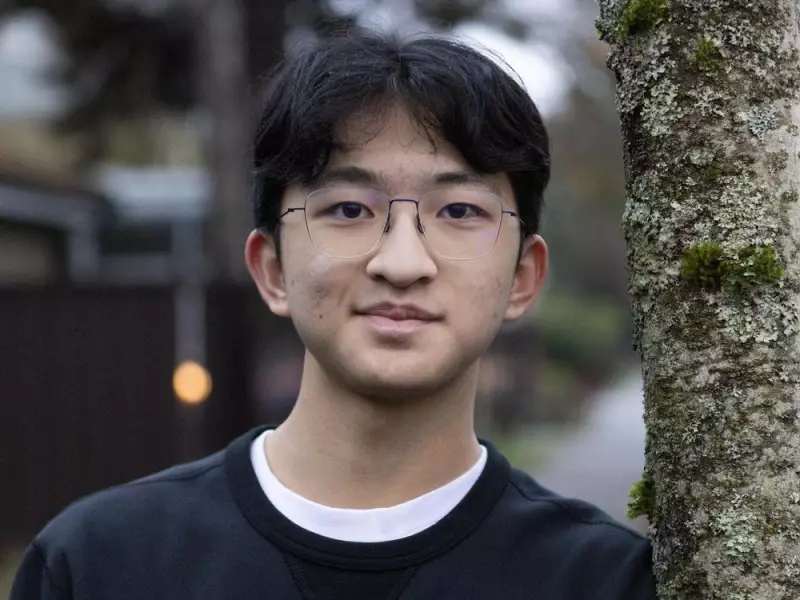
It's a universal modern struggle: you pick up your phone for a quick check, and suddenly an hour has vanished into a social media vortex. Henry Chuang, a Grade 10 student at St. George's School in Vancouver, knows this feeling all too well. He decided to stop just feeling guilty about it and instead, understand the science behind it. His investigation has now propelled him onto the global stage as a finalist in a prestigious international science competition.
From Personal Struggle to Scientific Inquiry
Henry Chuang noticed his own recurring habit of reaching for social media when he should have been focusing on other priorities. This procrastination was impacting three key areas: his academic studies, his cross-country running, and his personal artwork. "I didn't want to keep scrolling, but my mind was getting tricked into it," Chuang explained, describing a sense of being "stuck" in the cycle.
Rather than simply trying to exert more willpower, the Vancouver teenager embarked on a mission to decode the neurological mechanisms at play. He turned his curiosity into a concise, two-minute video that breaks down the conflict between our long-term goals and the immediate, powerful lure of the smartphone.

A Global Spotlight on a Local Discovery
Chuang's self-produced video earned him a spot among the top 16 finalists worldwide in the 11th annual Breakthrough Junior Challenge. This global competition invites students aged 13 to 18 to create engaging videos that explain complex concepts in life sciences, physics, or mathematics. The field was highly competitive, with judges selecting Chuang's entry from more than 2,500 applications based on its ability to illuminate and communicate science effectively.
The stakes for the final are high. The grand prize winner, to be announced in early 2026, will receive a $250,000 post-secondary scholarship. Additionally, their teacher wins $50,000, and their school is awarded a new science lab valued at $100,000. The prizes are funded by foundations created by tech and science luminaries including Sergey Brin, Priscilla Chan and Mark Zuckerberg, and Yuri and Julia Milner.
The Science Behind the Scroll
In his video, Chuang delves into the brain chemistry that social media platforms expertly exploit. He explains how various triggers—such as notifications, vibrant colors, and compelling storylines—are deliberately engineered by platform architects. "Each trigger of social media activates a brain region," Chuang states, leading to a release of dopamine, the neurotransmitter associated with pleasure and reward. This creates a powerful feedback loop that makes disengaging difficult.
There's a layer of irony to his success: the videography skills that helped him become a finalist were largely self-taught from tutorials he found on YouTube—another platform that capitalizes on similar engagement principles. For Chuang, the recognition is secondary to the original goal. Like many people his age, he continues to work on achieving a healthier balance with his device usage.
Henry Chuang's journey from a Vancouver classroom to the finals of an international science challenge highlights how personal observation, when paired with scientific curiosity, can lead to profound understanding. His work offers a clear-eyed look at why putting down your phone is so hard, providing a first step toward reclaiming our focus in an increasingly distracting digital world.