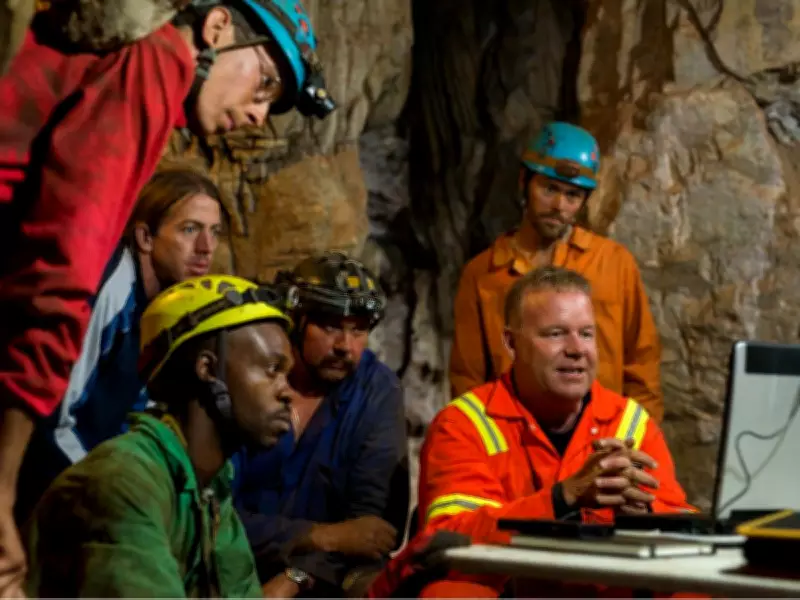
A few years ago, paleontologist Lee Berger nearly died while squeezing into a cave system in South Africa's Cradle of Humankind. The expedition into the Dinaledi Chamber in the Rising Star Caves required Berger and his team of slender scientists to navigate harrowingly tight spaces. Berger lost 50 pounds for the journey to fit into crevices only 17 to 18 centimeters wide. The team adhered to a survival mantra Berger calls “the rule of life or death.”
“If you get yourself in, you have to get yourself out,” Berger explains from his office in Johannesburg. “Other people can’t help you. You’re alone. They can’t reach you.”
Despite the danger, Berger wanted to see firsthand the engravings on cave walls and other discoveries that led to startling conclusions about Homo naledi, diminutive human relatives who lived about 335,000 years ago. “I’ve never been back, and I’ll never go back,” he says. “It’s a big toll on your body.”

Controversial Discoveries
Berger led the team that first discovered Homo naledi in 2013 and 2014, unearthing over 1,500 specimens from 15 individuals in the Dinaledi Chamber. Further evidence suggested that Homo naledi, despite having a brain one-third the size of modern humans, used the cave system to bury their dead—a practice previously believed exclusive to modern humans, reflecting nuanced thinking and spiritual beliefs.
Pop Culture Savvy
Berger brings science to the public through pop culture. A National Geographic Explorer in Residence, his work was featured in the 2023 Netflix documentary Unknown: Cave of Bones and the 2023 book Cave of Bones: A True Story of Discovery, Adventure, and Human Origins. He will present a multimedia talk, “Lee Berger: Cave of Bones,” at the Werklund Centre’s Jack Singer Concert Hall on May 31 and June 1.
When told a listener suffers from claustrophobia, Berger laughs: “I hope you come to the lecture! You’ll get a real feel for it. You’ll be one of those people turning green in the audience.”