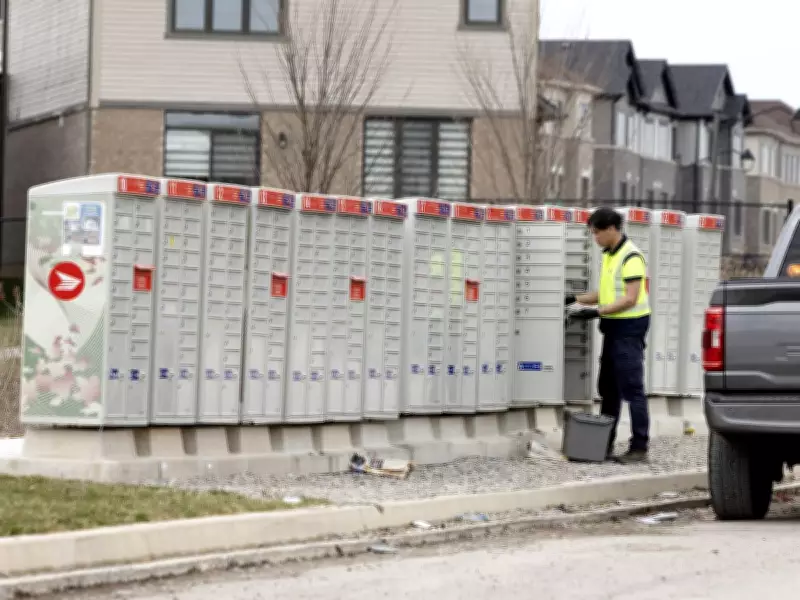
Canada Post Initiates Major Overhaul: Phasing Out Home Delivery Nationwide
Canada Post Corporation has officially launched its ambitious five-year plan to transition away from traditional door-to-door mail delivery, moving instead toward community mailbox systems. This dramatic restructuring comes as the national postal service grapples with mounting financial pressures, operational challenges, and shifting consumer behaviors that have fundamentally altered the postal landscape.
Financial Crisis Drives Restructuring Decision
The decision to eliminate home delivery stems from Canada Post's deepening financial troubles. In November 2025 alone, the corporation reported a staggering pre-tax loss of $541 million—the largest quarterly deficit in its history. Since 2018, cumulative losses have exceeded $5 billion, creating what experts describe as an "existential crisis" for the Crown corporation.
"Canada Post is a very sick company," stated Marvin Ryder, an associate professor at McMaster University's DeGroote School of Business. "If this was a private sector company, I would describe it to you as being in a death spiral."

Despite receiving two billion-dollar government bailouts in recent years to maintain operations, the corporation faces continued financial strain. Minister of Government Transformation, Public Works and Procurement Joël Lightbound emphasized the need for dramatic restructuring, noting that converting the remaining four million addresses with door-to-door service to community mailboxes could generate approximately $400 million in annual savings.
Implementation Challenges and Community Impact
The transition to community mailboxes presents significant implementation hurdles, particularly for rural communities and business operations. Richard Shearmur, a professor at McGill University's School of Urban Planning, noted that while community mailboxes clearly offer cost savings, "the proposal raises important questions about how they will be implemented."
Key concerns include:
- Accessibility for elderly and disabled residents who rely on home delivery
- Security of mail in centralized locations
- Impact on business parcel shipments and delivery timelines
- Winter maintenance of community mailbox sites in harsh climates
The government has also announced it will lift the moratorium on rural post office closures—a policy first implemented in 1994 that currently protects nearly 4,000 locations. This decision could further complicate access to postal services in remote areas.
Additional Cost-Saving Measures
Beyond the mailbox transition, Canada Post plans several other operational changes to stabilize its finances:
- Adjusting delivery standards to allow non-urgent mail to travel by ground rather than air, saving over $20 million annually
- Modernizing the retail network by closing underperforming post office locations
- Addressing a 30% decline in retail revenue since 2021 as Canadians visit physical locations less frequently
Professor Ryder acknowledged that while these measures represent "a step in the right direction," they may not immediately transform Canada Post into a profitable enterprise. The success of the restructuring will depend on careful implementation and ongoing adaptation to changing market conditions.
Broader Implications for Canadian Society
The elimination of home delivery marks a significant shift in how Canadians receive mail and packages. Businesses that rely on timely parcel delivery may need to adjust their logistics strategies, while residents must adapt to collecting mail from centralized locations. The changes reflect broader trends in postal services worldwide, as digital communication continues to reduce traditional letter mail volumes while parcel delivery demands increase.
As Canada Post begins this multi-year transition, stakeholders across the country will be watching closely to see how the corporation balances financial sustainability with service accessibility—a challenge that will define the future of postal service in Canada for years to come.