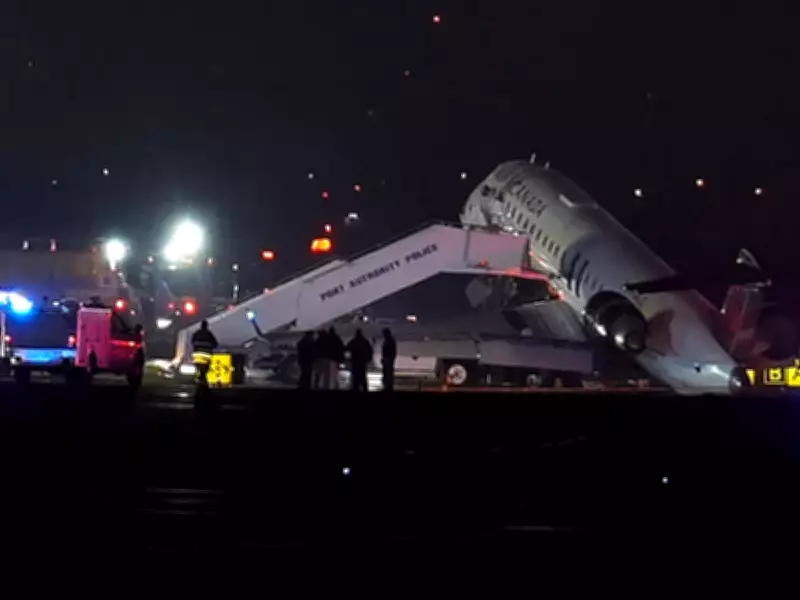
Air Canada Flight Attendant Survives Terrifying Ejection After Runway Collision
In a remarkable survival story emerging from a tragic aviation accident, an Air Canada flight attendant was found alive on the tarmac of New York's LaGuardia Airport, still strapped into her jump seat after being ejected from the aircraft during a catastrophic collision. The incident occurred on Sunday night, March 23, 2026, when an Air Canada Express CRJ-900 jet collided with a Port Authority fire truck on the runway.
Dramatic Rescue and Survival Details
According to multiple reports from law enforcement sources cited by WNBC and CNN, the flight attendant was thrown from the wreckage following the impact with the aircraft rescue and firefighting vehicle. The fire truck had reportedly been given clearance to cross the runway to respond to an emergency involving another aircraft when the collision occurred.
The flight attendant sustained injuries but is expected to survive, according to official sources. Her discovery on the tarmac, still secured in the jump seat that had been torn from the aircraft structure, represents one of the most extraordinary aspects of this aviation disaster.

Tragic Losses and Extensive Injuries
The collision proved fatal for both the pilot and co-pilot of the nearly fully-loaded aircraft. Of the 72 passengers aboard, 39 were transported to area hospitals for treatment. As of the latest reports, nine passengers remain hospitalized, with some in critical condition.
Two occupants of the fire truck also suffered injuries described as non-life-threatening. The status of the other flight attendant aboard the aircraft remains unclear at this time.
Seating Configuration and Safety Procedures
Based on aircraft schematics from travel sites like Fly Radius, the Bombardier CRJ-900 model operated by Air Canada features two jump seats for cabin crew—one positioned near the tail section and another located near the cockpit. Sources indicate the ejected flight attendant was seated in the forward jump seat near the cockpit area.
Shakti Denis, a former Air Canada flight attendant now working as a reporter for New Jersey's News 12, confirmed this seating arrangement and explained standard safety protocols. "When there is an impact, normally the flight attendants will wait to hear from the pilots," she stated. "If the flight attendants don't hear anything from the pilots, then they would themselves initiate an evacuation... If you don't hear that call, then you must use your own judgment."
Airline Response and Investigation
Air Canada Jazz president Doug Clarke addressed the tragedy in an official statement: "Today is an incredibly difficult day for our airline, our employees, and most importantly, the families and loved ones of those affected by the accident involving flight 8646. We extend our deepest condolences to the family and friends of our two pilots and our unwavering support to those who have been injured."
The U.S. National Transportation Safety Board has taken the lead in investigating the accident, with Canada's Transportation Safety Board providing support through a dispatched team. The investigation will examine multiple factors including runway procedures, communication protocols, and the circumstances surrounding the collision between the commercial aircraft and emergency response vehicle.
This incident marks one of the most serious aviation accidents at LaGuardia Airport in recent years and raises significant questions about runway safety protocols and emergency response coordination at major metropolitan airports.