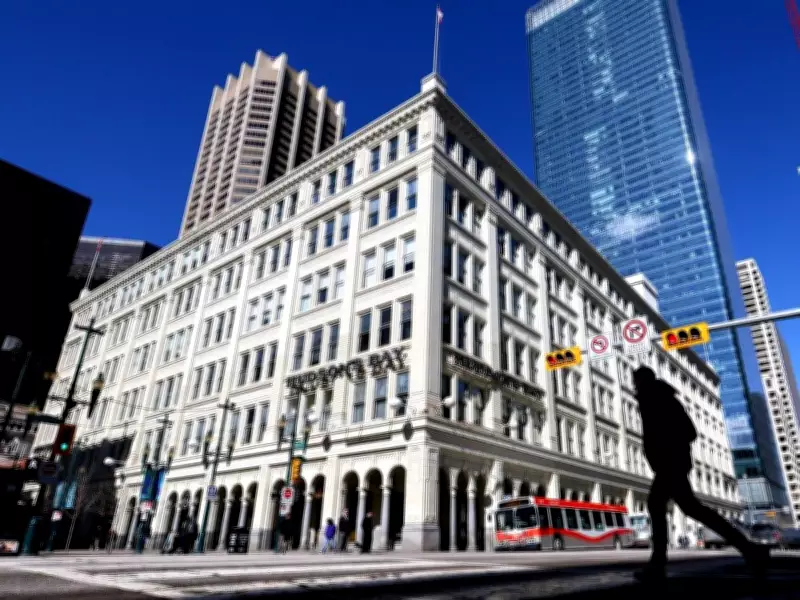
Calgary's Hudson's Bay Building: A Call to Revive Its Historic Social Role
As Calgary undergoes a major transition, particularly in its downtown core due to rapid population growth, the future of the historic Hudson's Bay building is a topic of intense discussion. Experts emphasize that Calgarians should look to the building's rich social history to guide its redevelopment, transforming it into a vibrant community hub once again.
A Legacy of Community Gathering
When the Hudson's Bay building opened in 1913, it was more than just a retail space. It featured amenities like a dining room, a rooftop playground, and a tea room, designed to serve as a gathering place for the community. For women in that era, who had limited options for socializing, the building offered a rare venue to meet and connect. The Calgary Herald reported at the time that it aimed to "make the hard day's shopping for the housewife easy," with a governess on the rooftop playground to watch children while their mothers shopped. The newspaper even predicted it would become a "favourite meeting place," highlighting its early social significance.
Design and Potential for Revitalization
The building's architecture supports its role as a community center, with connections to public spaces on three sides. Already a key part of downtown circulation and access, with the right investment and vision, it could become the heart of the city for both residents and visitors. However, to achieve this, the building must have the freedom to evolve while preserving key historical elements. These include the innovative terracotta exterior, the unique arcade, and its display windows, which are integral to Calgary's heritage.

Challenges and Opportunities in Upcycling
Transforming the Hudson's Bay building won't be easy. Remediation issues pose significant challenges due to its age and lack of maintenance, problems that will worsen if the space remains vacant. Yet, upcycling is seen as the most prudent option, offering economic and environmental benefits. The building remains functional, with operational elevators and mechanical systems, and businesses like the Oliver and Bonacini hospitality group continue to operate there. Additionally, it attracts interest from the film industry, indicating its potential for diverse uses.
By balancing historic designation with adaptive reuse, Calgary can create a space that honors the building's past while inviting the community in. This approach not only preserves a piece of history but also helps re-establish downtown as a favored meeting place, bringing more people into the city center during this period of growth.