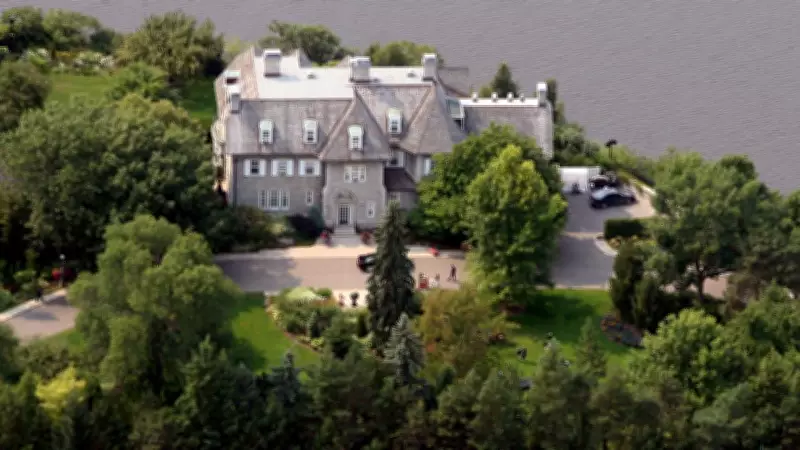
Architects Propose Solutions for Canada's Decaying Prime Minister's Residence at 24 Sussex Drive
Government decision-making appears paralyzed, yet there is widespread agreement that the neglect of the official prime minister's residence must end. The Mark Carney government, elected a year ago, prioritized housing with a $13-billion plan aiming to build 500,000 houses annually for the next decade. However, one house remains untouched and largely undiscussed: 24 Sussex Drive, the prime minister's official residence, which sits unoccupied and uninhabitable just over two kilometers from Parliament Hill.
Prime Minister Carney and his family currently reside across the street at Rideau Cottage, a backup two-storey building on the grounds of Rideau Hall, following Justin Trudeau's nearly decade-long occupancy there. The 35-room, 12,000-square-foot stone mansion at 24 Sussex has been out of commission since the Stephen Harper era, suffering from outdated wiring, heating and plumbing issues, asbestos, water damage, mould, and rodent infestations.
Architectural Perspectives on a National Disgrace
"What does it say about us as a country that our prime minister's house is a ruin?" questioned Toon Dreessen, president of Architects DCA in Ottawa. Robert Martin of Robertson Martin Architects echoed this sentiment, calling the situation "kind of silly — disgraceful, really. Canadians deserve better." Originally named Gorffwysfa (Welsh for "The Place of Peace") when built in 1867-68, 24 Sussex has housed nine prime ministers since 1951 and is designated a Classified Federal Heritage Building.

An Angus Reid Institute poll in 2023 revealed that about 70% of Canadians believe the government should fund an official residence for the prime minister, though opinions varied on specific solutions. Political optics and priorities have stalled progress, with Carney stating last year that resolving the issue is not urgent, while former Conservative leader Pierre Poilievre previously ranked it low among priorities, emphasizing housing for working-class Canadians instead.
Security and Feasibility Concerns
Neither 24 Sussex nor Rideau Cottage were designed for modern security needs. A government memo highlighted challenges at Rideau Cottage, including inadequate infrastructure for security offices and safe rooms. Security incidents, such as a 1995 intrusion at 24 Sussex and a 2020 armed entry at Rideau Hall, underscore these vulnerabilities. RCMP spokesperson Marie-Eve Breton confirmed ongoing collaboration with government agencies to determine future security requirements, though no decisions have been made.
The property at 24 Sussex, perched on a 2.1-hectare site overlooking the Ottawa River, offers advantages like proximity to Parliament Hill and natural security from the river cliff. However, it is modest compared to other G7 leaders' residences, such as the 55,000-square-foot White House or 25,000-square-foot 10 Downing Street.
Architectural Options and Estimated Costs
Architects propose three main options, with costs ranging from $40 million to $100 million:

- Major Renovation: Ottawa's Trace Architectures suggests rehabilitating the main building as a residence and constructing a second building or wing for events and security, connected by an underground tunnel. This could include sustainability features like green roofs and solar thermal energy. Dreessen advocates for a "deep-energy" retrofit and more public access, estimating costs around $35 million.
- Tear Down and Rebuild: Demolishing the existing structure would allow for innovative designs, such as D'Arcy Jones Architects' concept representing Canadian landscapes, though it risks losing heritage value. Samantha Schneider of Simmonds Architecture emphasizes using local materials like stone and wood.
- Build New Elsewhere: Alternative sites, such as Rockcliffe Park or converting Stornoway (the Opposition leader's residence), have been considered, but present their own challenges, including security and feasibility.
Heritage Ottawa has urged rehabilitation, arguing that letting the property decay sends a negative message about national heritage. As the building continues to deteriorate, architects warn that costs will only increase, urging decisive action to restore this symbol of Canadian governance.